
289
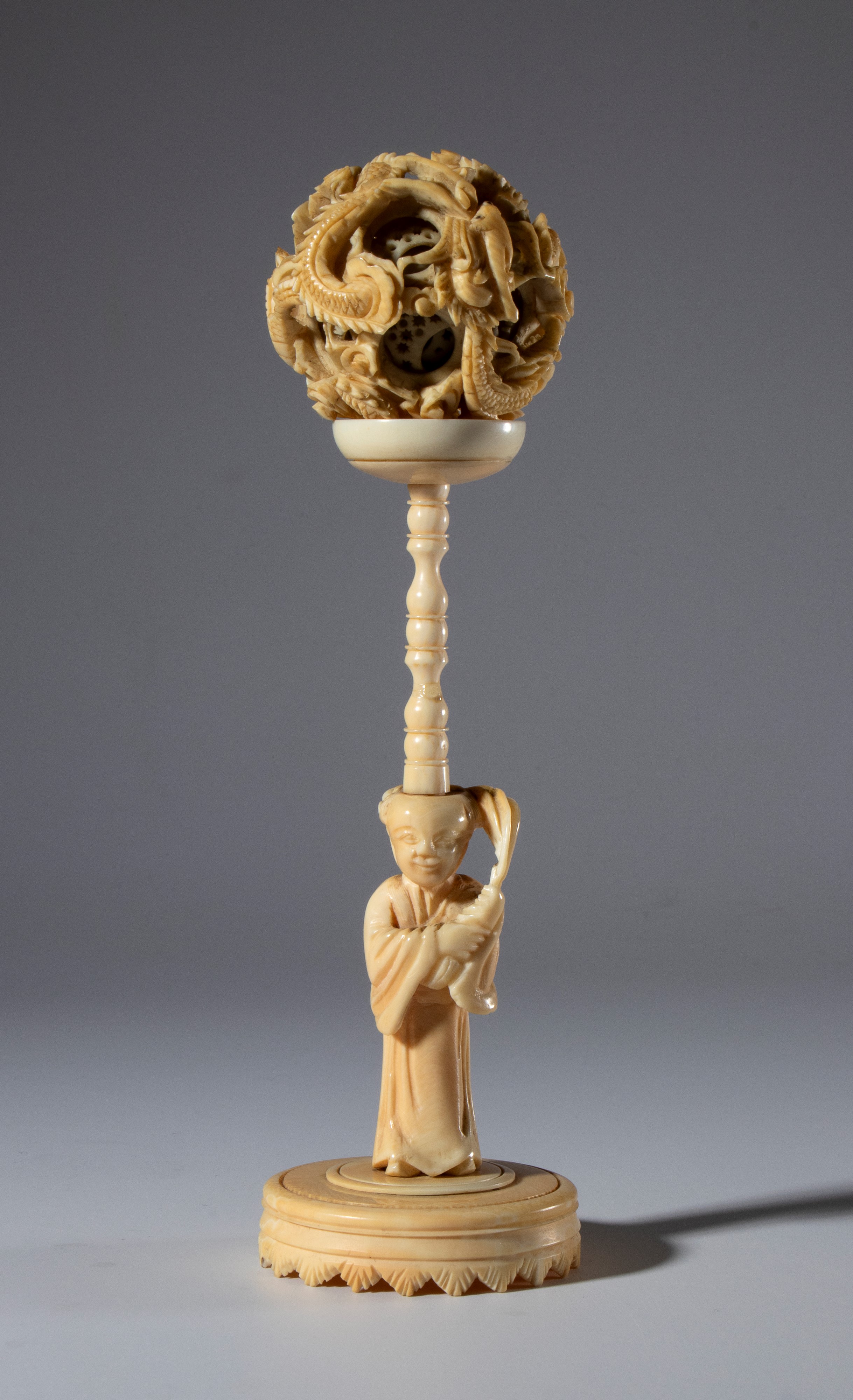
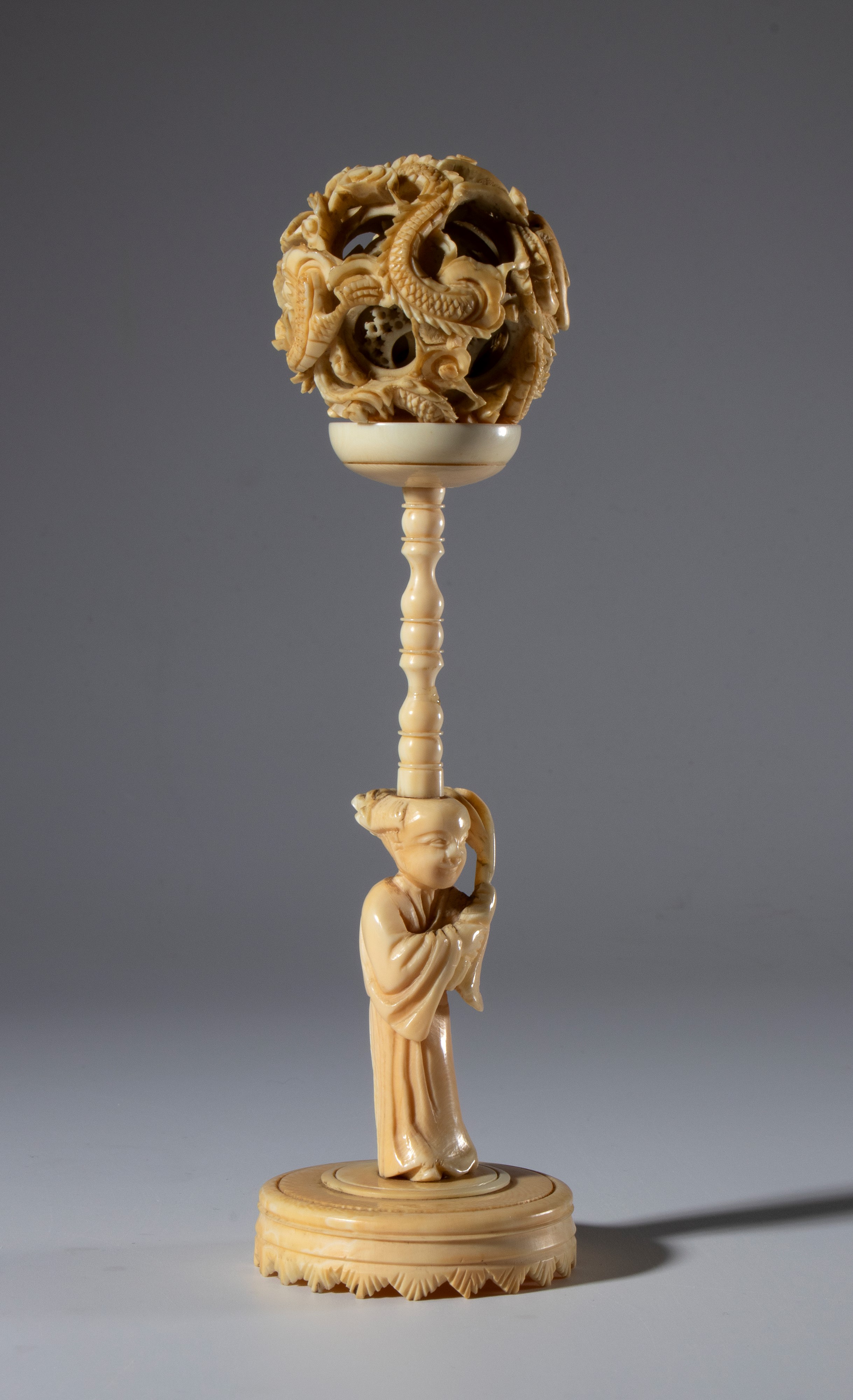
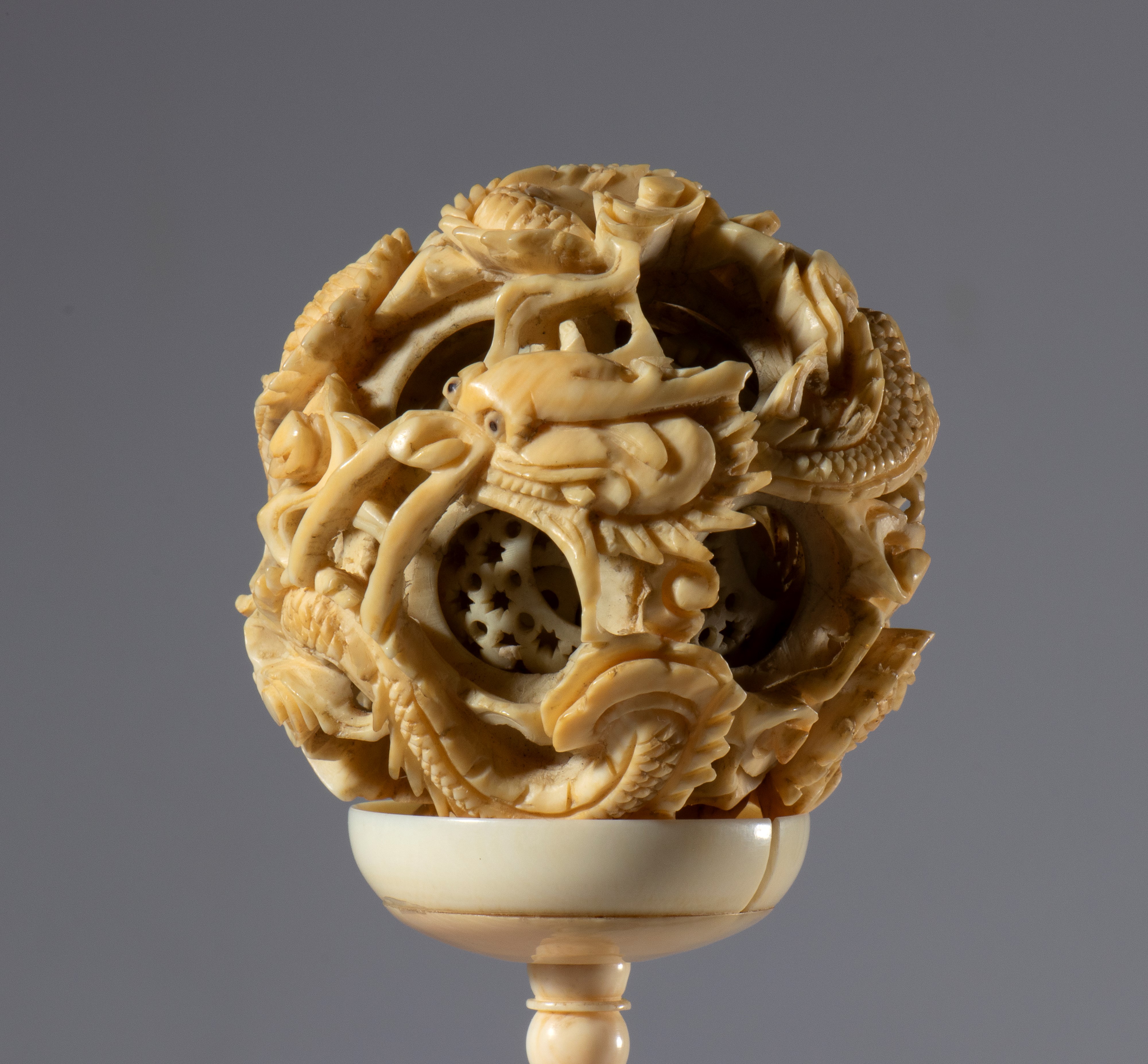
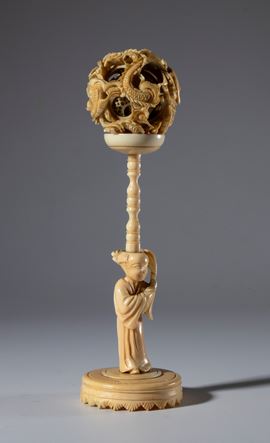
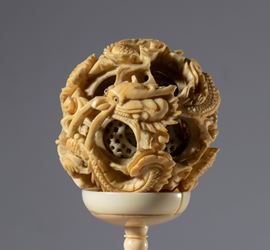
Small sculpture with a turned base and a spirit sphere (鬼功球 “guĭ gōng qiú”) in elephant ivory. China, 19th century
Overall height 175 mm
In 1388 AD, the scholar Cáo Zhāo 曹昭 published a guide for collectors of antiquities, which, in addition to jades, porcelains and bronzes, also mentioned a type of objects with a curious name: “spirit-made balls” (鬼功球 “guĭ gōng qiú”).
In the work entitled “Fundamental Notes on the Evaluation of Ancient Objects” (“格古要論 “gé gǔ yào lùn”), paragraph 120 of the second volume states the following:
“Deserving of praise are some ivory spheres whose interior can be directly penetrated through openings. All the numerous internal layers can be made to rotate. Such spheres are therefore called 'spirit-made balls'. It is also said that they were produced in the palaces of the Song dynasty.” ( 嘗有象牙圎球兒一箇中直通一竅內車數重皆可轉動故謂之鬼功球或云宋內院中作者). (1)
We can deduce from Cao Zhao's text that these ivory spheres were called “spirit-made balls” because the extreme ingenuity with which they were crafted seemed to go beyond the limits of human possibility.
Although ivory carving in China can be traced back to the Shāng Dynasty (c. 1600 BC–1046 BC), Cao Zhāo is the first source to mention the existence of these objects. He notes, however, that, according to rumors of his time, ivory spheres crafted in this way were already being produced during the Sòng Dynasty (960 AD–1279 AD), during which ivory carving flourished. Unfortunately, no examples have survived.
The reference to "imperial palaces" leads us to assume that these objects were produced, if not exclusively for the imperial palace, at least for a select clientele with enormous financial resources. The cost of the materials and the extreme complexity of the work, which required not only incredible manual skill but also an extraordinary expenditure of time, meant that prices were affordable only to a very fortunate few.
The spheres were obviously seen primarily as exceptional works of art (or craftsmanship), but they could also be used as (very expensive) pastimes, as by carefully moving the individual spheres back and forth, it was possible to align all their openings and glimpse the central sphere. It is for this reason that the English also call them "Chinese puzzle balls." Their use as a toy, however, requires an extremely delicate touch (usually using very thin sticks, quills, or even toothpicks to move the internal spheres) because the layers of ivory that compose the individual spheres are so thin as to be extremely fragile.
The production of “puzzle spheres” saw a great increase during the period in which China was subjected to the Qing dynasty (1644 AD-1912), when they aroused the interest of the ever-increasing number of Westerners who came into contact with the Celestial Empire.
This lot, accompanied by a CITES certificate and a technical report issued by Ce.S.Ar. Centro Studi Archeometri, is available for sale only with shipments within the European Community.
In the work entitled “Fundamental Notes on the Evaluation of Ancient Objects” (“格古要論 “gé gǔ yào lùn”), paragraph 120 of the second volume states the following:
“Deserving of praise are some ivory spheres whose interior can be directly penetrated through openings. All the numerous internal layers can be made to rotate. Such spheres are therefore called 'spirit-made balls'. It is also said that they were produced in the palaces of the Song dynasty.” ( 嘗有象牙圎球兒一箇中直通一竅內車數重皆可轉動故謂之鬼功球或云宋內院中作者). (1)
We can deduce from Cao Zhao's text that these ivory spheres were called “spirit-made balls” because the extreme ingenuity with which they were crafted seemed to go beyond the limits of human possibility.
Although ivory carving in China can be traced back to the Shāng Dynasty (c. 1600 BC–1046 BC), Cao Zhāo is the first source to mention the existence of these objects. He notes, however, that, according to rumors of his time, ivory spheres crafted in this way were already being produced during the Sòng Dynasty (960 AD–1279 AD), during which ivory carving flourished. Unfortunately, no examples have survived.
The reference to "imperial palaces" leads us to assume that these objects were produced, if not exclusively for the imperial palace, at least for a select clientele with enormous financial resources. The cost of the materials and the extreme complexity of the work, which required not only incredible manual skill but also an extraordinary expenditure of time, meant that prices were affordable only to a very fortunate few.
The spheres were obviously seen primarily as exceptional works of art (or craftsmanship), but they could also be used as (very expensive) pastimes, as by carefully moving the individual spheres back and forth, it was possible to align all their openings and glimpse the central sphere. It is for this reason that the English also call them "Chinese puzzle balls." Their use as a toy, however, requires an extremely delicate touch (usually using very thin sticks, quills, or even toothpicks to move the internal spheres) because the layers of ivory that compose the individual spheres are so thin as to be extremely fragile.
The production of “puzzle spheres” saw a great increase during the period in which China was subjected to the Qing dynasty (1644 AD-1912), when they aroused the interest of the ever-increasing number of Westerners who came into contact with the Celestial Empire.
This lot, accompanied by a CITES certificate and a technical report issued by Ce.S.Ar. Centro Studi Archeometri, is available for sale only with shipments within the European Community.
Live auction 387
ORIENTAL ART FROM SELECTED EUROPEAN COLLECTIONS
Palazzo Caetani Lovatelli, wed 10 June 2026
SINGLE SESSION 10/06/2026 Hours 12:00
New lots currently at auction
PRINTS FROM 15th TO 20th CENTURY
Lot 321ter
Johann Nepomuk Strixner
La visita del medico, da Frans van Mieris
DRAWINGS FROM 16th TO 19th CENTURY
Lot 42
Life of Saint Francis
PRINTS FROM 15th TO 20th CENTURY
Lot 173
Giovanni Maggi
Fontane diverse che si vedano nel'Alma Città di Roma e altre parte d'Italia
DRAWINGS FROM 16th TO 19th CENTURY
Lot 28
Paolo Gerolamo Piola
Study for an Oval with a Saint in Prayer
PRINTS FROM 15th TO 20th CENTURY
Lot 275
Johann Baptist Klauber
Santa Izabel Rahina de Portugal | San Francisco de Paula | Santa Petronilla virgo
PRINTS FROM 15th TO 20th CENTURY
Lot 412
FORTUNATO DEPERO
SE LA PIOGGIA FOSSE DI BITTER CAMPARI
ORIENTAL ART FROM ARISTOCRATIC MANSIONS. [..]
Lot 24
Blue and white porcelain gourd-shaped bottle with a long metal neck and a Turkish-style stopper and [..]
PRINTS FROM 15th TO 20th CENTURY
Lot 401
AA.VV.
Novissima. Albo Annuale D'Arti e Lettere. Anno IV
ORIENTAL ART FROM ARISTOCRATIC MANSIONS. [..]
Lot 192
Travel case with knife and chopsticks. Tibet, late 19th-20th century.
PRINTS FROM 15th TO 20th CENTURY
Lot 377