



46
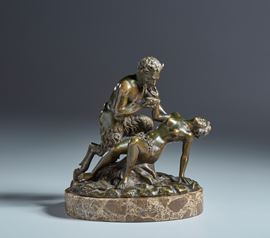
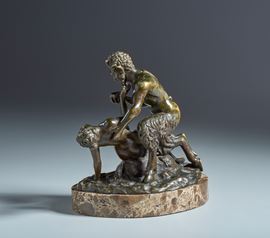
Satyr and nymph, Venetian art, 17th century, Bronze with black bituminous patina
18.5 x 18 x 12 cm
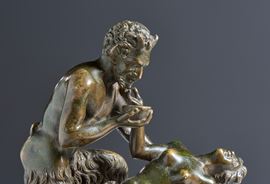
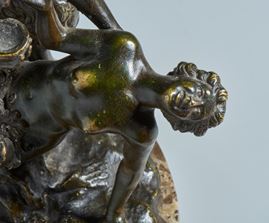
The bronze statuette presented here depicts a kneeling satyr supporting a nymph and offering her a drink from a cup.
The erotic meaning of the subject is evident, and it enjoyed varying success in both painting and sculpture. It was probably originally inspired by some archaeological marble unearthed during excavations during the Renaissance.
We recall the bronze versions of the subject created by Giambologna and replicated by his school. In particular, the satyr observing a sleeping nymph, replicated by his follower Antonio Susini.
Another similar subject was created by Pietro Tacca, heir to the Florentine Grand Ducal foundry, who replicated the subject by placing a syringe in the hand of the lustful satyr...
However, it is an extremely rare and fascinating subject, as well as difficult to propose due to the obvious erotic allusions.
Our bronze is a unique piece that presents all the characteristics of an ancient casting, starting from the somewhat rigid handling of the subject, to the workmanship of the details, such as the hair, to the black bituminous patina peeled off in the areas of wear.
Furthermore, the lead repairs visible on the satyr's back, due to casting errors, typical of ancient castings, and originally hidden by the artificial patination, provide classic clues for an ancient dating of the artefact.
Due to these characteristics, less lively than the Tuscan versions, we trace it back to the Venetian-Paduan production of the late Renaissance, prudently placing it in the 17th century, in the wake of the well-known satyrs from the workshops of Riccio and Severo da Ravenna.
Bibliography:
AAVV, edited by Davide Banzato, Donatello and his Time, exhibition catalogue, Skira publisher, Geneva-Milan, 2001.
The erotic meaning of the subject is evident, and it enjoyed varying success in both painting and sculpture. It was probably originally inspired by some archaeological marble unearthed during excavations during the Renaissance.
We recall the bronze versions of the subject created by Giambologna and replicated by his school. In particular, the satyr observing a sleeping nymph, replicated by his follower Antonio Susini.
Another similar subject was created by Pietro Tacca, heir to the Florentine Grand Ducal foundry, who replicated the subject by placing a syringe in the hand of the lustful satyr...
However, it is an extremely rare and fascinating subject, as well as difficult to propose due to the obvious erotic allusions.
Our bronze is a unique piece that presents all the characteristics of an ancient casting, starting from the somewhat rigid handling of the subject, to the workmanship of the details, such as the hair, to the black bituminous patina peeled off in the areas of wear.
Furthermore, the lead repairs visible on the satyr's back, due to casting errors, typical of ancient castings, and originally hidden by the artificial patination, provide classic clues for an ancient dating of the artefact.
Due to these characteristics, less lively than the Tuscan versions, we trace it back to the Venetian-Paduan production of the late Renaissance, prudently placing it in the 17th century, in the wake of the well-known satyrs from the workshops of Riccio and Severo da Ravenna.
Bibliography:
AAVV, edited by Davide Banzato, Donatello and his Time, exhibition catalogue, Skira publisher, Geneva-Milan, 2001.
€ 3.000,00 / 6.000,00
Estimate
€ 2.000,00
Starting price
Unsold
Live auction 390
CUPRUM. Bronzetti from 16th to 18th Century. An important collection
in collaboration with IL Labirinto Fine Art, fri 26 June 2026
SINGLE SESSION 26/06/2026 Hours 16:00
New lots currently at auction
FINE WINES. ICONS FROM FRANCE & ITALY
Lot 86
Pauillac Château Latour 1999 3 Bot
FINE WINES. ICONS FROM FRANCE & ITALY
Lot 305
Schidione Jacopo Biondi Santi 2011 1 Bot
FINE WINES. ICONS FROM FRANCE & ITALY
Lot 203
Barolo Campè La Spinetta 2000 1 Bot
FINE WINES. ICONS FROM FRANCE & ITALY
Lot 95
Pauillac Château Pichon-Longueville Comtesse De Lalande 2000 3 Bot
FINE WINES. ICONS FROM FRANCE & ITALY
Lot 108
Pessac-Léognan Château Haut-Brion 2001 3 Bot
FINE WINES. ICONS FROM FRANCE & ITALY
Lot 343
Sassicaia 2019 3 Bot
FINE WINES. ICONS FROM FRANCE & ITALY
Lot 185
Champagne Grand Siècle Laurent-Perrier 1 Bot
FINE WINES. ICONS FROM FRANCE & ITALY
Lot 342
Sassicaia 2018 1 Mag
FINE WINES. ICONS FROM FRANCE & ITALY
Lot 168
Chablis Henri De Bareuil 2021 6 Bot
FINE WINES. ICONS FROM FRANCE & ITALY
Lot 60