
151
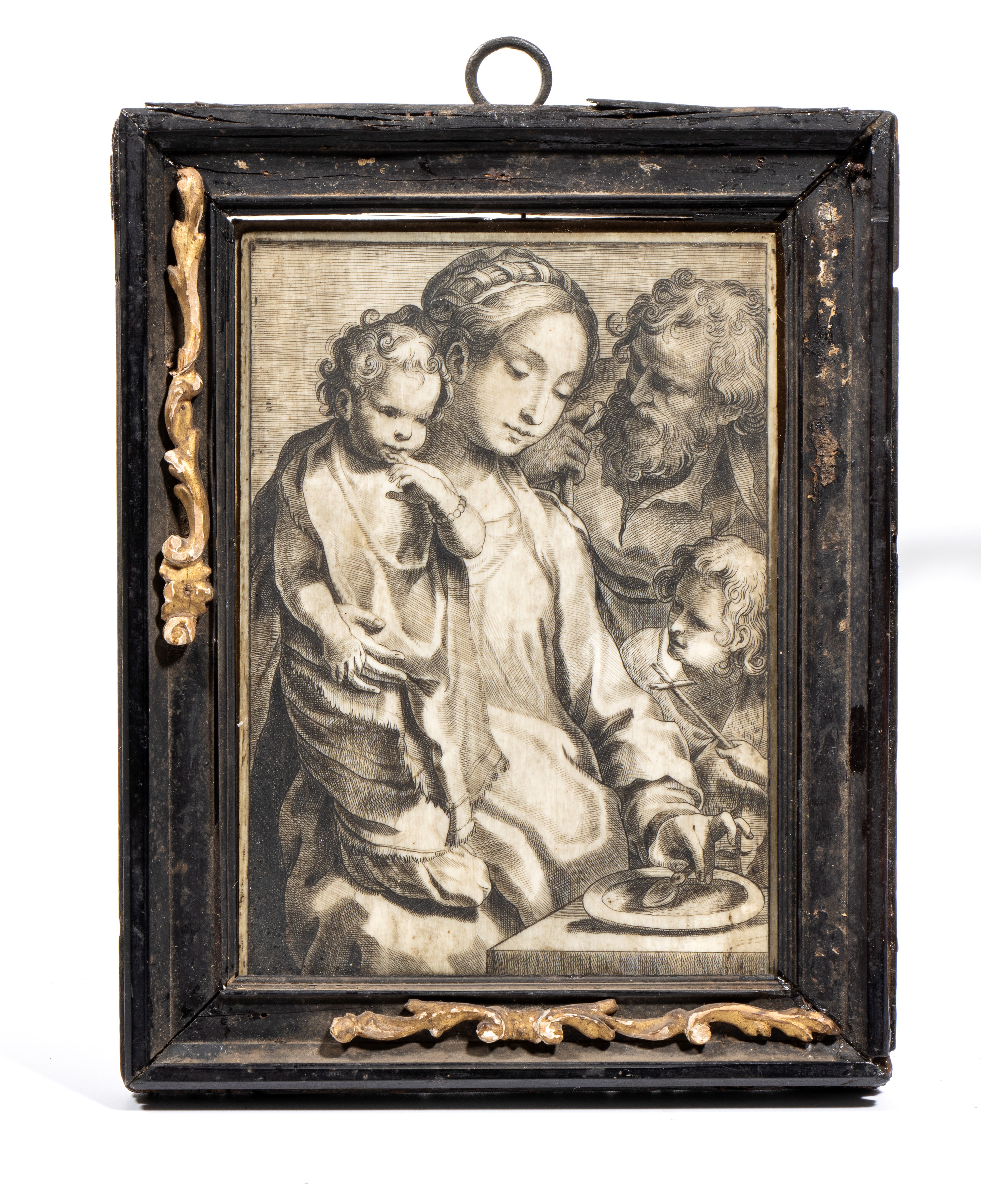
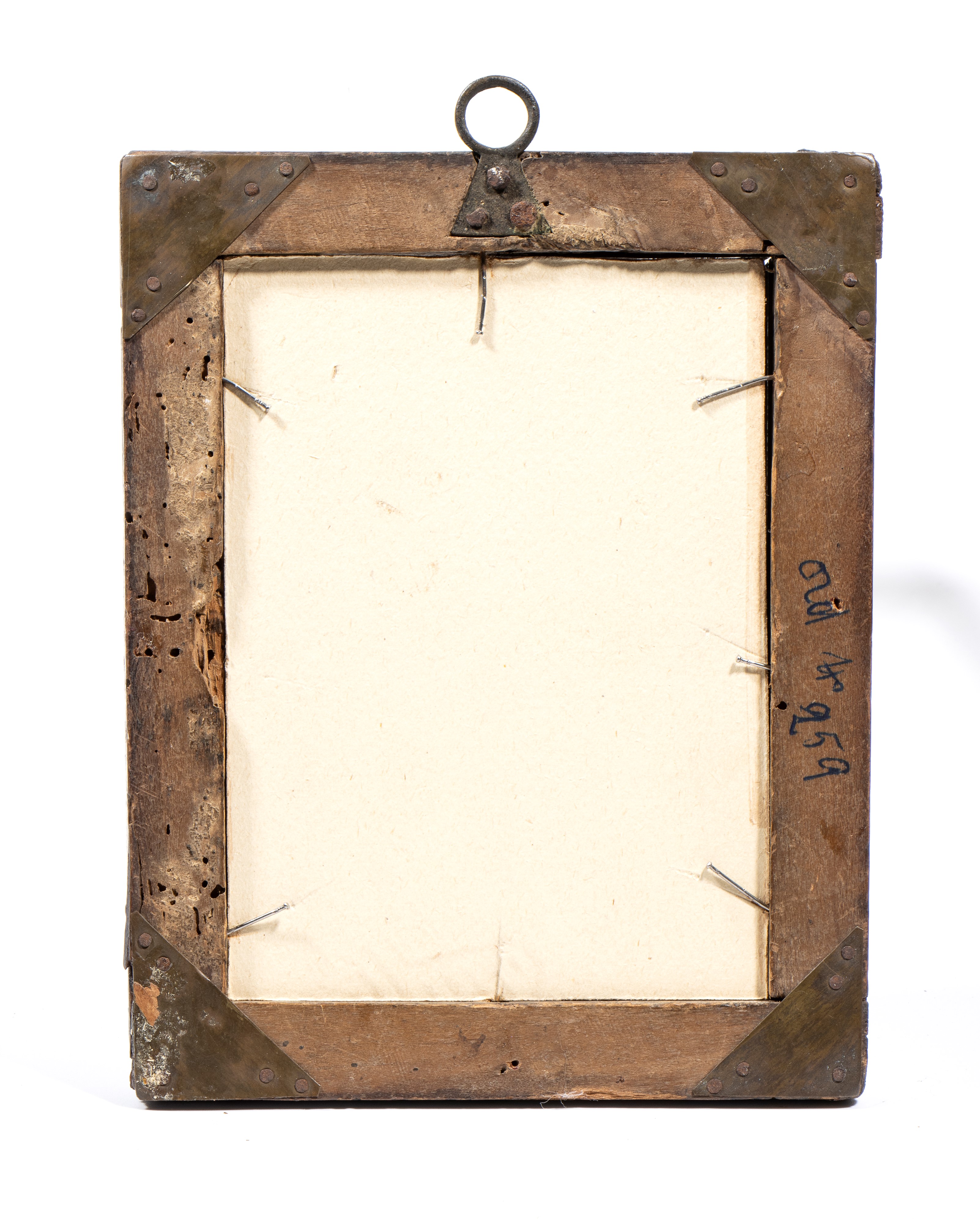
Ivory engraving with ink depicting The Holy Family with the Porridge Bowl, Early 17th century
Height x depth: 15.8 x 9.9 cm. Weight: 29.5 g
Antique and rare devotional engraving depicting the Holy Family, with the Virgin Mary, Saint Joseph, the Baby Jesus, and Saint John. The work features a meticulous engraving on elephant ivory (Elephas maximus Linnaeus, 1758 or Loxodonta africana Blumenbach, 1797), subsequently retouched with Indian ink to enhance the definition of the lines and the chiaroscuro effect. The scene depicts the Holy Family gathered around a domestic table, with the Baby Jesus in the centre, the Virgin Mary in a pensive pose, St Joseph behind her and St John, recognisable by the processional cross on the right. The theme, known as The Holy Family with the Porridge Bowl, belongs to an iconographic typology that highlights the everyday humanity of the Holy Family, emphasising the infant nutrition of Christ. The engraving shows tight, calibrated hatching, with clear references to late Mannerist graphics from Rome and Siena, while the choice of ivory as a support—extremely rare for works of this kind— gives the piece a precious character, probably intended for a cultured and private clientele, combining the charm of Mannerist graphics with the rarity of the medium.
This lot, accompanied by a CITES certificate and expertise issued by Ce.S.Ar Centro studi archeometici, is only available for sale with shipments within the European Union. (expertise Ce.S.Ar. 2025-229)
Literature:
Comparisons:
Comparisons:
There are two similar but not identical examples of the same composition: in the two engravings compared, Saint Joseph is depicted picking cherries and an angel is depicted in place of Saint John.
I. MET, New York: The Holy Family with the Porridge Bowl (c. 1580–1614), engraving by Raffaello Guidi (active in Rome 1585–1615) based on an invention by Francesco Vanni (Siena, 1563–1610).
II. Pinacoteca Nazionale di Bologna, Gabinetto dei Disegni e delle Stampe: a variant engraved by Cornelis Galle III (c. 1642 – post 1670), where the composition is enriched with details and leans towards a later Baroque style.
Although this ivory engraving derives from these graphic models, it differs from them in some compositional solutions and in its material transposition, falling within the practice of translations and reworkings that characterised the spread of Vanni's inventions in Italy and the Flemish area.
The artwork in question belongs to a transitional phase between late 16th-century Mannerism and the naturalistic sensibilities of the early 17th century. The rarity of the technique — engraving on ivory, destined to remain a unique piece or to circulate in extremely limited numbers — increases its interest to collectors. The use of ivory, an unusual medium for matrices, transforms the sacred scene into a precious devotional object and Wunderkammer piece.
€ 10.000,00 / 15.000,00
Estimate
€ 5.000,00
Starting price
Unsold
Live auction 369
SILVER ANTIQUES, IVORIES, WUNDERKAMMER - Including selected Works of Art from the Count Luigi Rigi Luperti Collection
Palazzo Caetani Lovatelli, thu 19 February 2026
SINGLE SESSION 19/02/2026 Hours 15:00
New lots currently at auction
ORIENTAL ART FROM ARISTOCRATIC MANSIONS. [..]
Lot 203
Bronze figure of Weituo Pusa. China, late Qing Dynasty, 19th century.
PRINTS FROM 15th TO 20th CENTURY
Lot 322
Abraham Girardet
Le Triomphe de Vespasien et de Titus, after Giulio Romano
OLD MASTER PAINTINGS FROM 14th to 19th CE [..]
Lot 45
Francesco Trevisani
The Agony in the Garden
PRINTS FROM 15th TO 20th CENTURY
Lot 218
View of Campo di San Stefano
ORIENTAL ART FROM ARISTOCRATIC MANSIONS. [..]
Lot 83
A Hotan dark jade pendant decorated with a rice grain motif. China, Qing Dynasty (1644–1912), 16th ce [..]
ORIENTAL ART FROM ARISTOCRATIC MANSIONS. [..]
Lot 183
Silver-plated bowl. Tibet, 20th century.
OLD MASTER PAINTINGS FROM 14th to 19th CE [..]
Lot 47
Sebastiano Conca
Madonna in Glory with Hosts of Angels and Penitents
ORIENTAL ART FROM ARISTOCRATIC MANSIONS. [..]
Lot 188
Seated bodhisattva figure on a double-barrelled bronze base. India, 20th century.
PRINTS FROM 15th TO 20th CENTURY
Lot 114
Lambert Suavius
Deposition
PRINTS FROM 15th TO 20th CENTURY
Lot 239