
9
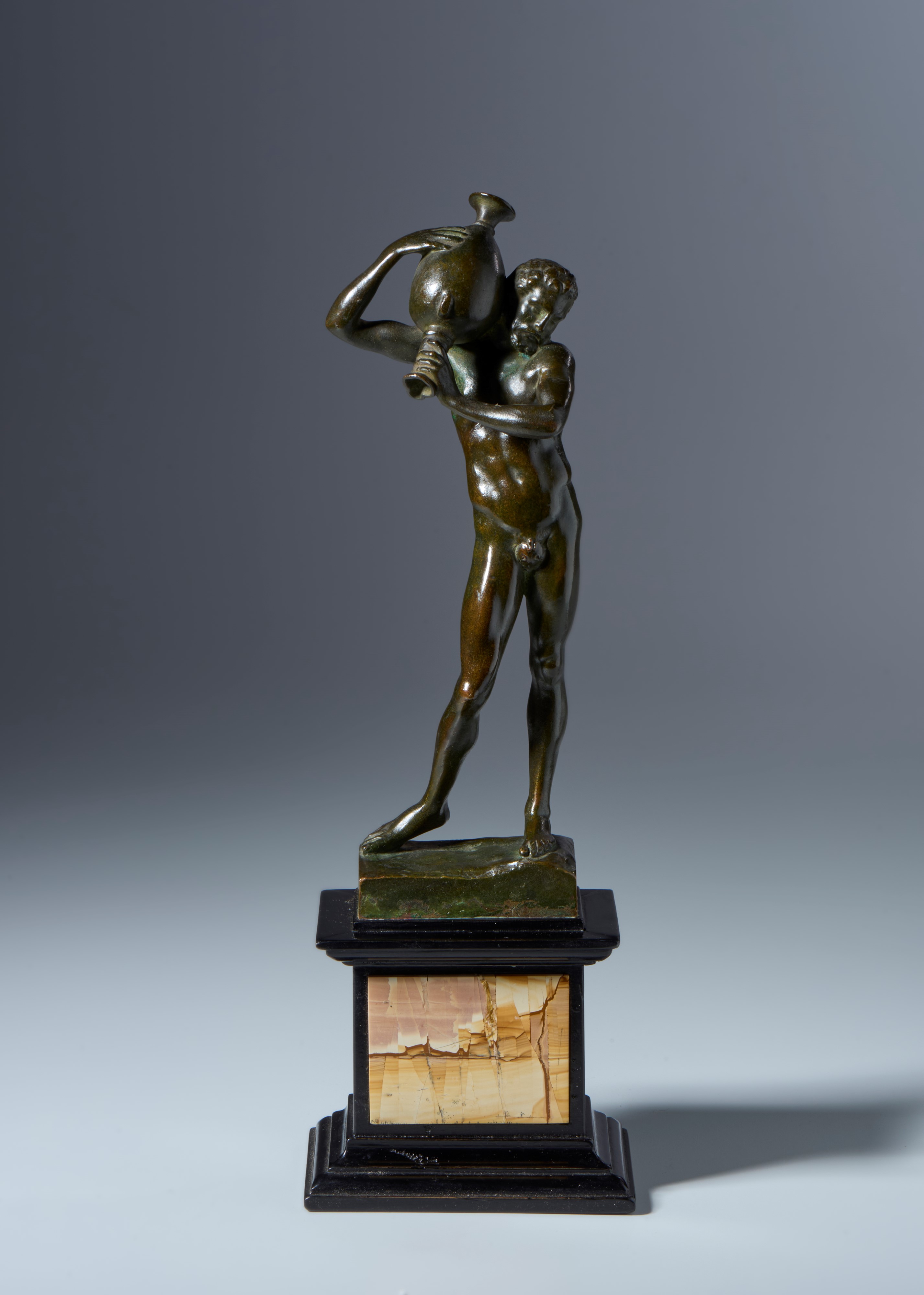
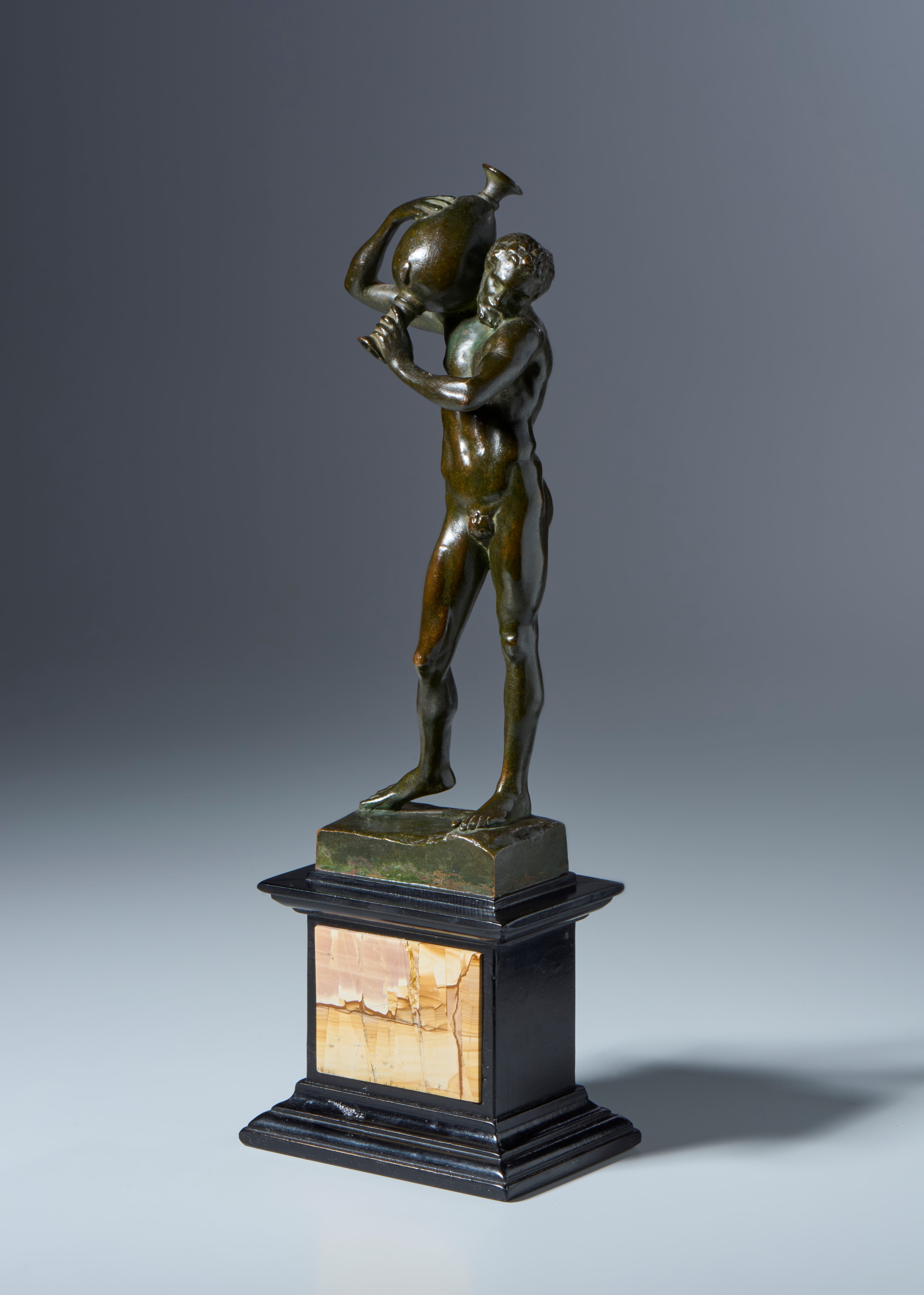
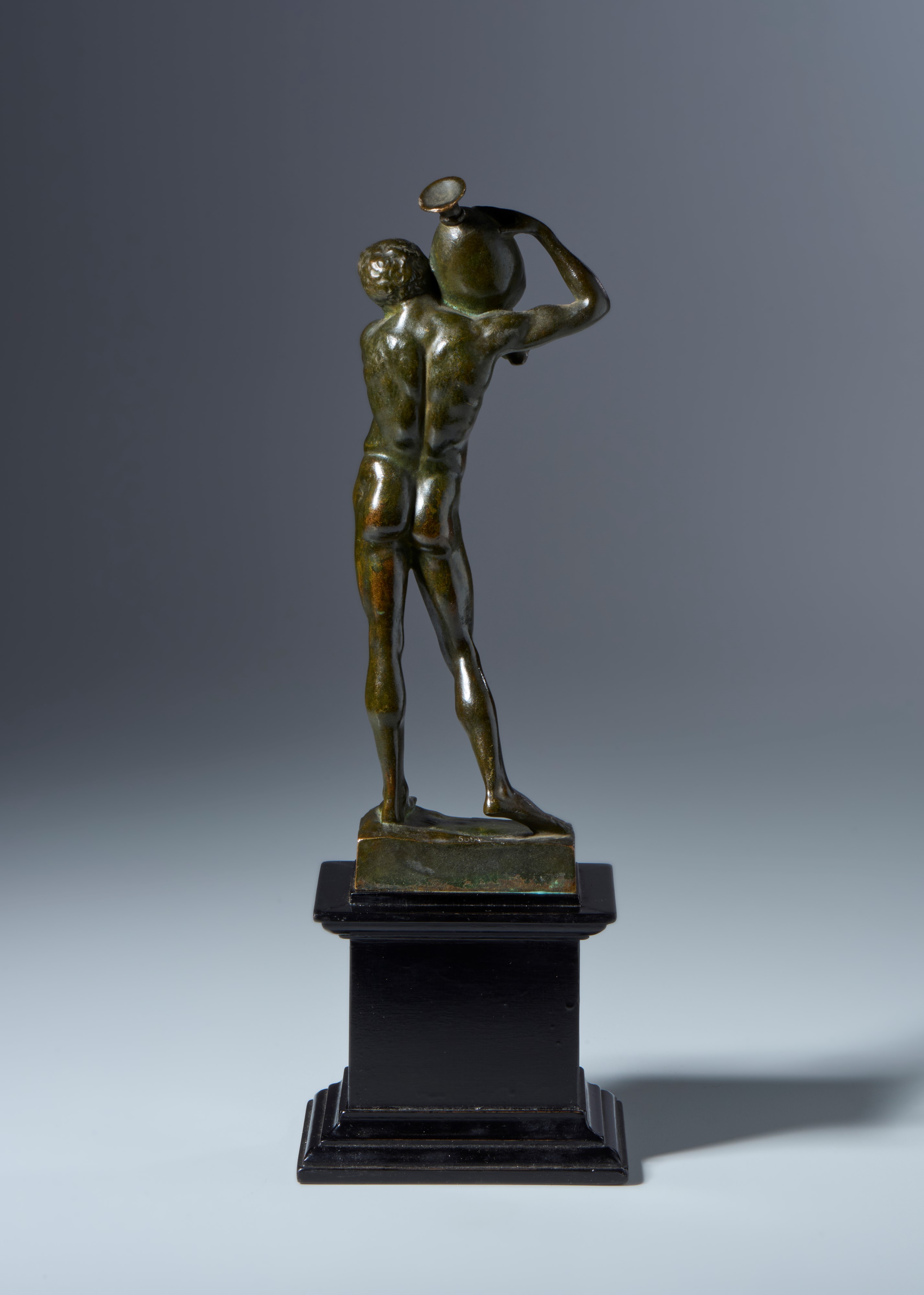
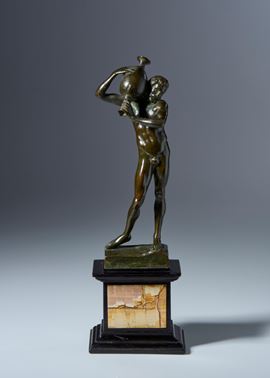
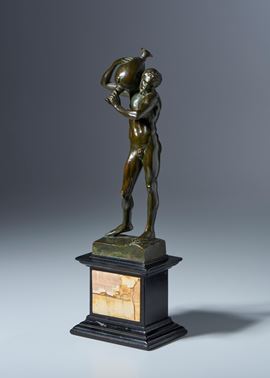
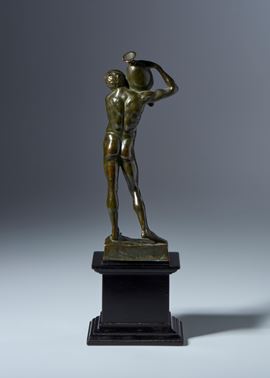
Astrological sign of Aquarius. Padua or Venice, 16th-17th century. Traces of dark artificial patina, large areas of transparent natural patina.
28 x 12 x 6.5 cm
The model of the bronze statuette under examination is based on a similar one held at the Bode Museum in Berlin. Its dimensions are 27.7 cm (including a low cast bronze pedestal), while ours are approximately 26 cm (the figure alone) and 28.5 cm (with the parallelepiped pedestal, also cast).
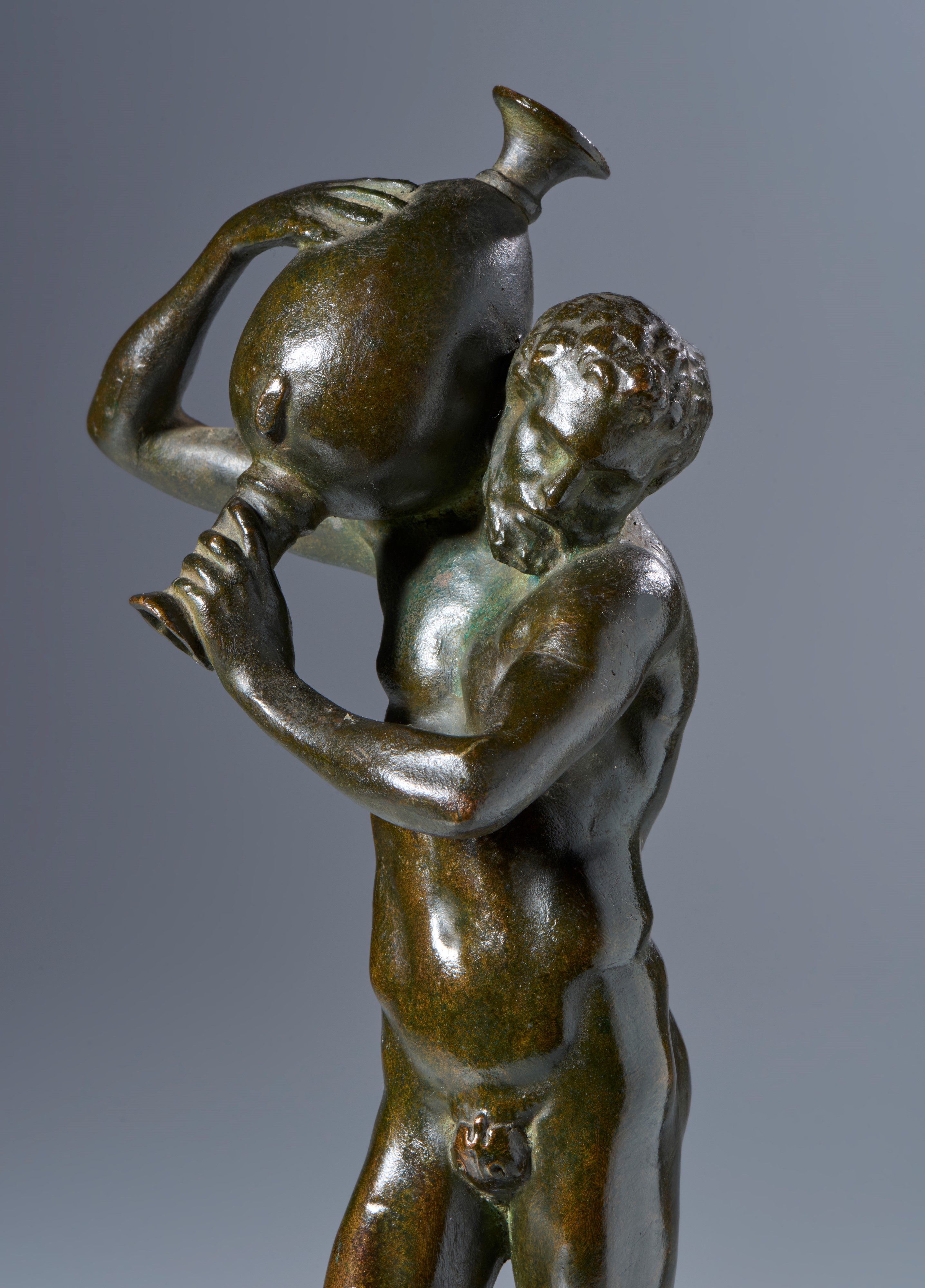
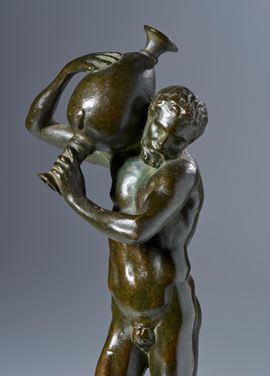
This mysterious subject depicts a standing bearded man: balanced on his left leg, he brings his right leg slightly back, giving a subtle sense of movement to the composition.
On his right shoulder he holds a jar with both hands, its mouth curiously turned downwards.
If we compare the two bronzes stylistically, we note a greater materiality in the Berlin bronze, with little cold finishing of the details, characterized by a hammered finish present across the entire surface. This method of working gives the metal a vibrant vibrancy and is typical of many works of the early Renaissance. It is particularly typical of the bronzes attributed to Andrea Briosco, known as Riccio (Trento 1470-Padua 1532), the absolute genius of Paduan Renaissance bronze, to whom many works were initially attributed, later passed to other foundries, particularly that of Severo da Ravenna (Ravenna 1465-Ravenna 1543).
The Berlin bronze was also initially attributed to Riccio, but later changed to other attributions that were never definitively confirmed.
Our "Amphora Bearer" has slightly more worked and therefore more reflective surfaces, while maintaining the same materiality of the metal and little cold finishing of the details, such as the workmanship of the hair and face.
Another rather evident difference is represented by the flat base in the German model and the parallelepiped one in ours.
Comparing the details of the two bearded men, we find a series of small differences, such as in the composition of the locks of hair or the definition of the genitals. These findings highlight the fact that the two bronzes do not come from the same mold, but are, to some extent, original works. While it is clear that the Berlin bronze is the original, we can assume that ours came from the same foundry that replicated its invention or from another workshop that drew inspiration from it, perhaps some time later, possibly even in the following century.
It remains a commonly accepted practice, and found in museum catalogs, that the production of Renaissance subjects continued into the 17th century and was therefore inherent to the foundries' practices, which often repeated the models for generations. That said, for intellectual honesty and a thorough understanding of these artifacts, anyone who has handled many of these objects and seen just as many in museum displays can hardly guarantee that the casting dates back to the 16th or 17th century.
It remains certain that these are extremely rare objects with an extraordinary evocative power that must maintain certain standards of workmanship and patina to be considered ancient and not from other centuries.
The last detail to highlight between our two castings is the preservation of the patina, which is very similar in both. That is, both retain traces of an original dark artificial patination replaced by a natural transparent one in the areas of worn bronze. In the Berlin bronze, it appears more reddish, while in ours, it appears more golden.
In the bronze base we notice a hole that was once used to fix the sculpture to the marble with a pin.
The bronze is currently placed on a beautiful "monumental" marble base of recent production, perhaps from the early 1900s.
Early 20th-century art critics attributed a number of small bronzes to the great masters of Renaissance bronze, which were then prudently passed on to the school or other foundries inspired by them. The vast majority of the works attributed by Bode or Planischig to Riccio were revealed to be workshop castings, primarily by Severo, another extraordinary figure active in Padua during the same period.
This consideration must always be kept in mind in order to discard any attribution taken for granted to great authors, unless it is supported by studies by historians of established fame or by certain historical documentation.
The production of bronze statuettes during the Renaissance was fueled by the ever-increasing demand of humanists, who saw in this art form the rebirth of classical antiquity. These same intellectual princes loved to surround themselves with these statuettes, which filled the shelves of their studies.
Foundries meet these demands by reproducing the designs invented by the most successful masters, often copying them with variations or serially, even for generations. However, this is an elite and limited production inherent to the foundry's working practices, where the master craftsman invented and other professionals created the finished product.
A key aspect of bronze statuettes is their reproducibility, and it's common to find the same subject replicated multiple times in museum displays or on the art market. This shouldn't discourage you, as these are among the very few surviving copies, and comparing the various versions must be quite meticulous to determine their estimated age and quality.
The "Amphora Bearer" is an extremely rare specimen, one I've never encountered in my experience, other than the one presented here. This fact makes its discovery slightly more interesting.
Now, a few words about the subject represented by this intriguing little bronze.
Various scholars have established that it represents the zodiac sign of Aquarius. This extremely rare representation is almost never found in sculpture, but rather in frescoes or astrological treatises. Curiously, it does not belong to a series of statuettes of a similar subject: some would likely have survived. Therefore, we can assume it is an important subject in itself and not part of a decorative cycle, which would contain an "infinite" series of twelve statuettes.
We know from the many studies produced at the Waburg Iconological School in London how much weight astrology had in the medieval and later Renaissance periods in the production of iconographic cycles and paintings.
Far from being the ancient culture bound to superstition we know today, astrology was the "science" that studied the movement of the stars and their influence on human lives. The macrocosm of the universe reflected the microcosm of the human being: every movement above corresponded to a movement below in the life of the individual.
Each part of the starry sky corresponded to a part of the physical body of man, hence many imaginative cures peacefully accepted in ancient medicine.
Ancient graphic representations by "Phlebotomists" linked constellations and planets to every part of the human body: consequently, doctors treated diseases with elements astrally connected to the affected parts. This symbolic approach could, of course, create some problems, but sometimes it worked.
In some of these "medical" representations the sign of Aquarius was connected to the lower part of the body, the legs.
Sometimes people healed themselves with talismans: these reproduced astral images that attracted positive influences to the person who wore them. Warburg gave new meaning to many mythological images linked to celestial constellations, reproduced in frescoes and various objects, intuiting their hidden talismanic nature.
Some fresco cycles represented the horoscope of the owner of the house and acted as a talisman attracting positive astral influences into his life.
Many medallions reinterpreted in this light served as talismans and it does not seem far-fetched to think that many astral-themed statuettes could also have been so.
All things considered, we might speculate that our bronze statuette, being the astral representation of Aquarius and not part of a generic decorative cycle, could be connected to this culture. Bronze statuettes related to astrology are indeed very rare, and given the era of their creation, it's not a crime to speculate.
In ancient esoteric culture, the Age of Aquarius represents one of the twelve epochs, or "aeons," into which human history was divided. Each era lasts approximately two thousand years, and in 2021 we will enter the Age of Aquarius, also known as the Age of the Spirit, traditionally considered humanity's most positive evolution. The preceding Age, that of Pisces, was linked to the coming of Christ.
This meaning also links the subject of our bronze statuette to an extremely fascinating esoteric world, certainly widespread among Renaissance intellectuals. It could be linked to the patron's astral interests and also a harbinger of the arrival of a highly positive age, that of Aquarius.
It might still be for us now.
Bibliography:
Volker Krahn, Venetian Bronzes, SMB-Dumont, Germany, 2003, pp. 52, 53,54.
This mysterious subject depicts a standing bearded man: balanced on his left leg, he brings his right leg slightly back, giving a subtle sense of movement to the composition.
On his right shoulder he holds a jar with both hands, its mouth curiously turned downwards.
If we compare the two bronzes stylistically, we note a greater materiality in the Berlin bronze, with little cold finishing of the details, characterized by a hammered finish present across the entire surface. This method of working gives the metal a vibrant vibrancy and is typical of many works of the early Renaissance. It is particularly typical of the bronzes attributed to Andrea Briosco, known as Riccio (Trento 1470-Padua 1532), the absolute genius of Paduan Renaissance bronze, to whom many works were initially attributed, later passed to other foundries, particularly that of Severo da Ravenna (Ravenna 1465-Ravenna 1543).
The Berlin bronze was also initially attributed to Riccio, but later changed to other attributions that were never definitively confirmed.
Our "Amphora Bearer" has slightly more worked and therefore more reflective surfaces, while maintaining the same materiality of the metal and little cold finishing of the details, such as the workmanship of the hair and face.
Another rather evident difference is represented by the flat base in the German model and the parallelepiped one in ours.
Comparing the details of the two bearded men, we find a series of small differences, such as in the composition of the locks of hair or the definition of the genitals. These findings highlight the fact that the two bronzes do not come from the same mold, but are, to some extent, original works. While it is clear that the Berlin bronze is the original, we can assume that ours came from the same foundry that replicated its invention or from another workshop that drew inspiration from it, perhaps some time later, possibly even in the following century.
It remains a commonly accepted practice, and found in museum catalogs, that the production of Renaissance subjects continued into the 17th century and was therefore inherent to the foundries' practices, which often repeated the models for generations. That said, for intellectual honesty and a thorough understanding of these artifacts, anyone who has handled many of these objects and seen just as many in museum displays can hardly guarantee that the casting dates back to the 16th or 17th century.
It remains certain that these are extremely rare objects with an extraordinary evocative power that must maintain certain standards of workmanship and patina to be considered ancient and not from other centuries.
The last detail to highlight between our two castings is the preservation of the patina, which is very similar in both. That is, both retain traces of an original dark artificial patination replaced by a natural transparent one in the areas of worn bronze. In the Berlin bronze, it appears more reddish, while in ours, it appears more golden.
In the bronze base we notice a hole that was once used to fix the sculpture to the marble with a pin.
The bronze is currently placed on a beautiful "monumental" marble base of recent production, perhaps from the early 1900s.
Early 20th-century art critics attributed a number of small bronzes to the great masters of Renaissance bronze, which were then prudently passed on to the school or other foundries inspired by them. The vast majority of the works attributed by Bode or Planischig to Riccio were revealed to be workshop castings, primarily by Severo, another extraordinary figure active in Padua during the same period.
This consideration must always be kept in mind in order to discard any attribution taken for granted to great authors, unless it is supported by studies by historians of established fame or by certain historical documentation.
The production of bronze statuettes during the Renaissance was fueled by the ever-increasing demand of humanists, who saw in this art form the rebirth of classical antiquity. These same intellectual princes loved to surround themselves with these statuettes, which filled the shelves of their studies.
Foundries meet these demands by reproducing the designs invented by the most successful masters, often copying them with variations or serially, even for generations. However, this is an elite and limited production inherent to the foundry's working practices, where the master craftsman invented and other professionals created the finished product.
A key aspect of bronze statuettes is their reproducibility, and it's common to find the same subject replicated multiple times in museum displays or on the art market. This shouldn't discourage you, as these are among the very few surviving copies, and comparing the various versions must be quite meticulous to determine their estimated age and quality.
The "Amphora Bearer" is an extremely rare specimen, one I've never encountered in my experience, other than the one presented here. This fact makes its discovery slightly more interesting.
Now, a few words about the subject represented by this intriguing little bronze.
Various scholars have established that it represents the zodiac sign of Aquarius. This extremely rare representation is almost never found in sculpture, but rather in frescoes or astrological treatises. Curiously, it does not belong to a series of statuettes of a similar subject: some would likely have survived. Therefore, we can assume it is an important subject in itself and not part of a decorative cycle, which would contain an "infinite" series of twelve statuettes.
We know from the many studies produced at the Waburg Iconological School in London how much weight astrology had in the medieval and later Renaissance periods in the production of iconographic cycles and paintings.
Far from being the ancient culture bound to superstition we know today, astrology was the "science" that studied the movement of the stars and their influence on human lives. The macrocosm of the universe reflected the microcosm of the human being: every movement above corresponded to a movement below in the life of the individual.
Each part of the starry sky corresponded to a part of the physical body of man, hence many imaginative cures peacefully accepted in ancient medicine.
Ancient graphic representations by "Phlebotomists" linked constellations and planets to every part of the human body: consequently, doctors treated diseases with elements astrally connected to the affected parts. This symbolic approach could, of course, create some problems, but sometimes it worked.
In some of these "medical" representations the sign of Aquarius was connected to the lower part of the body, the legs.
Sometimes people healed themselves with talismans: these reproduced astral images that attracted positive influences to the person who wore them. Warburg gave new meaning to many mythological images linked to celestial constellations, reproduced in frescoes and various objects, intuiting their hidden talismanic nature.
Some fresco cycles represented the horoscope of the owner of the house and acted as a talisman attracting positive astral influences into his life.
Many medallions reinterpreted in this light served as talismans and it does not seem far-fetched to think that many astral-themed statuettes could also have been so.
All things considered, we might speculate that our bronze statuette, being the astral representation of Aquarius and not part of a generic decorative cycle, could be connected to this culture. Bronze statuettes related to astrology are indeed very rare, and given the era of their creation, it's not a crime to speculate.
In ancient esoteric culture, the Age of Aquarius represents one of the twelve epochs, or "aeons," into which human history was divided. Each era lasts approximately two thousand years, and in 2021 we will enter the Age of Aquarius, also known as the Age of the Spirit, traditionally considered humanity's most positive evolution. The preceding Age, that of Pisces, was linked to the coming of Christ.
This meaning also links the subject of our bronze statuette to an extremely fascinating esoteric world, certainly widespread among Renaissance intellectuals. It could be linked to the patron's astral interests and also a harbinger of the arrival of a highly positive age, that of Aquarius.
It might still be for us now.
Bibliography:
Volker Krahn, Venetian Bronzes, SMB-Dumont, Germany, 2003, pp. 52, 53,54.
€ 1.500,00 / 3.000,00
Estimate
1.000,00 €
Starting price
€
Your bid
(The reserve price has not been exceeded)
(The reserve price has been exceeded)
Set your maximum bid
Live auction 390
CUPRUM. An important collection of ancient small bronzes
Palazzo Caetani Lovatelli, fri 26 June 2026
SINGLE SESSION 26/06/2026 Hours 16:00
Discover Similar Lots
CUPRUM. An important collection of ancient [..]
Lot 6
Venus Anadyomene. Tuscany, 16th-17th century. Bronze and transparent reddish patina.
CUPRUM. An important collection of ancient [..]
Lot 42
Rampant Horse. Francesco Fanelli (Florence, 1577-Paris? 1663). 17th-18th century. Bronze with a transparent [..]
CUPRUM. An important collection of ancient [..]
Lot 16
River God. Pietro Tacca (Carrara, 1577-Florence, 1640) Workshop. Bronze with a translucent reddish patina. [..]
CUPRUM. An important collection of ancient [..]
Lot 4
Hermaphrodite. Giovan Francesco Susini (Florence 1585-1653) School of. Possibly 17th century. Brass [..]
CUPRUM. An important collection of ancient [..]
Lot 3
Satyr holding a candle. Severo Calzetta da Ravenna (Ravenna 1465-1543). School of the 17th century, [..]
CUPRUM. An important collection of ancient [..]
Lot 29
Bacchic Man. Adriaen de Vries (The Hague, 1556-Prague, 1626). From a 16th-17th century model? Accompanied [..]
CUPRUM. An important collection of ancient [..]
Lot 15
Candlestick with satyr and tritons. Severo Calzetta da Ravenna (Ravenna, 1465-1543). Workshop of the [..]
CUPRUM. An important collection of ancient [..]
Lot 45
Pair of putti. Niccolò Roccatagliata (1560 - 1636) School of. 17th century. Bronze with a transparent [..]
CUPRUM. An important collection of ancient [..]
Lot 13
Caesar in lorica. Venetian art? 16th-17th century. Patinated bronze. Non-contemporary wooden base.
CUPRUM. An important collection of ancient [..]
Lot 48