
214
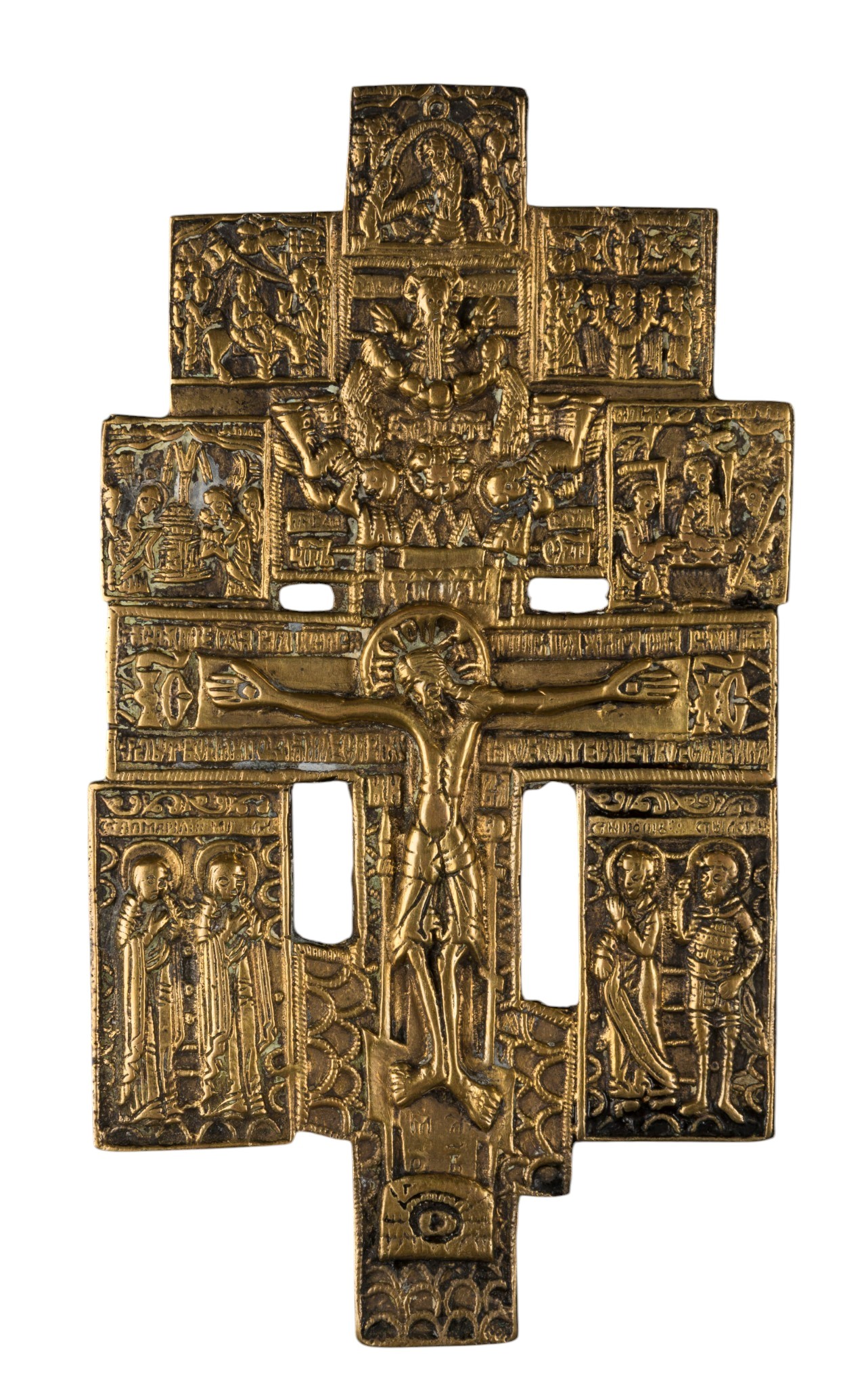
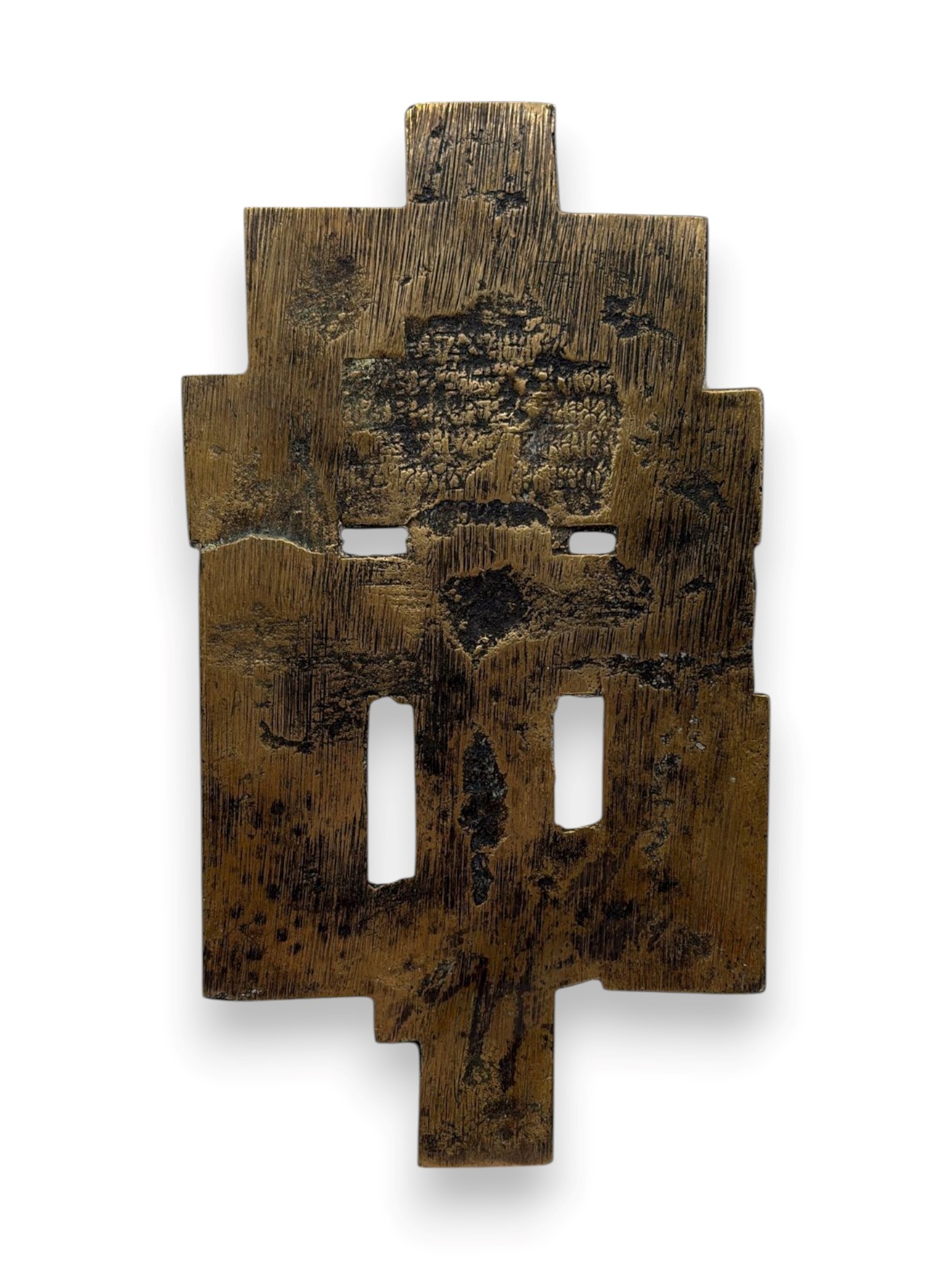
Kiot cross, 19th century
Bronze casting
Height × width: 17 × 10 cm Weight: 263.1 g.
The artwork features the canonical structure of the Russian eight-pointed cross, with three crossbeams, where the slanted lower arm serves as a symbolic suppedaneum. At the center is the depiction of the Crucifixion, while the upper section features the dove of the Holy Spirit, flanked by two flying angels. Above them, Christ emerges from the clouds, creating a symbolic vertical axis that unites Father, Holy Spirit, and Son. At the base of the cross, a skull is visible, representing Golgotha, which recalls the site of Christ's death and the victory over death through the resurrection. At the foot of the cross, the Calvary scene is completed by the four canonical witness figures: on the left, the Virgin Mary accompanied by Saint Mary of Clopas, while on the right stand Saint John the Evangelist and the Centurion Longinus, identifiable by his Roman armor. The decorative program expands above the main arm of the cross into four lateral panels. On the left side, the upper register depicts the Entry of Christ into Jerusalem, followed below by the Presentation of Jesus at the Temple. On the right side, the mirrored composition presents the Ascension of Christ, depicted within a clipeus supported by angels above the Virgin and the Apostles, and an exceptional panel dedicated to the Holy Fathers of Russian Monasticism. This last panel is a rare and significant iconographic variant, highlighting the three pillars of Northern spirituality: Saint Barlaam of Khutyn, depicted with the symbolic axe of his hermitic work in the forests of Novgorod; Saint Sergius of Radonezh, with a blossoming staff sprouting leaves as a symbol of spiritual renewal; and Saint Anthony or Theodosius of Pečers’ka, with the abbatial staff of the pilgrim. Crowning the composition, above the figure of the Pantocrator, is the scene of the Descent into Hell (Anastasis), where Christ breaks open the gates of Hades to draw Adam and Eve to Himself. The composition reaches its zenith at the top with the depiction of the six-winged Seraphim, sealing the work and symbolizing the threshold of Divine Glory. These objects, generally small in size, were intended for private devotion. Such artifacts were generally small in size and intended for private devotion. Their portability allowed them to be easily carried and, if necessary, hidden, thus meeting the religious needs of a community that, after the schism known as the Raskol, endured periods of persecution by the official Russian Orthodox Church.
€ 250,00 / 300,00
Estimate
60,00 €
Starting price
€
Your bid
(The reserve price has not been exceeded)
(The reserve price has been exceeded)
Set your maximum bid
Live auction 396
OLD ORTHODOX ICONS FROM 17TH UNTIL 20TH CENTURY. Including a collection of important Traveling Russian Icons
Palazzo Caetani Lovatelli, tue 29 September 2026
SINGLE SESSION 29/09/2026 Hours 15:00
Discover Similar Lots
ANCIENT FURNITURE AND WORKS OF ART FROM [..]
Lot 37
Pair of Angels Holding Candles
ANCIENT FURNITURE AND WORKS OF ART FROM [..]
Lot 140
A pair of marble columns with gilded bronze angels
ANCIENT FURNITURE AND WORKS OF ART FROM [..]
Lot 172
Polychrome terracotta sculpture
ART AND ARTISTS' BOOKS FROM THE MARIO PADOVAN'S [..]
Lot 26
Schifano e ricerche contemporanee (4 volumi)
ANCIENT FURNITURE AND WORKS OF ART FROM [..]
Lot 196
JEAN-JOSEPH ROBIN
Black Belgian marble mantel clock
FINE WINES. ICONS FROM FRANCE & ITALY
Lot 121
Saint-Émilion Château Du Calvaire 2003 1 Bot
OLD ORTHODOX ICONS FROM 17TH UNTIL 20TH [..]
Lot 311
Pectoral icon depicting Christ enthroned
ANCIENT FURNITURE AND WORKS OF ART FROM [..]
Lot 51
Provençal Wardrobe
ART AND ARTISTS' BOOKS FROM THE MARIO PADOVAN'S [..]
Lot 400
Baj, Enrico: Senza titolo, Bolaffiarte
OLD ORTHODOX ICONS FROM 17TH UNTIL 20TH [..]
Lot 28