
26
Russian Icon depicting Christ Pantocrator, mid-20th century (circa 1930–1950
tempera on panel
Height x width: 35.5 x 26.5 cm
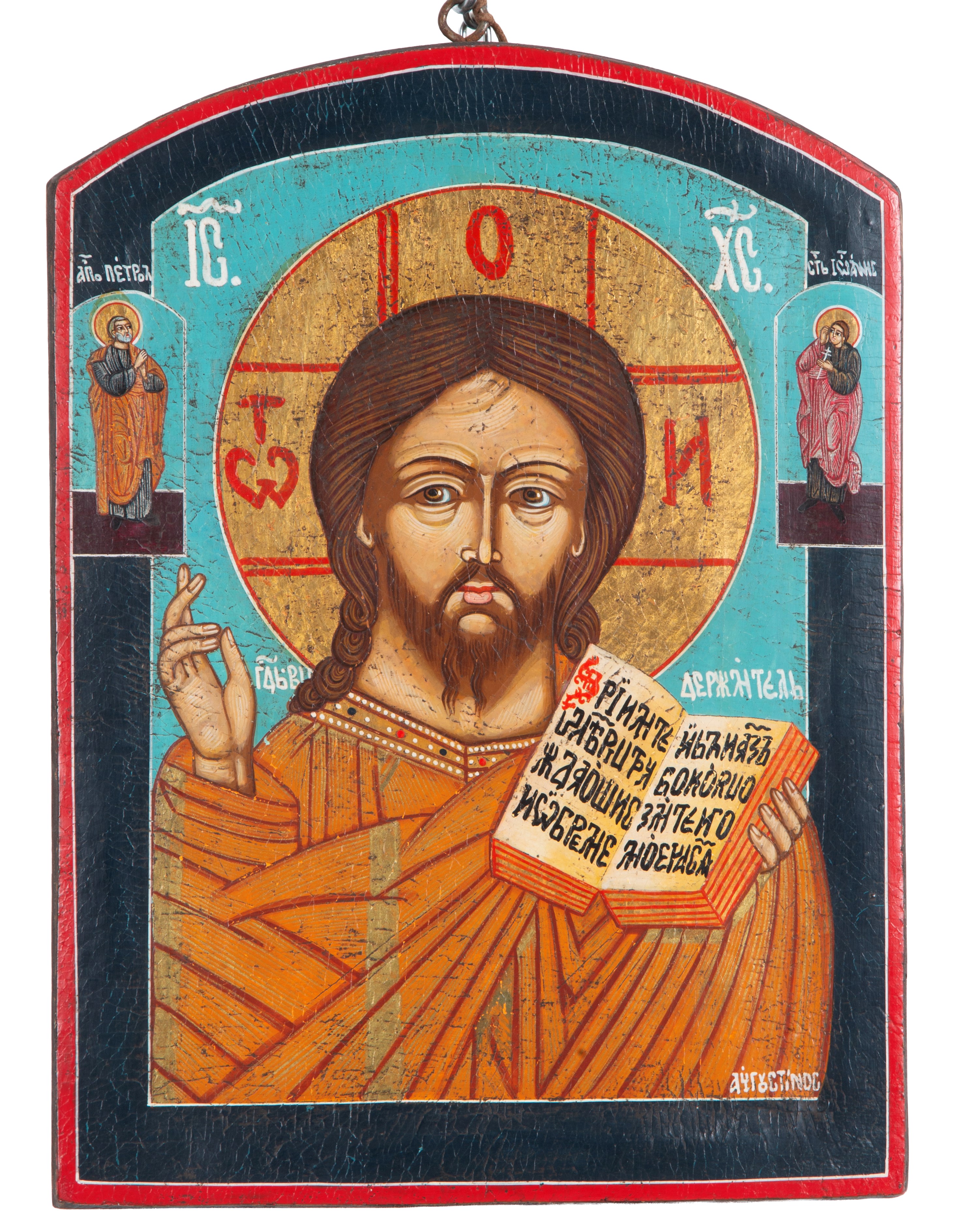
Icon on panel depicting Christ Pantocrator (Christos Pantokrator), one of the most solemn and iconic images of the Orthodox tradition, in which Christ is represented as the Lord of the Universe, Judge, and Savior of humankind.
The composition presents the Redeemer in a half-length frontal pose, with a perfectly symmetrical face and an intense gaze directed toward the viewer. His right hand is raised in the traditional gesture of blessing according to the Eastern rite, while his left hand holds an open Gospel bearing an inscription in Church Slavonic taken from the Gospel text.
The cruciform halo is executed in gold leaf and bears the traditional Greek letters Ὁ ὬΝ ("He Who Is"), while the abbreviations IC XC, identifying the name of Jesus Christ, appear on either side of His head. His garments, consisting of an ochre-gold tunic and an himation modelled with delicate linear highlights, reflect the pictorial tradition of the ancient-inspired Russian icon schools.
Flanking the central figure are two standing saints: Saint Peter the Apostle on the left and Saint John the Evangelist on the right, depicted as witnesses to the Gospel revelation and to the divine nature of Christ.
The deep blue background creates a striking chromatic contrast with the gilded halo and the warm tones of Christ's garments, while the broad black border outlined in red lends balance and monumentality to the overall composition. In the lower right corner appears the signature "Augustinou," likely referring to the iconographer or the workshop responsible for the execution of the icon.
The iconography of Christ Pantocrator has been the central subject of Byzantine and Orthodox sacred art since the sixth century, becoming the most widespread devotional image in icons intended both for ecclesiastical settings and for private worship.
Based on its stylistic characteristics, compositional design, and execution technique, the present icon can be attributed to a 20th-century production, created according to the models of the Russian iconographic tradition while employing a more modern and simplified pictorial language.
The composition presents the Redeemer in a half-length frontal pose, with a perfectly symmetrical face and an intense gaze directed toward the viewer. His right hand is raised in the traditional gesture of blessing according to the Eastern rite, while his left hand holds an open Gospel bearing an inscription in Church Slavonic taken from the Gospel text.
The cruciform halo is executed in gold leaf and bears the traditional Greek letters Ὁ ὬΝ ("He Who Is"), while the abbreviations IC XC, identifying the name of Jesus Christ, appear on either side of His head. His garments, consisting of an ochre-gold tunic and an himation modelled with delicate linear highlights, reflect the pictorial tradition of the ancient-inspired Russian icon schools.
Flanking the central figure are two standing saints: Saint Peter the Apostle on the left and Saint John the Evangelist on the right, depicted as witnesses to the Gospel revelation and to the divine nature of Christ.
The deep blue background creates a striking chromatic contrast with the gilded halo and the warm tones of Christ's garments, while the broad black border outlined in red lends balance and monumentality to the overall composition. In the lower right corner appears the signature "Augustinou," likely referring to the iconographer or the workshop responsible for the execution of the icon.
The iconography of Christ Pantocrator has been the central subject of Byzantine and Orthodox sacred art since the sixth century, becoming the most widespread devotional image in icons intended both for ecclesiastical settings and for private worship.
Based on its stylistic characteristics, compositional design, and execution technique, the present icon can be attributed to a 20th-century production, created according to the models of the Russian iconographic tradition while employing a more modern and simplified pictorial language.
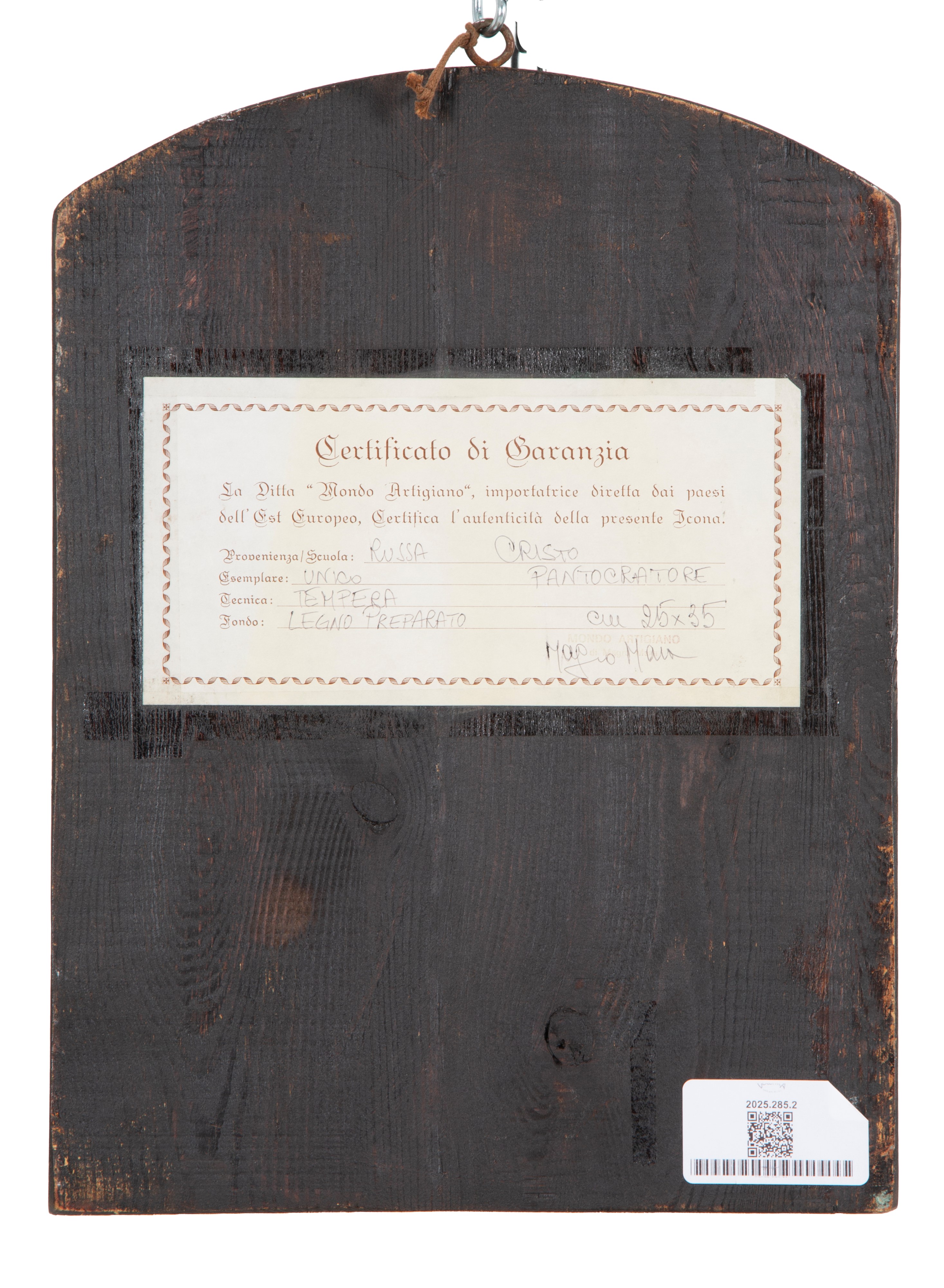
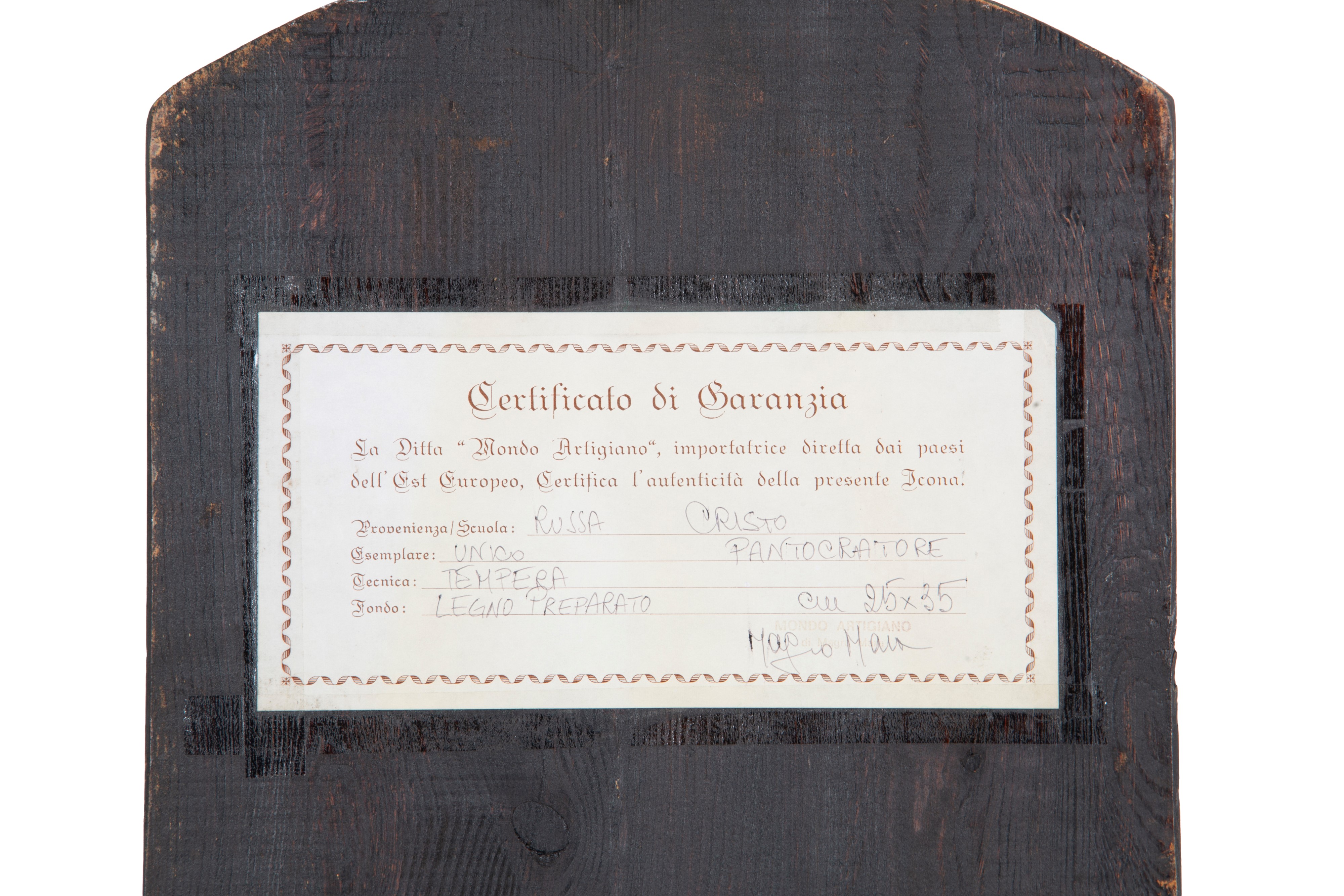
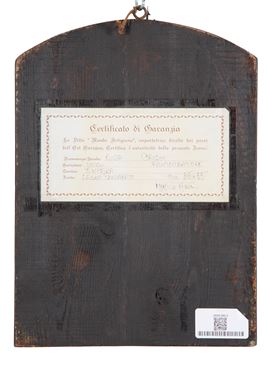
The reverse bears an importer's certificate of authenticity relating to the icon, together with normal signs of age and use.
€ 350,00 / 400,00
Estimate
260,00 €
Starting price
€
Your bid
(The reserve price has not been exceeded)
(The reserve price has been exceeded)
Set your maximum bid
Live auction 396
OLD ORTHODOX ICONS FROM 17TH UNTIL 20TH CENTURY. Including a collection of important Traveling Russian Icons
Palazzo Caetani Lovatelli, tue 29 September 2026
SINGLE SESSION 29/09/2026 Hours 15:00
Discover Similar Lots
OLD ORTHODOX ICONS FROM 17TH UNTIL 20TH [..]
Lot 28
Russian Icon depicting the Holy Martyrs of Edessa (Gurias, Samonas, and Abibus) with Saint Euphemia
OLD ORTHODOX ICONS FROM 17TH UNTIL 20TH [..]
Lot 93
Travel icon depicting an expanded Deesis
OLD ORTHODOX ICONS FROM 17TH UNTIL 20TH [..]
Lot 58
ALEXANDER PANFILOV
Russian icon depicting Christ Pantocrator with silver riza
OLD ORTHODOX ICONS FROM 17TH UNTIL 20TH [..]
Lot 2
Russian Icon depicting the Mother of God Feodorovskaya
OLD ORTHODOX ICONS FROM 17TH UNTIL 20TH [..]
Lot 34
Russian Icon depicting Saints Cosmas, Damian and Panteleimon, the Holy Unmercenary Healers
OLD ORTHODOX ICONS FROM 17TH UNTIL 20TH [..]
Lot 31
Russian Icon depicting Saint John the Evangelist
OLD ORTHODOX ICONS FROM 17TH UNTIL 20TH [..]
Lot 72
Travel icon depicting the expanded Deesis
OLD ORTHODOX ICONS FROM 17TH UNTIL 20TH [..]
Lot 244
Travel icon depicting the expanded Deesis
OLD ORTHODOX ICONS FROM 17TH UNTIL 20TH [..]
Lot 257
Travel icon depicting the expanded Deesis
OLD ORTHODOX ICONS FROM 17TH UNTIL 20TH [..]
Lot 210