
50
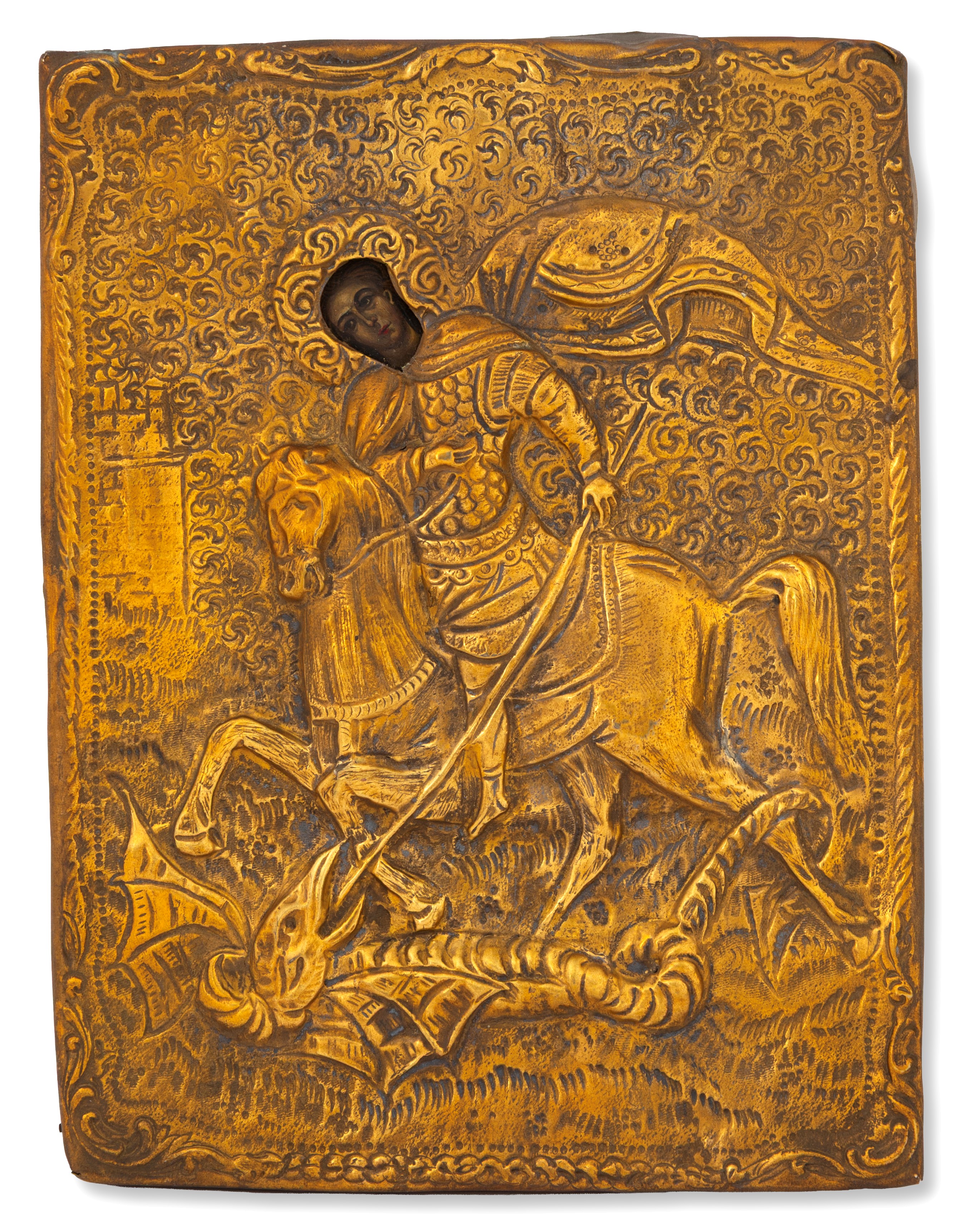
Russian icon depicting St George slaying the dragon with riza, second half of the 19th century (around 1860–1890)
tempera on panel with gilded riza
Height x width: 23,5 x 18 cm
The icon on panel depicts Saint George the Great Martyr in the episode of his victory over the dragon, one of the most widespread and venerated subjects in the Orthodox tradition.
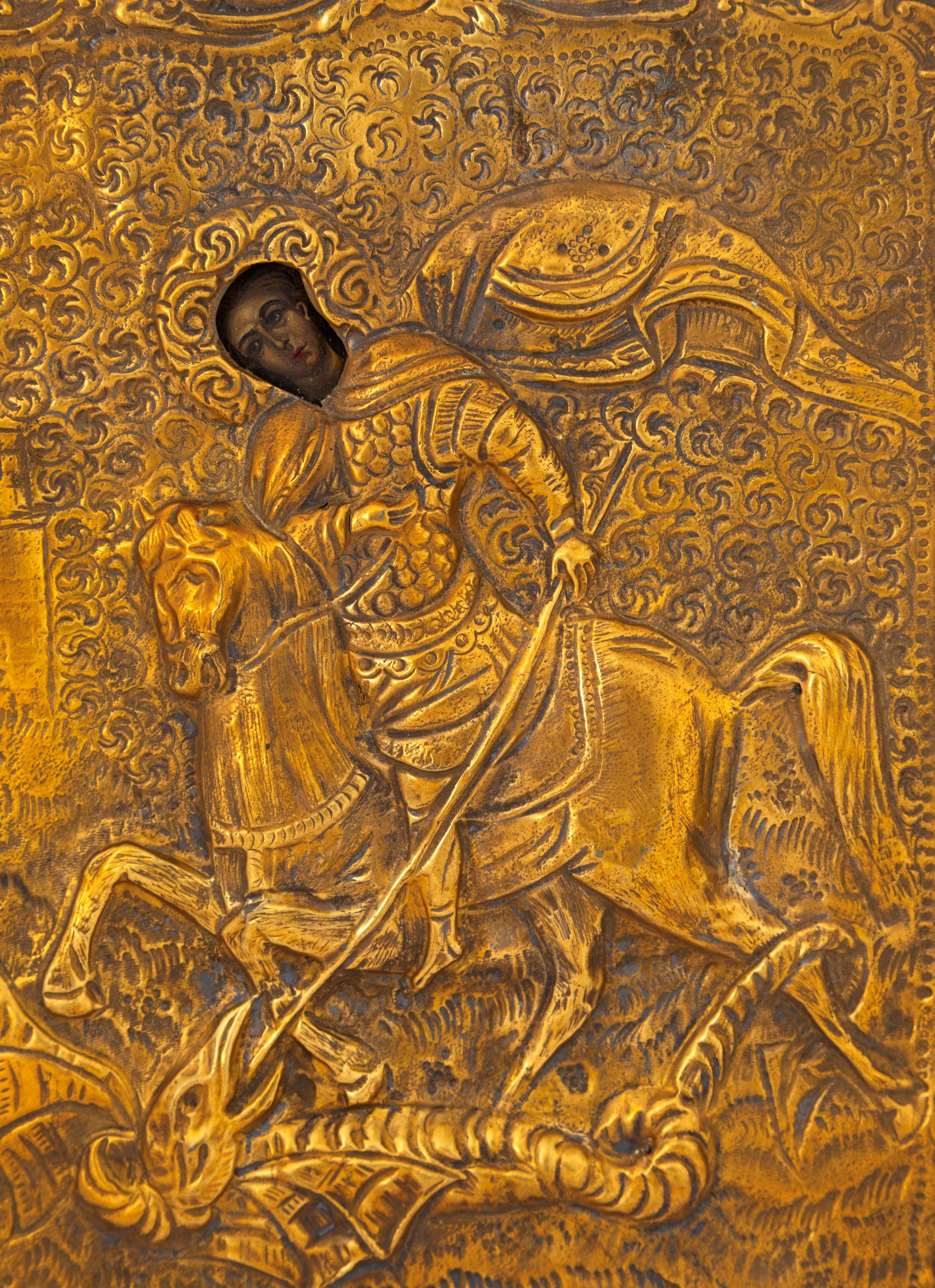
The saint is portrayed on horseback, charging forward as he pierces the dragon with a long lance. The white horse, depicted in full motion, enhances the dynamic quality of the composition, while the saint's flowing cloak billows gracefully behind him. In the background appears a fortified tower from which, according to the traditional hagiographic narrative, the princess destined for sacrifice witnesses the miraculous event.
The icon is covered with a gilded brass riza, entirely repoussé and chased with a dense ornamental pattern of scrolling foliate motifs that conceals almost the entire painted surface. Only the saint's face and part of the landscape remain visible, in accordance with a typology widely emplyed in nineteenth-century Russian devotional icons.
The riza is richly and continuously decorated, featuring a finely punched ground with stylized foliate scrolls and a raised border embellished with vegetal ornament. The skilful modelling of the horse, the saint's armour, and the dragon reflects a competent level of craftsmanship.
The composition derives from the traditional iconography of Saint George Slaying the Dragon, which became firmly established in Russia from the sixteenth century onward and remained substantially unchanged throughout the nineteenth century.
The characteristics of the riza—executed in gilded brass with an uninterrupted scrolling foliate decoration, lacking visible silver hallmarks, and displaying a serial yet carefully executed workmanship—are entirely consistent with the production of Russian workshops during the second half of the nineteenth century. The painted face, still visible through the opening of the metal cover, exhibits the stylistic features characteristic of Russian devotional painting of the period.
The saint is portrayed on horseback, charging forward as he pierces the dragon with a long lance. The white horse, depicted in full motion, enhances the dynamic quality of the composition, while the saint's flowing cloak billows gracefully behind him. In the background appears a fortified tower from which, according to the traditional hagiographic narrative, the princess destined for sacrifice witnesses the miraculous event.
The icon is covered with a gilded brass riza, entirely repoussé and chased with a dense ornamental pattern of scrolling foliate motifs that conceals almost the entire painted surface. Only the saint's face and part of the landscape remain visible, in accordance with a typology widely emplyed in nineteenth-century Russian devotional icons.
The riza is richly and continuously decorated, featuring a finely punched ground with stylized foliate scrolls and a raised border embellished with vegetal ornament. The skilful modelling of the horse, the saint's armour, and the dragon reflects a competent level of craftsmanship.
The composition derives from the traditional iconography of Saint George Slaying the Dragon, which became firmly established in Russia from the sixteenth century onward and remained substantially unchanged throughout the nineteenth century.
The characteristics of the riza—executed in gilded brass with an uninterrupted scrolling foliate decoration, lacking visible silver hallmarks, and displaying a serial yet carefully executed workmanship—are entirely consistent with the production of Russian workshops during the second half of the nineteenth century. The painted face, still visible through the opening of the metal cover, exhibits the stylistic features characteristic of Russian devotional painting of the period.
€ 500,00 / 700,00
Estimate
320,00 €
Starting price
€
Your bid
(The reserve price has not been exceeded)
(The reserve price has been exceeded)
Set your maximum bid
Live auction 396
OLD ORTHODOX ICONS FROM 17TH UNTIL 20TH CENTURY. Including a collection of important Traveling Russian Icons
Palazzo Caetani Lovatelli, tue 29 September 2026
SINGLE SESSION 29/09/2026 Hours 15:00
Discover Similar Lots
OLD ORTHODOX ICONS FROM 17TH UNTIL 20TH [..]
Lot 136
Travel icon depicting Saint George
OLD ORTHODOX ICONS FROM 17TH UNTIL 20TH [..]
Lot 27
Russian Icon depicting the Mother of God of the Passion (Strastnaja)
OLD ORTHODOX ICONS FROM 17TH UNTIL 20TH [..]
Lot 187
Travel icon depicting Saint George and the Deesis
OLD ORTHODOX ICONS FROM 17TH UNTIL 20TH [..]
Lot 24
A four-panel Russian icon depicting the crucifixion of Christ and the Holy Protectors
OLD ORTHODOX ICONS FROM 17TH UNTIL 20TH [..]
Lot 53
Russian Icon Depicting the Mother of God of Iver with a Silver Riza
OLD ORTHODOX ICONS FROM 17TH UNTIL 20TH [..]
Lot 30
Russian icon depicting the Mother of God of Tikhvin
OLD ORTHODOX ICONS FROM 17TH UNTIL 20TH [..]
Lot 34
Russian Icon depicting Saints Cosmas, Damian and Panteleimon, the Holy Unmercenary Healers
OLD ORTHODOX ICONS FROM 17TH UNTIL 20TH [..]
Lot 32
Russian Icon depicting an Archangel and Saints
OLD ORTHODOX ICONS FROM 17TH UNTIL 20TH [..]
Lot 21
Russian Icon depicting the Crucifixion of Christ with the Kazan Mother of God, Saint Nicholas the Wonderworker [..]
OLD ORTHODOX ICONS FROM 17TH UNTIL 20TH [..]
Lot 125