
21
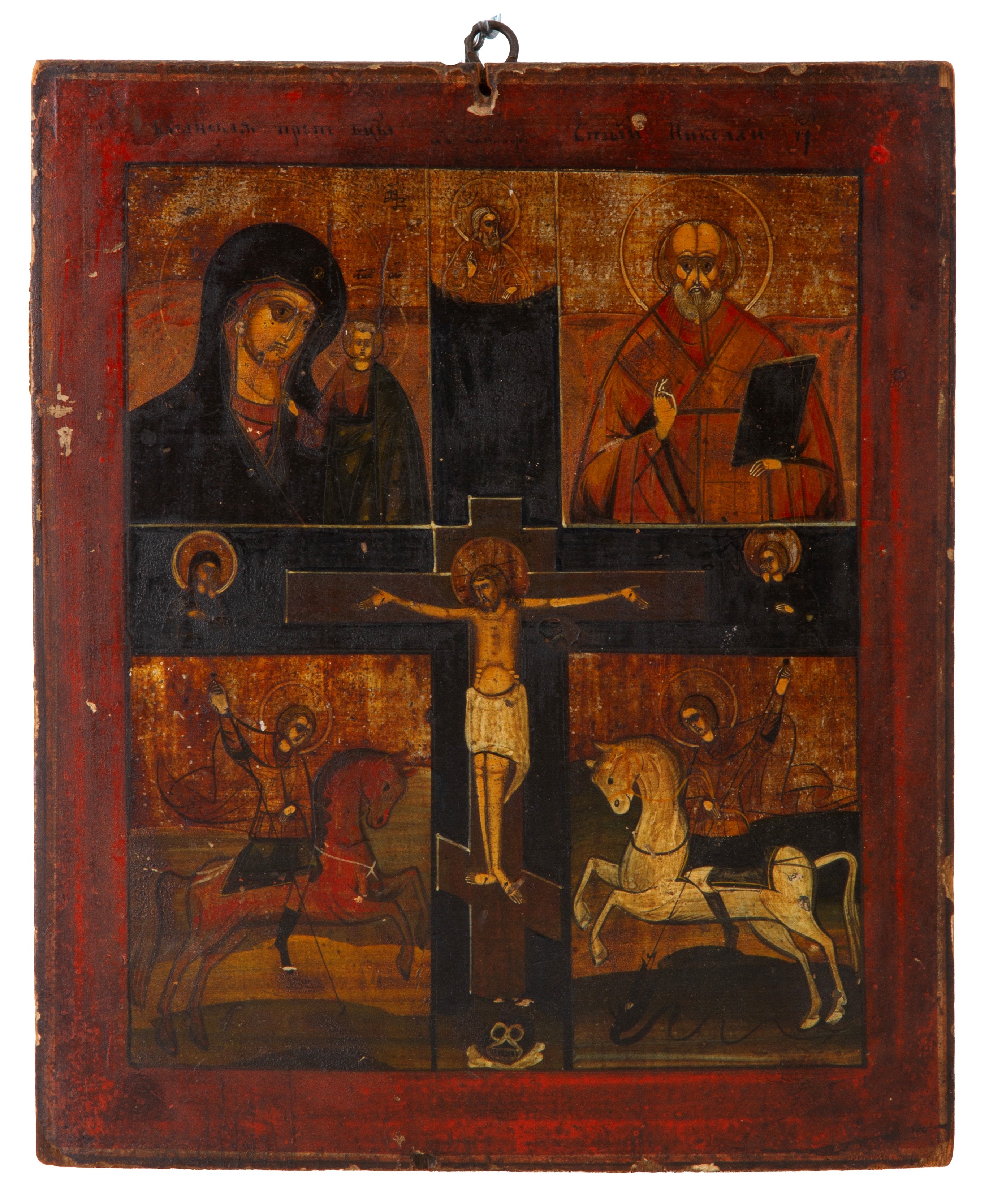
Russian Icon depicting the Crucifixion of Christ with the Kazan Mother of God, Saint Nicholas the Wonderworker and Saint Floro and Saint Lauro, early 19th century
Tempera on panel
Height x width: 36,5 x 30 cm
Icon depicting the Crucifixion of Christ, the central subject of the composition, accompanied by a complex devotional program including the Kazan Mother of God, Saint Nicholas the Wonderworker, and two mounted warrior saints, most likely Saint George and Saint Demetrius, all of whom were especially venerated within the Russian Orthodox tradition.
The composition is arranged according to a quadripartite scheme dominated by the large wooden cross at the center, upon which Christ is depicted dead, with His head inclined and His body gracefully modeled in accordance with the Byzantine iconographic tradition. Flanking the cross are the Mother of God and Saint John the Evangelist, portrayed in attitudes of sorrowful contemplation following the traditional iconography of the Crucifixion.
In the upper left register appears the Kazan Mother of God, represented half-length with the Christ Child, one of the most revered Marian images of Imperial Russia. Opposite her is Saint Nicholas the Wonderworker, depicted in episcopal vestments, blessing with his right hand while holding the Gospel in his left. Between these two principal figures is a small image of the Mother of God set within a niche, further emphasizing the devotional character of the composition.
The lower register depicts two mounted warrior saints armed with lances, most likely identifiable as Saint George and Saint Demetrius, shown riding horses of different colors according to an iconographic scheme widely employed in Russian productions of the eighteenth and nineteenth centuries. Their presence alongside the Crucifixion and the figures of the Virgin and Saint Nicholas underscores the protective function of the icon, intended for private devotion.
The gilded background and broad red border, together with the restrained composition and identifying Slavonic inscriptions, reflect the tradition of provincial Russian icon painting, distinguished by its sober yet profoundly symbolic visual language.
This type of composite icon enjoyed widespread popularity throughout central Russia between the late eighteenth and the first half of the nineteenth century. By uniting the principal subjects of popular devotion within a single panel, it enabled the faithful to invoke in one image the protection of the Crucified Christ, the Mother of God, and the saints most frequently called upon in everyday life.
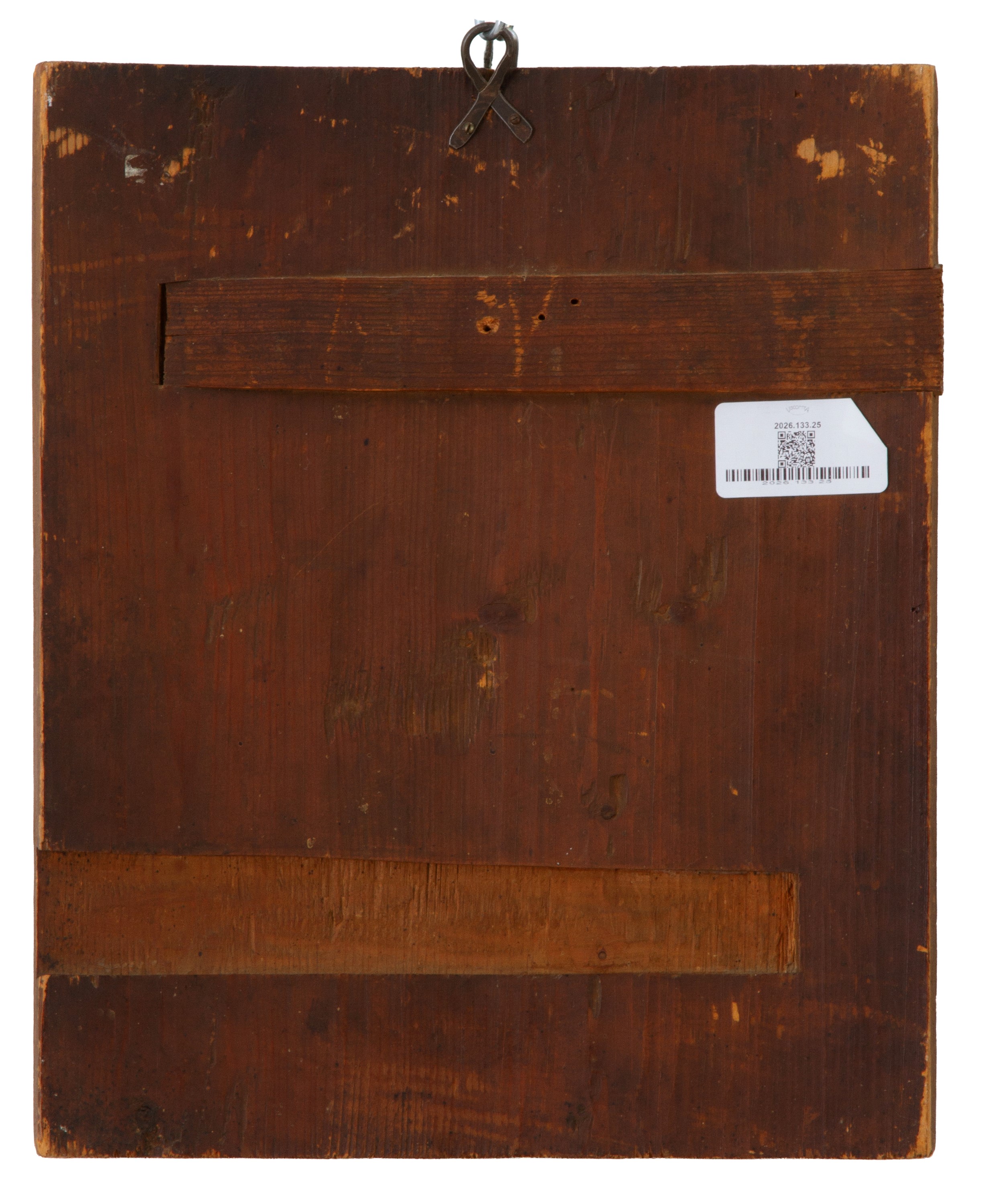
On the basis of its stylistic characteristics, painting technique, iconographic arrangement, and the construction of the wooden support, the present work may be attributed to a Russian workshop active between the late eighteenth and the early nineteenth century.
The composition is arranged according to a quadripartite scheme dominated by the large wooden cross at the center, upon which Christ is depicted dead, with His head inclined and His body gracefully modeled in accordance with the Byzantine iconographic tradition. Flanking the cross are the Mother of God and Saint John the Evangelist, portrayed in attitudes of sorrowful contemplation following the traditional iconography of the Crucifixion.
In the upper left register appears the Kazan Mother of God, represented half-length with the Christ Child, one of the most revered Marian images of Imperial Russia. Opposite her is Saint Nicholas the Wonderworker, depicted in episcopal vestments, blessing with his right hand while holding the Gospel in his left. Between these two principal figures is a small image of the Mother of God set within a niche, further emphasizing the devotional character of the composition.
The lower register depicts two mounted warrior saints armed with lances, most likely identifiable as Saint George and Saint Demetrius, shown riding horses of different colors according to an iconographic scheme widely employed in Russian productions of the eighteenth and nineteenth centuries. Their presence alongside the Crucifixion and the figures of the Virgin and Saint Nicholas underscores the protective function of the icon, intended for private devotion.
The gilded background and broad red border, together with the restrained composition and identifying Slavonic inscriptions, reflect the tradition of provincial Russian icon painting, distinguished by its sober yet profoundly symbolic visual language.
This type of composite icon enjoyed widespread popularity throughout central Russia between the late eighteenth and the first half of the nineteenth century. By uniting the principal subjects of popular devotion within a single panel, it enabled the faithful to invoke in one image the protection of the Crucified Christ, the Mother of God, and the saints most frequently called upon in everyday life.
On the basis of its stylistic characteristics, painting technique, iconographic arrangement, and the construction of the wooden support, the present work may be attributed to a Russian workshop active between the late eighteenth and the early nineteenth century.
€ 500,00 / 700,00
Estimate
280,00 €
Starting price
€
Your bid
(The reserve price has not been exceeded)
(The reserve price has been exceeded)
Set your maximum bid
Live auction 396
OLD ORTHODOX ICONS FROM 17TH UNTIL 20TH CENTURY. Including a collection of important Traveling Russian Icons
Palazzo Caetani Lovatelli, tue 29 September 2026
SINGLE SESSION 29/09/2026 Hours 15:00
Discover Similar Lots
OLD ORTHODOX ICONS FROM 17TH UNTIL 20TH [..]
Lot 16
Russian Icon Depicting the Descent into Hades
OLD ORTHODOX ICONS FROM 17TH UNTIL 20TH [..]
Lot 5
Russian Icon Depicting the Twelve Great Feasts with the Resurrection of Christ and the Anastasis at [..]
OLD ORTHODOX ICONS FROM 17TH UNTIL 20TH [..]
Lot 56
Russian Icon Depicting Saint Nicholas the Wonderworker with a Riza
OLD ORTHODOX ICONS FROM 17TH UNTIL 20TH [..]
Lot 20
Russian Icon depicting the Mother of God Comfort of the Afflicted
OLD ORTHODOX ICONS FROM 17TH UNTIL 20TH [..]
Lot 1
Russian icon depicting the Ascension of the Prophet Elijah
OLD ORTHODOX ICONS FROM 17TH UNTIL 20TH [..]
Lot 50
Russian icon depicting St George slaying the dragon with riza
OLD ORTHODOX ICONS FROM 17TH UNTIL 20TH [..]
Lot 18
Russian four-panel icon depicting the Mother of God of Kazan, Saint Nicholas the Wonderworker, and the [..]
OLD ORTHODOX ICONS FROM 17TH UNTIL 20TH [..]
Lot 17
Russian icon depicting Saints Peter and Paul, the Apostles
OLD ORTHODOX ICONS FROM 17TH UNTIL 20TH [..]
Lot 22
Russian Icon depicting the Holy Trinity
OLD ORTHODOX ICONS FROM 17TH UNTIL 20TH [..]
Lot 13