
16
Russian Icon Depicting the Descent into Hades, late 19th century (circa 1880–1900)
tempera on panel
Height x width: 31 x 25.5 cm
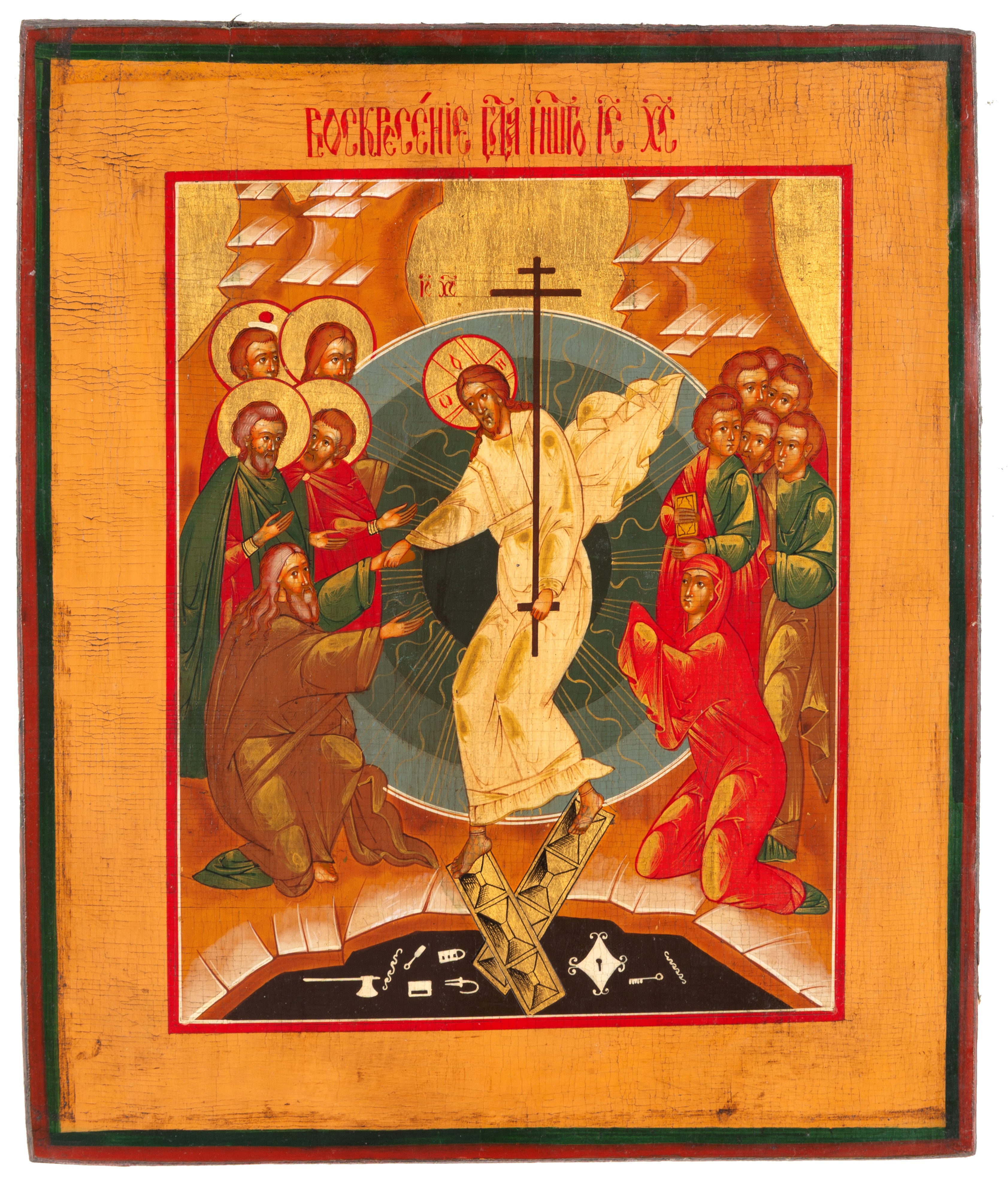
Icon painted on a wooden panel depicting the Descent into Hades (Anastasis), traditionally regarded in the Orthodox Church as the Resurrection of Christ, one of the most important and solemn representations of the Paschal cycle.
The composition portrays the triumphant Christ who, following the Crucifixion, descends into the realm of the dead to liberate humanity from the bondage of death. At the centre of the scene, Christ, clothed in a radiant white garment, emerges within a large blue-grey mandorla illuminated by delicate rays of divine light. With His right hand He firmly grasps Adam, kneeling at His left, while with His left He holds the long processional cross, the symbol of His victory over death and sin.
At the Saviour's feet lie the shattered bronze gates of Hades, depicted diagonally beneath Him together with broken locks, keys, hinges, and chains scattered across the dark abyss, in accordance with the traditional Byzantine and Russian iconography symbolizing the definitive triumph over death and the underworld.
To Christ's left appears the assembly of the Righteous of the Old Testament, led by Adam and accompanied by numerous patriarchs, kings, and prophets, identifiable through their traditional physiognomies and gilded halos. On the opposite side stands a second group of saints and patriarchs gathered in reverence as they witness the triumph of the Redeemer.
In the foreground, Eve is shown kneeling at Christ's feet, wearing the traditional red maphorion as she receives salvation. The two groups of figures converge harmoniously towards the Risen Christ, emphasizing the universal significance of Redemption.
The background is dominated by high stylized rocky cliffs symbolically defining the entrance to Hades. The extensive use of gold leaf lends exceptional luminosity to the composition, enhancing the contrast between the deep central mandorla and the vibrant red, green, and ochre tones of the surrounding figures.
The Church Slavonic inscription at the top clearly identifies the subject as the "Resurrection of Our Lord Jesus Christ," according to the traditional Orthodox liturgical designation.
The iconography of the Descent into Hades (Anastasis) constitutes the principal representation of the Resurrection in the Byzantine and Russian traditions, differing fundamentally from the Western depiction of the Resurrection showing Christ emerging from the tomb.
Between the second half of the nineteenth century and the early twentieth century, the principal workshops of Moscow, Mstëra, Palekh, and Kholuy produced numerous icons intended for private devotion, distinguished by a conscious revival of seventeenth-century Russian iconographic traditions, reinterpreted through a more refined and academic pictorial language.
The composition portrays the triumphant Christ who, following the Crucifixion, descends into the realm of the dead to liberate humanity from the bondage of death. At the centre of the scene, Christ, clothed in a radiant white garment, emerges within a large blue-grey mandorla illuminated by delicate rays of divine light. With His right hand He firmly grasps Adam, kneeling at His left, while with His left He holds the long processional cross, the symbol of His victory over death and sin.
At the Saviour's feet lie the shattered bronze gates of Hades, depicted diagonally beneath Him together with broken locks, keys, hinges, and chains scattered across the dark abyss, in accordance with the traditional Byzantine and Russian iconography symbolizing the definitive triumph over death and the underworld.
To Christ's left appears the assembly of the Righteous of the Old Testament, led by Adam and accompanied by numerous patriarchs, kings, and prophets, identifiable through their traditional physiognomies and gilded halos. On the opposite side stands a second group of saints and patriarchs gathered in reverence as they witness the triumph of the Redeemer.
In the foreground, Eve is shown kneeling at Christ's feet, wearing the traditional red maphorion as she receives salvation. The two groups of figures converge harmoniously towards the Risen Christ, emphasizing the universal significance of Redemption.
The background is dominated by high stylized rocky cliffs symbolically defining the entrance to Hades. The extensive use of gold leaf lends exceptional luminosity to the composition, enhancing the contrast between the deep central mandorla and the vibrant red, green, and ochre tones of the surrounding figures.
The Church Slavonic inscription at the top clearly identifies the subject as the "Resurrection of Our Lord Jesus Christ," according to the traditional Orthodox liturgical designation.
The iconography of the Descent into Hades (Anastasis) constitutes the principal representation of the Resurrection in the Byzantine and Russian traditions, differing fundamentally from the Western depiction of the Resurrection showing Christ emerging from the tomb.
Between the second half of the nineteenth century and the early twentieth century, the principal workshops of Moscow, Mstëra, Palekh, and Kholuy produced numerous icons intended for private devotion, distinguished by a conscious revival of seventeenth-century Russian iconographic traditions, reinterpreted through a more refined and academic pictorial language.
€ 500,00 / 700,00
Estimate
360,00 €
Starting price
€
Your bid
(The reserve price has not been exceeded)
(The reserve price has been exceeded)
Set your maximum bid
Live auction 396
OLD ORTHODOX ICONS FROM 17TH UNTIL 20TH CENTURY. Including a collection of important Traveling Russian Icons
Palazzo Caetani Lovatelli, tue 29 September 2026
SINGLE SESSION 29/09/2026 Hours 15:00
Discover Similar Lots
OLD ORTHODOX ICONS FROM 17TH UNTIL 20TH [..]
Lot 10
Russian Icon Depicting the Descent into Hades with Feast Scenes, the Mother of God of the Sign and Saint [..]
OLD ORTHODOX ICONS FROM 17TH UNTIL 20TH [..]
Lot 5
Russian Icon Depicting the Twelve Great Feasts with the Resurrection of Christ and the Anastasis at [..]
OLD ORTHODOX ICONS FROM 17TH UNTIL 20TH [..]
Lot 21
Russian Icon depicting the Crucifixion of Christ with the Kazan Mother of God, Saint Nicholas the Wonderworker [..]
OLD ORTHODOX ICONS FROM 17TH UNTIL 20TH [..]
Lot 17
Russian icon depicting Saints Peter and Paul, the Apostles
OLD ORTHODOX ICONS FROM 17TH UNTIL 20TH [..]
Lot 3
Russian Icon with the New Testament Trinity, the Mother of God Joy of All Who Sorrow, Saint George, [..]
OLD ORTHODOX ICONS FROM 17TH UNTIL 20TH [..]
Lot 355
Small travel icon depicting the Virgin of Smolensk
OLD ORTHODOX ICONS FROM 17TH UNTIL 20TH [..]
Lot 39
Russian Icon depicting the Virgin Eleousa with a metal riza
OLD ORTHODOX ICONS FROM 17TH UNTIL 20TH [..]
Lot 23
Russian Icon depicting Christ Pantocrator
OLD ORTHODOX ICONS FROM 17TH UNTIL 20TH [..]
Lot 52
Russian icon depicting the Mother of God “Truly Worthy” with scenes from the lives of Christ and the [..]
OLD ORTHODOX ICONS FROM 17TH UNTIL 20TH [..]
Lot 75