
10
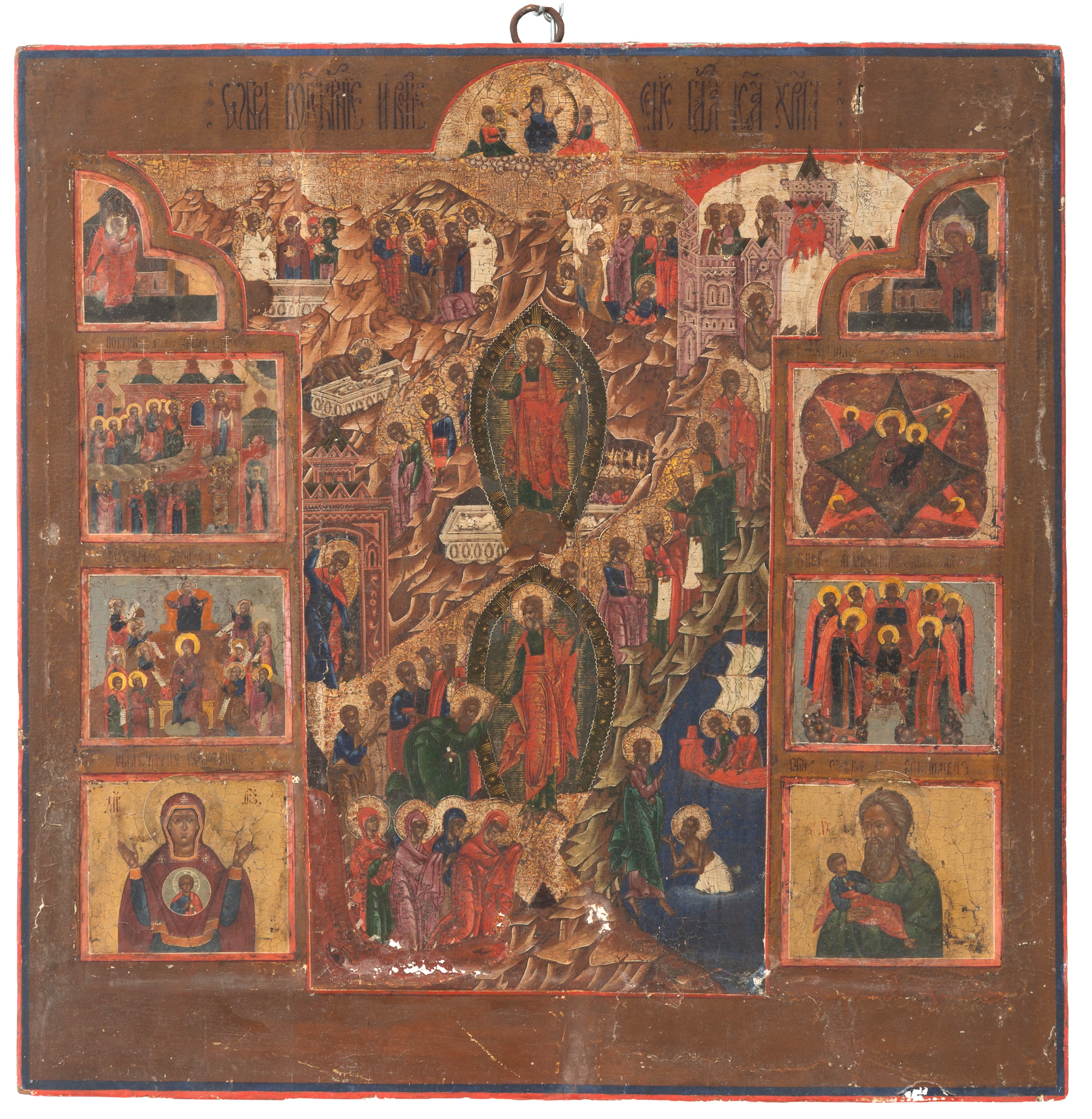
Russian Icon Depicting the Descent into Hades with Feast Scenes, the Mother of God of the Sign and Saint Christopher, late 18th – early 19th century
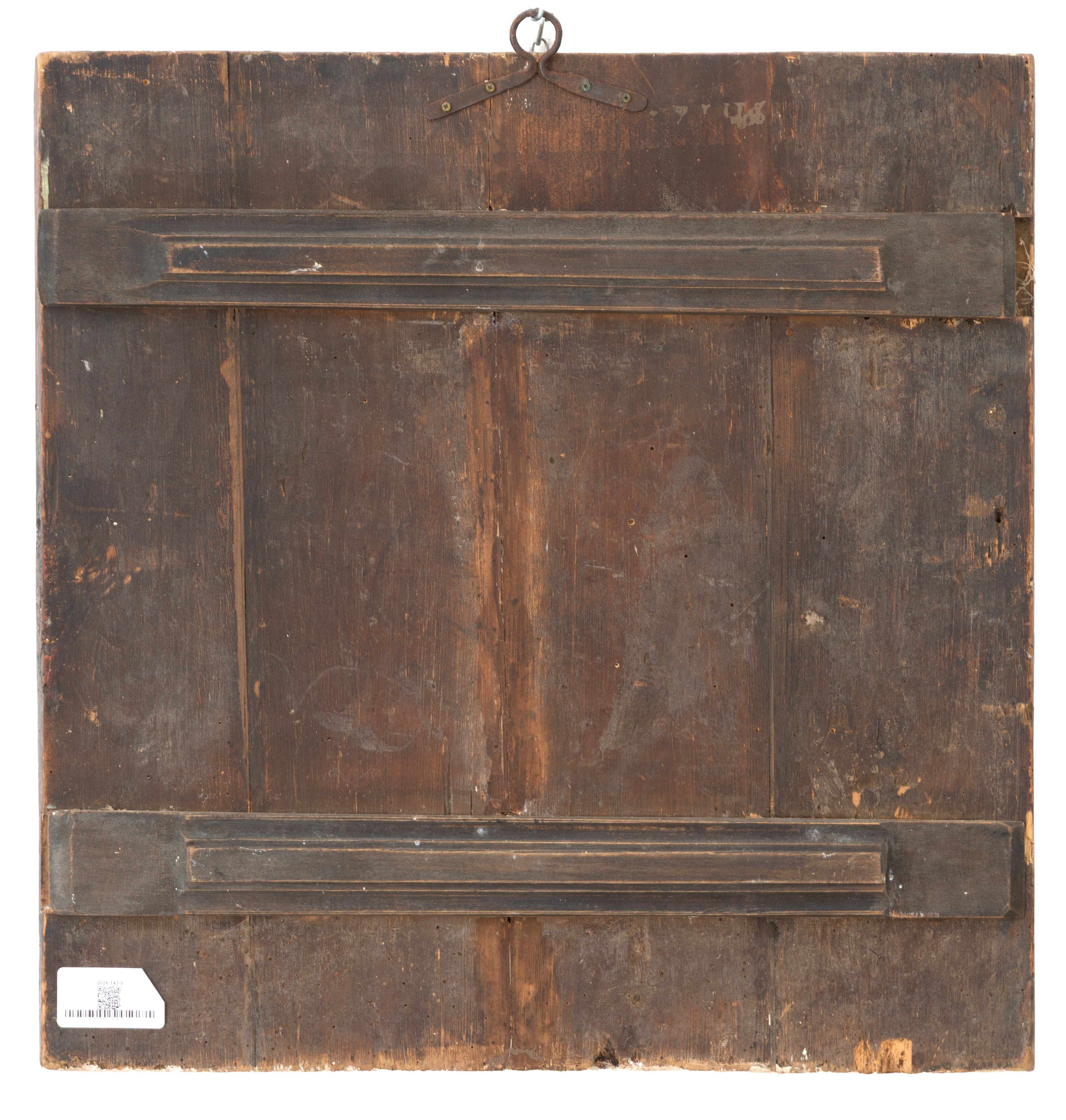
Tempera on panel
Height x width: 54 x 54 cm
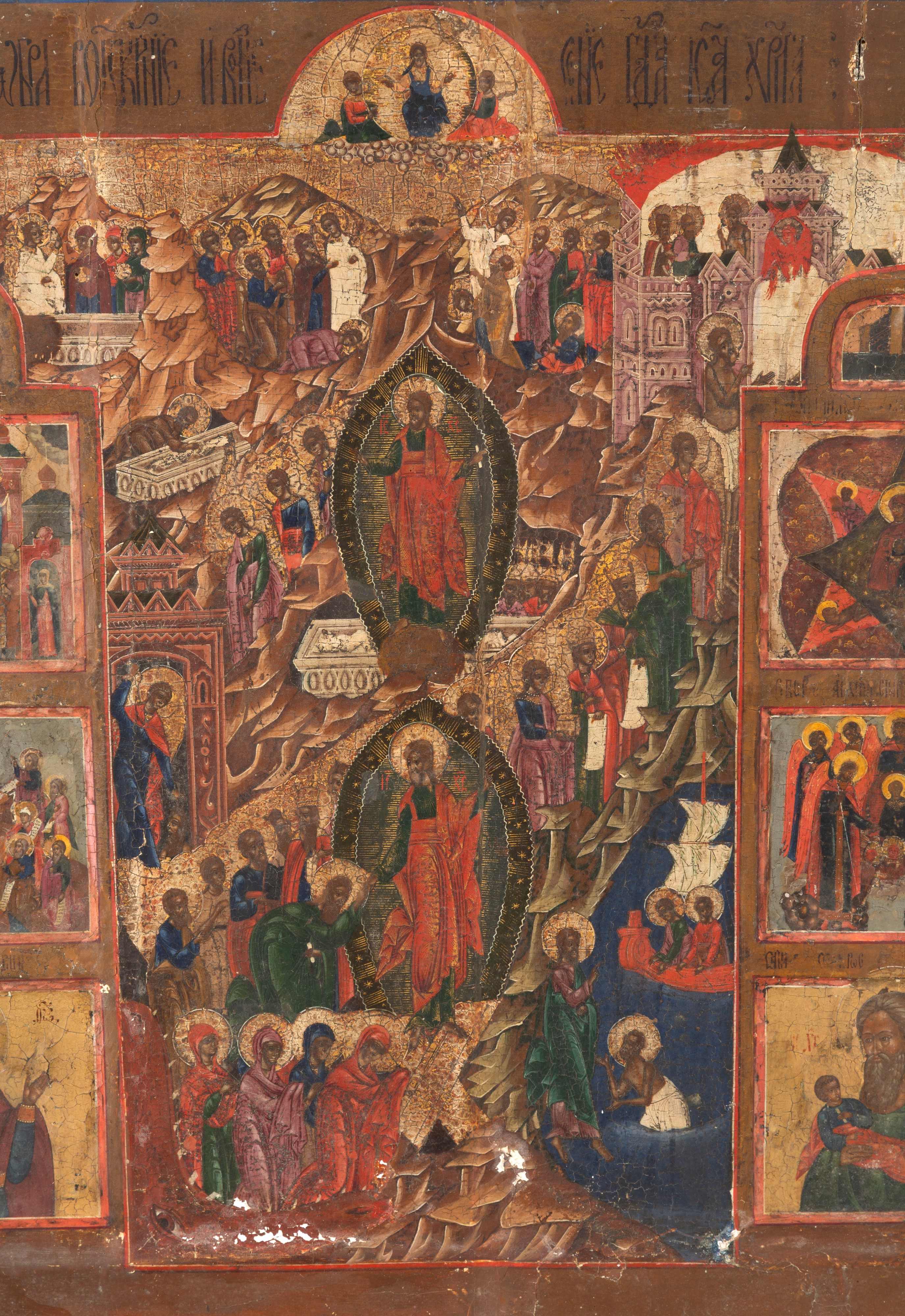
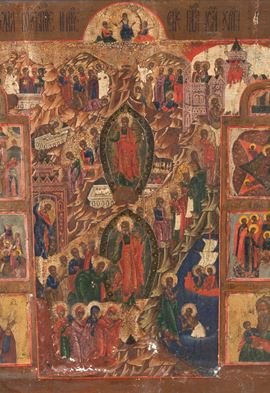
The icon on panel depicts at its centre the Descent into Hades (Anastasis), one of the most solemn and theologically significant subjects in the Orthodox tradition, corresponding to the Western concept of the Resurrection of Christ.
Christ, enveloped in a radiant mandorla, descends into the realm of Hades following the Crucifixion, trampling the shattered gates of the Underworld and delivering the forefathers Adam and Eve, accompanied by the patriarchs, the prophets, and the righteous of the Old Testament. The scene is set within an elaborate rocky landscape that rises vertically and incorporates numerous subsidiary episodes from the Paschal narrative.
The upper register depicts the New Testament Trinity, while the lateral panels contain a series of devotional images, including scenes illustrating the principal liturgical feasts and representations of particularly venerated saints.
The lower register features the Mother of God of the Sign (Znamenie) and Saint Christopher, while the right-hand side includes the Mother of God, Joy of All Who Sorrow, the Vision of the Mother of God of the Burning Bush (Neopalimaya Kupina), and an assembly of angels.
The ensemble forms a complex devotional composition conceived as a visual synthesis of the principal mysteries of the Orthodox faith.
The iconographic scheme belongs to the established tradition of the Anastasis, which developed in Byzantine art and became one of the most widespread subjects in Russian icon painting between the seventeenth and nineteenth centuries.
The figures are characterized by elongated faces, flesh tones modelled through successive highlights, and draperies articulated with delicate gold assist lines, features that are entirely consistent with the production of workshops in Central Russia between the late eighteenth and early nineteenth centuries.
Christ, enveloped in a radiant mandorla, descends into the realm of Hades following the Crucifixion, trampling the shattered gates of the Underworld and delivering the forefathers Adam and Eve, accompanied by the patriarchs, the prophets, and the righteous of the Old Testament. The scene is set within an elaborate rocky landscape that rises vertically and incorporates numerous subsidiary episodes from the Paschal narrative.
The upper register depicts the New Testament Trinity, while the lateral panels contain a series of devotional images, including scenes illustrating the principal liturgical feasts and representations of particularly venerated saints.
The lower register features the Mother of God of the Sign (Znamenie) and Saint Christopher, while the right-hand side includes the Mother of God, Joy of All Who Sorrow, the Vision of the Mother of God of the Burning Bush (Neopalimaya Kupina), and an assembly of angels.
The ensemble forms a complex devotional composition conceived as a visual synthesis of the principal mysteries of the Orthodox faith.
The iconographic scheme belongs to the established tradition of the Anastasis, which developed in Byzantine art and became one of the most widespread subjects in Russian icon painting between the seventeenth and nineteenth centuries.
The figures are characterized by elongated faces, flesh tones modelled through successive highlights, and draperies articulated with delicate gold assist lines, features that are entirely consistent with the production of workshops in Central Russia between the late eighteenth and early nineteenth centuries.
€ 1.500,00 / 2.000,00
Estimate
1.100,00 €
Starting price
€
Your bid
(The reserve price has not been exceeded)
(The reserve price has been exceeded)
Set your maximum bid
Live auction 396
OLD ORTHODOX ICONS FROM 17TH UNTIL 20TH CENTURY. Including a collection of important Traveling Russian Icons
Palazzo Caetani Lovatelli, tue 29 September 2026
SINGLE SESSION 29/09/2026 Hours 15:00
Discover Similar Lots
ART AND ARTISTS' BOOKS FROM THE MARIO PADOVAN'S [..]
Lot 458
Mario Giansone. Composizione con figure
ART AND ARTISTS' BOOKS FROM THE MARIO PADOVAN'S [..]
Lot 347
Maestri italiani del Novecento: Carrà, Donghi e Morandi (3 volumi)
ANCIENT FURNITURE AND WORKS OF ART FROM [..]
Lot 315
Painting: “Earthly Paradise”
ART AND ARTISTS' BOOKS FROM THE MARIO PADOVAN'S [..]
Lot 460
Attribuito a Mario Giansone. Figura maschile reclinata
OLD ORTHODOX ICONS FROM 17TH UNTIL 20TH [..]
Lot 164
Travel icon depicting the Three Holy Hierarchs
ART AND ARTISTS' BOOKS FROM THE MARIO PADOVAN'S [..]
Lot 454
Mario Giansone. Studio di figure
FINE WINES. ICONS FROM FRANCE & ITALY
Lot 277
Chianti Castello Di San Polo In Rosso 1997 3 Bot
FINE WINES. ICONS FROM FRANCE & ITALY
Lot 168
Chablis Henri De Bareuil 2021 6 Bot
ANCIENT FURNITURE AND WORKS OF ART FROM [..]
Lot 35
PIERRE LEDUC
A pair of French Louis XV Armchairs
FINE WINES. ICONS FROM FRANCE & ITALY
Lot 259