
47
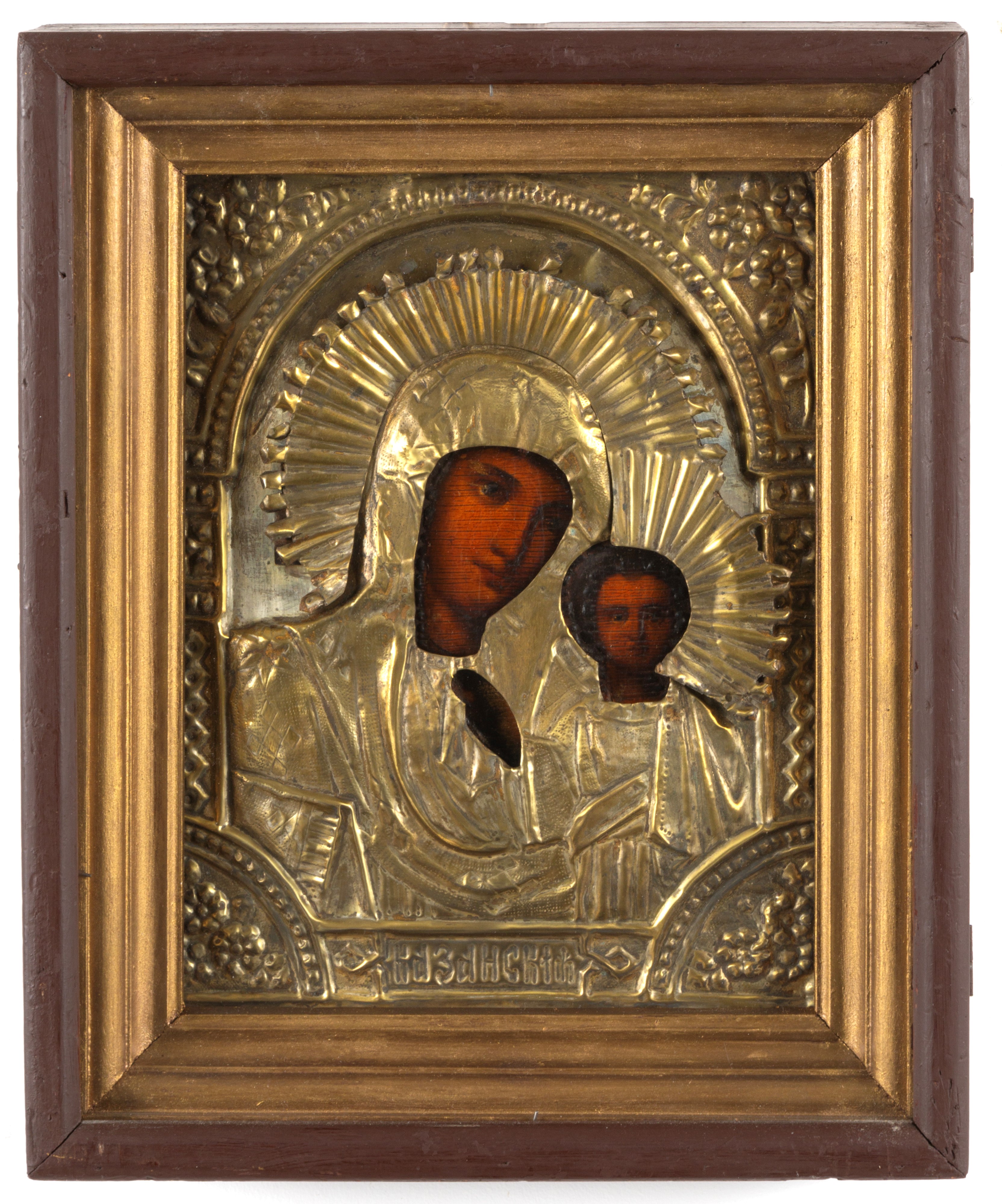
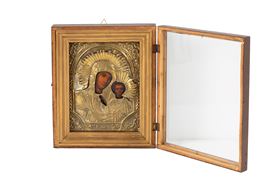
Russian Icon depicting the Mother of God of Kazan with riza, late 19th century (circa 1880–1900)
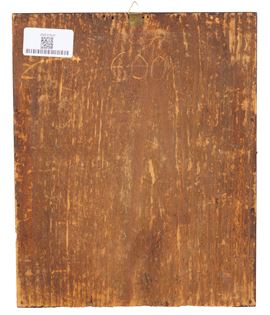
Tempera on panel
Height x width: 34 x 28 cm
Icon on a wooden panel depicting the Mother of God of Kazan (Kazanskaya Bogomater'), one of the most venerated Marian images in the entire Russian Orthodox tradition and regarded, since the seventeenth century, as the principal spiritual protectress of Russia.
The Virgin is represented half-length according to the traditional iconography of the Kazanskaya Bogomater', her head gently inclined towards the Christ Child while her gaze is directed towards the viewer. The Christ Child is depicted frontally, raising His right hand in blessing according to the Eastern rite, while holding the scroll of the Holy Scriptures in His left hand.
The painted surface is almost entirely covered by a finely repoussé and chased silvered brass riza, leaving visible only the faces and portions of the hands of the sacred figures. The Virgin's halo is executed with an elegant radiating pattern formed by deeply embossed rays, while the Child's halo follows the same decorative scheme on a smaller scale. The garments are rendered through refined repoussé work reproducing folds, borders, and embroidered decoration in accordance with the traditions of Russian workshops active during the second half of the nineteenth century.
The border of the riza is enriched with elaborate floral ornament at the corners and a punched peripheral band that lends balance and monumentality to the overall composition. At the lower edge appears the Slavonic inscription identifying the Mother of God of Kazan.
The image belongs to the iconographic type derived from the celebrated miraculous prototype discovered in Kazan in 1579, which rapidly spread throughout Russia as a symbol of the Virgin's protection over the Russian people. During the nineteenth century this iconography became one of the most sought-after subjects for both private devotion and domestic worship, encouraging the production of icons of remarkable quality by the principal workshops of Moscow and Central Russia.
The quality of the painting, the confident rendering of the faces, the refined treatment of the highlights, and the well-executed riza support an attribution to a workshop in Central Russia, dating to the final decades of the nineteenth century.
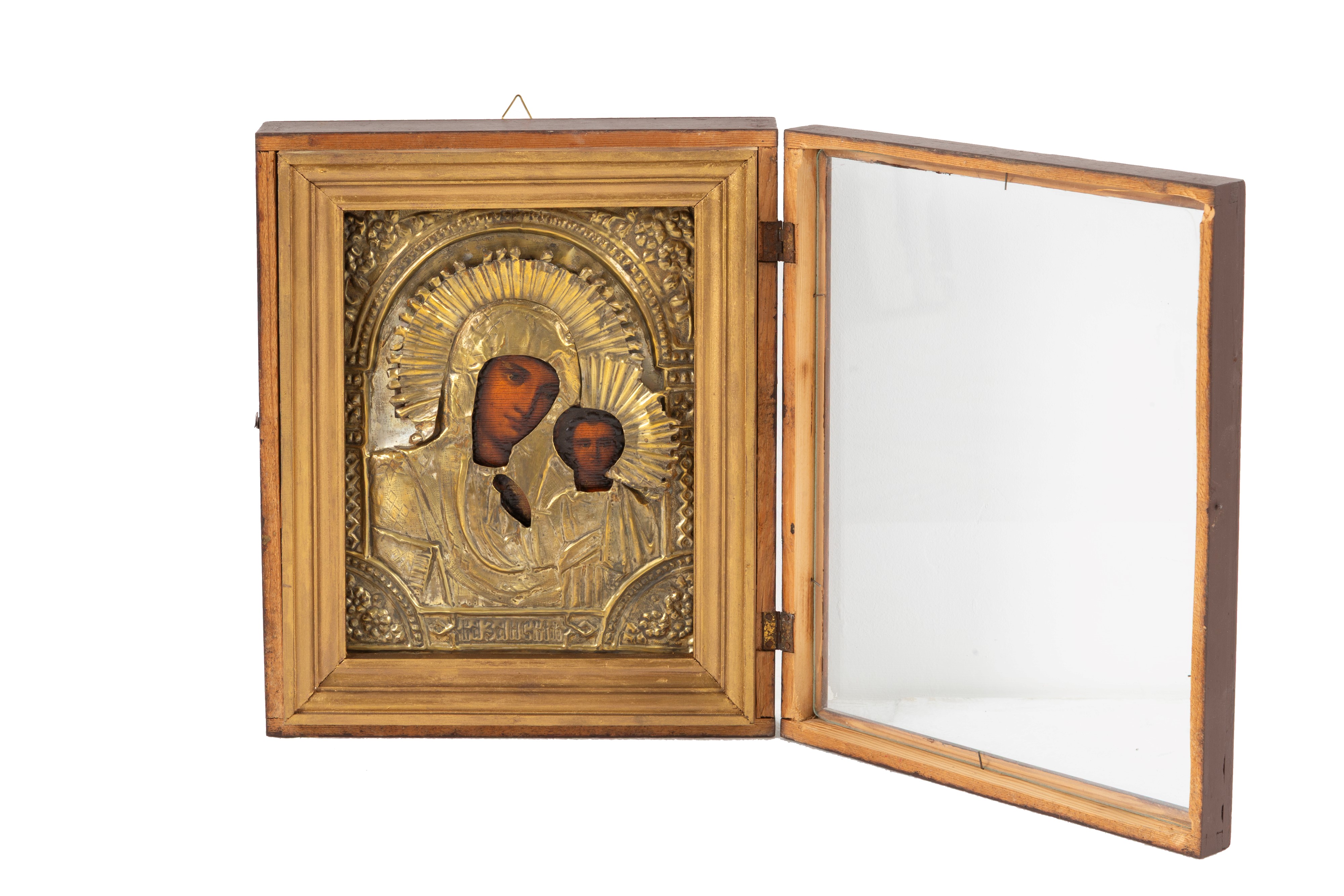
The icon is presently housed in a wooden display case with a hinged glazed door, most likely added during the twentieth century for both protective and devotional purposes.
The Virgin is represented half-length according to the traditional iconography of the Kazanskaya Bogomater', her head gently inclined towards the Christ Child while her gaze is directed towards the viewer. The Christ Child is depicted frontally, raising His right hand in blessing according to the Eastern rite, while holding the scroll of the Holy Scriptures in His left hand.
The painted surface is almost entirely covered by a finely repoussé and chased silvered brass riza, leaving visible only the faces and portions of the hands of the sacred figures. The Virgin's halo is executed with an elegant radiating pattern formed by deeply embossed rays, while the Child's halo follows the same decorative scheme on a smaller scale. The garments are rendered through refined repoussé work reproducing folds, borders, and embroidered decoration in accordance with the traditions of Russian workshops active during the second half of the nineteenth century.
The border of the riza is enriched with elaborate floral ornament at the corners and a punched peripheral band that lends balance and monumentality to the overall composition. At the lower edge appears the Slavonic inscription identifying the Mother of God of Kazan.
The image belongs to the iconographic type derived from the celebrated miraculous prototype discovered in Kazan in 1579, which rapidly spread throughout Russia as a symbol of the Virgin's protection over the Russian people. During the nineteenth century this iconography became one of the most sought-after subjects for both private devotion and domestic worship, encouraging the production of icons of remarkable quality by the principal workshops of Moscow and Central Russia.
The quality of the painting, the confident rendering of the faces, the refined treatment of the highlights, and the well-executed riza support an attribution to a workshop in Central Russia, dating to the final decades of the nineteenth century.
The icon is presently housed in a wooden display case with a hinged glazed door, most likely added during the twentieth century for both protective and devotional purposes.
€ 400,00 / 600,00
Estimate
240,00 €
Starting price
€
Your bid
(The reserve price has not been exceeded)
(The reserve price has been exceeded)
Set your maximum bid
Live auction 396
OLD ORTHODOX ICONS FROM 17TH UNTIL 20TH CENTURY. Including a collection of important Traveling Russian Icons
Palazzo Caetani Lovatelli, tue 29 September 2026
SINGLE SESSION 29/09/2026 Hours 15:00
Discover Similar Lots
ANCIENT FURNITURE AND WORKS OF ART FROM [..]
Lot 238
Revolving bookcase
ANCIENT FURNITURE AND WORKS OF ART FROM [..]
Lot 330
A pair of Covered Baluster Vases
ANCIENT FURNITURE AND WORKS OF ART FROM [..]
Lot 185
Iron bust of Diana
ANCIENT FURNITURE AND WORKS OF ART FROM [..]
Lot 252
Ship bathroom cabinet Liberty style
ANCIENT FURNITURE AND WORKS OF ART FROM [..]
Lot 364
Pair of Large Kerosene Lamps
ANCIENT FURNITURE AND WORKS OF ART FROM [..]
Lot 230