
59
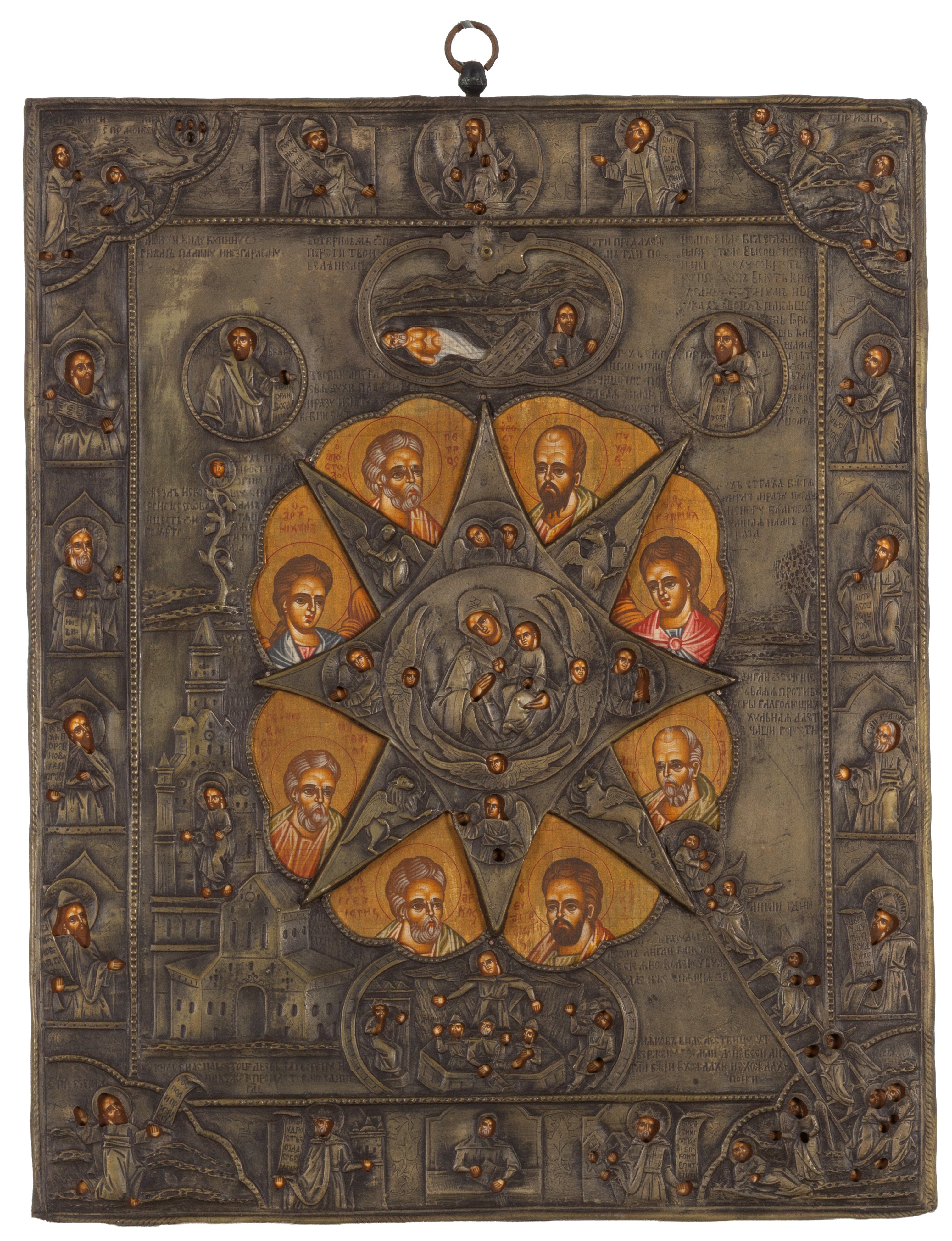
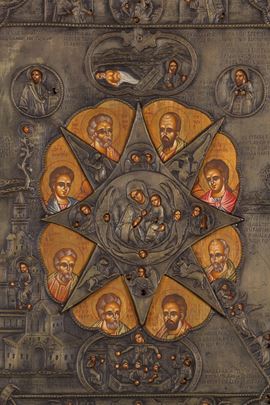
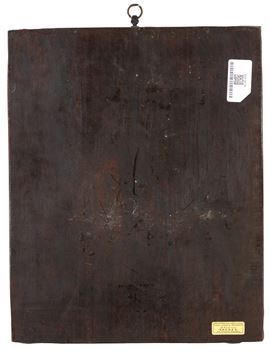
Russian Icon Depicting the Mother of God of the Burning Bush with a Riza, second half of the 19th century
Tempera on panel
Height x width: 43 x 34.5 cm
Important icon on panel depicting the Mother of God of the Burning Bush (Neopalimaya Kupina), one of the most elaborate and symbolically complex Marian images of the Russian Orthodox tradition, in which the Virgin is celebrated as the prefiguration of the Incarnation and as a powerful protectress against fire, calamities, and every form of danger.
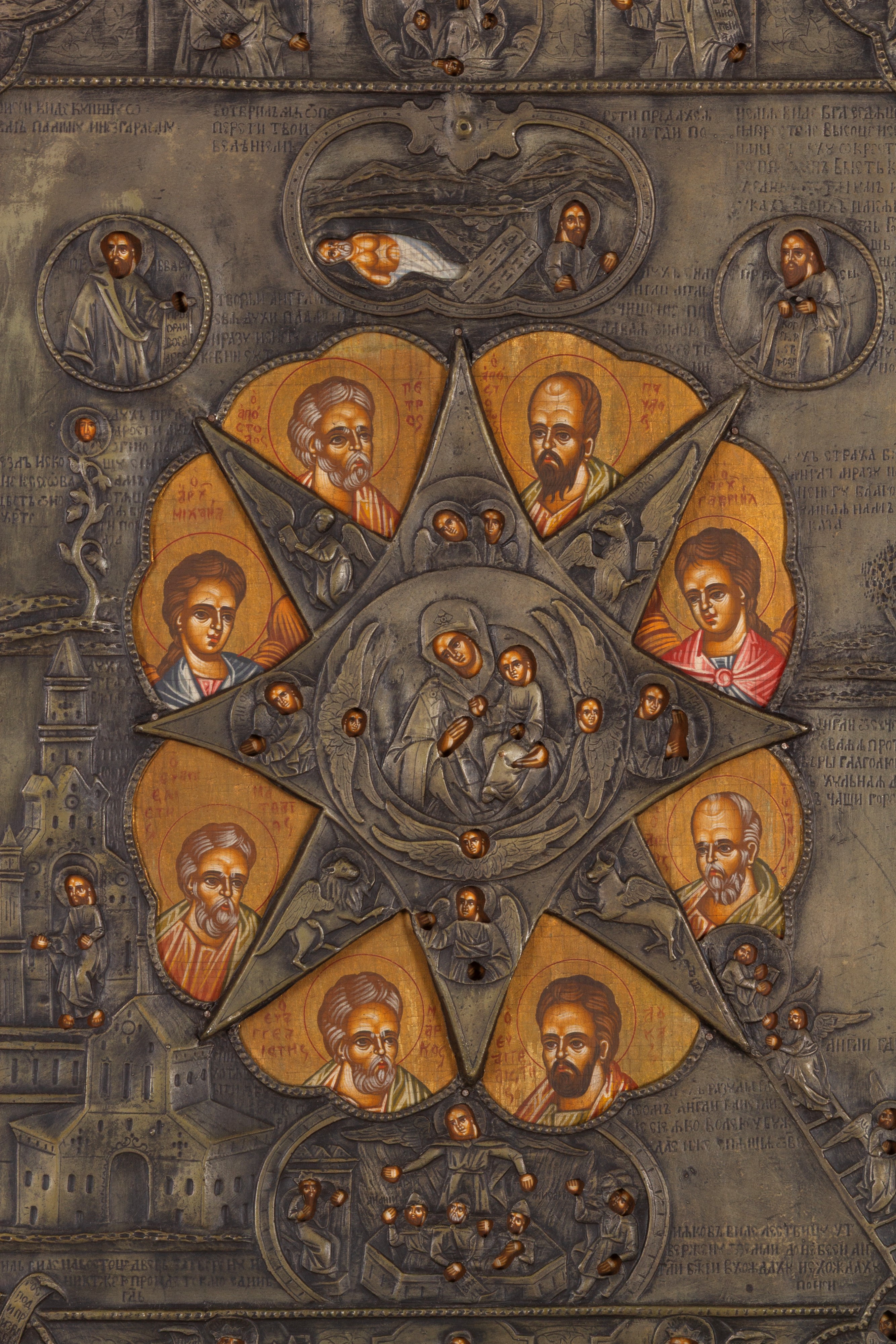
The entire surface is almost completely covered by a silvered metal riza, finely repoussé and chased, leaving exposed only the faces and hands of the principal figures, in accordance with a type widely employed in nineteenth-century Russian icon production.
The composition is organized around the characteristic eight-pointed star, formed by the intersection of two superimposed lozenges, symbolizing both the dual nature of Christ and the Virgin as the Burning Bush, which received the fire of the Divinity without being consumed.
At the center is the Mother of God with the Christ Child, enclosed within a circular mandorla and surrounded by a crown of angels. The points of the star contain angelic figures and the symbols of the Four Evangelists, derived from the vision of the Prophet Ezekiel and the Book of Revelation, according to the Byzantine and Russian iconographic tradition.
Surrounding the star are eight large medallions depicting saints, apostles, and evangelists shown in half-length with identifying inscriptions, while numerous angelic figures are distributed throughout the composition, contributing to its remarkable symbolic complexity.
The upper register depicts the Burning Bush together with the Prophet Moses, the Old Testament episode that forms the theological foundation of the entire Marian iconography. The lower and lateral registers include additional symbolic scenes and numerous Old Testament prophets, represented within architectural niches while holding scrolls bearing Church Slavonic inscriptions containing their respective Messianic prophecies relating to the Virgin and the mystery of the Incarnation.
The background is enriched with lengthy Church Slavonic inscriptions engraved on the riza, together with refined architectural and ornamental motifs executed in repoussé and chasing, creating a composition of remarkable plasticity and decorative richness.
The iconography of the Mother of God of the Burning Bush developed in Russia from the sixteenth century onward, reaching its greatest popularity between the eighteenth and nineteenth centuries. It represents one of the most sophisticated symbolic expressions of Orthodox Marian theology, uniting within a single image the principal Old Testament prophecies, apocalyptic visions, and the mystery of the Incarnation.
Throughout the nineteenth century, the principal workshops of central Russia, particularly those of Moscow, Mstëra, Palekh, and Kholuy, produced numerous icons of this subject, often adorned with elaborate metal riza coverings and distinguished by iconographic programs of extraordinary richness, intended both for private devotion and for the protection of homes.
The entire surface is almost completely covered by a silvered metal riza, finely repoussé and chased, leaving exposed only the faces and hands of the principal figures, in accordance with a type widely employed in nineteenth-century Russian icon production.
The composition is organized around the characteristic eight-pointed star, formed by the intersection of two superimposed lozenges, symbolizing both the dual nature of Christ and the Virgin as the Burning Bush, which received the fire of the Divinity without being consumed.
At the center is the Mother of God with the Christ Child, enclosed within a circular mandorla and surrounded by a crown of angels. The points of the star contain angelic figures and the symbols of the Four Evangelists, derived from the vision of the Prophet Ezekiel and the Book of Revelation, according to the Byzantine and Russian iconographic tradition.
Surrounding the star are eight large medallions depicting saints, apostles, and evangelists shown in half-length with identifying inscriptions, while numerous angelic figures are distributed throughout the composition, contributing to its remarkable symbolic complexity.
The upper register depicts the Burning Bush together with the Prophet Moses, the Old Testament episode that forms the theological foundation of the entire Marian iconography. The lower and lateral registers include additional symbolic scenes and numerous Old Testament prophets, represented within architectural niches while holding scrolls bearing Church Slavonic inscriptions containing their respective Messianic prophecies relating to the Virgin and the mystery of the Incarnation.
The background is enriched with lengthy Church Slavonic inscriptions engraved on the riza, together with refined architectural and ornamental motifs executed in repoussé and chasing, creating a composition of remarkable plasticity and decorative richness.
The iconography of the Mother of God of the Burning Bush developed in Russia from the sixteenth century onward, reaching its greatest popularity between the eighteenth and nineteenth centuries. It represents one of the most sophisticated symbolic expressions of Orthodox Marian theology, uniting within a single image the principal Old Testament prophecies, apocalyptic visions, and the mystery of the Incarnation.
Throughout the nineteenth century, the principal workshops of central Russia, particularly those of Moscow, Mstëra, Palekh, and Kholuy, produced numerous icons of this subject, often adorned with elaborate metal riza coverings and distinguished by iconographic programs of extraordinary richness, intended both for private devotion and for the protection of homes.
€ 900,00 / 1.200,00
Estimate
650,00 €
Starting price
€
Your bid
(The reserve price has not been exceeded)
(The reserve price has been exceeded)
Set your maximum bid
Live auction 396
OLD ORTHODOX ICONS FROM 17TH UNTIL 20TH CENTURY. Including a collection of important Traveling Russian Icons
Palazzo Caetani Lovatelli, tue 29 September 2026
SINGLE SESSION 29/09/2026 Hours 15:00
Discover Similar Lots
OLD ORTHODOX ICONS FROM 17TH UNTIL 20TH [..]
Lot 3
Russian Icon with the New Testament Trinity, the Mother of God Joy of All Who Sorrow, Saint George, [..]
OLD ORTHODOX ICONS FROM 17TH UNTIL 20TH [..]
Lot 7
Russian icon depicting the Protection of the Mother of God
OLD ORTHODOX ICONS FROM 17TH UNTIL 20TH [..]
Lot 4
Russian icon depicting the Protection of the Mother of God
OLD ORTHODOX ICONS FROM 17TH UNTIL 20TH [..]
Lot 45
VLADIMIR IVANOVICH MOROZOV
Russian Icon depicting the Our Lady of Kazan with silver riza
OLD ORTHODOX ICONS FROM 17TH UNTIL 20TH [..]
Lot 53
Russian Icon Depicting the Mother of God of Iver with a Silver Riza
OLD ORTHODOX ICONS FROM 17TH UNTIL 20TH [..]
Lot 169
Travel icon depicting the Blessed Silence
OLD ORTHODOX ICONS FROM 17TH UNTIL 20TH [..]
Lot 315
Travel icon depicting the Blessed Silence
OLD ORTHODOX ICONS FROM 17TH UNTIL 20TH [..]
Lot 52
Russian icon depicting the Mother of God “Truly Worthy” with scenes from the lives of Christ and the [..]
OLD ORTHODOX ICONS FROM 17TH UNTIL 20TH [..]
Lot 211
Travel icon depicting the Mother of God of the Burning Bush
OLD ORTHODOX ICONS FROM 17TH UNTIL 20TH [..]
Lot 190