
3
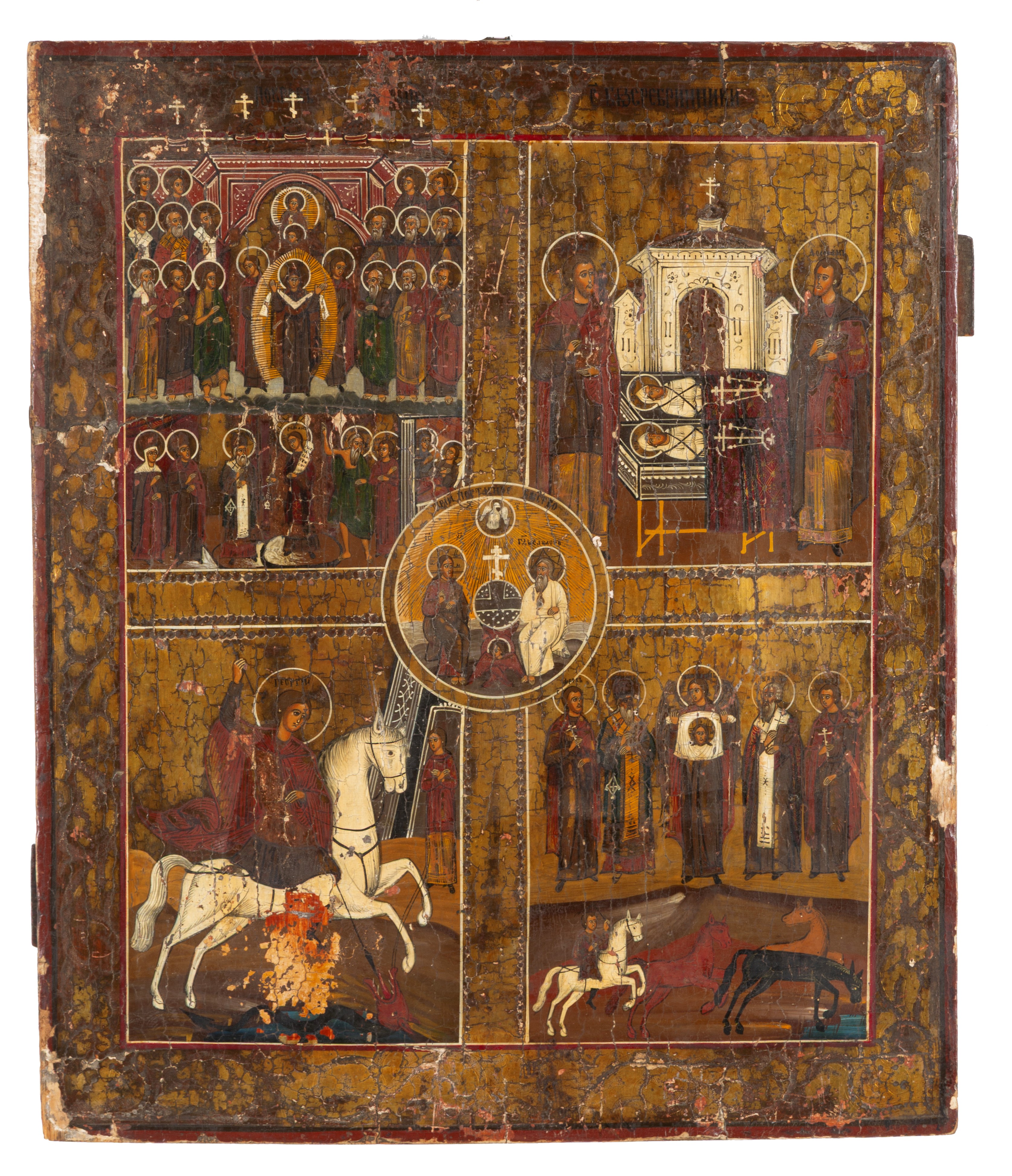
Russian Icon with the New Testament Trinity, the Mother of God Joy of All Who Sorrow, Saint George, and Saints, late 18th – early 19th century (c. 1790–1820)
Tempera on panel
Height x width: 44,5 x 37,5 cm
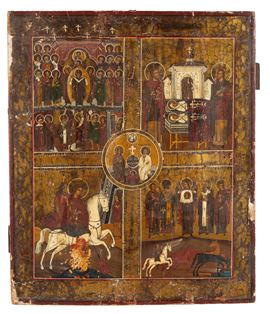
Important Russian composite icon depicting the Cross of Golgotha as the central symbol of Redemption, surrounded by numerous sacred images belonging to the devotional tradition of the Russian Orthodox Church.
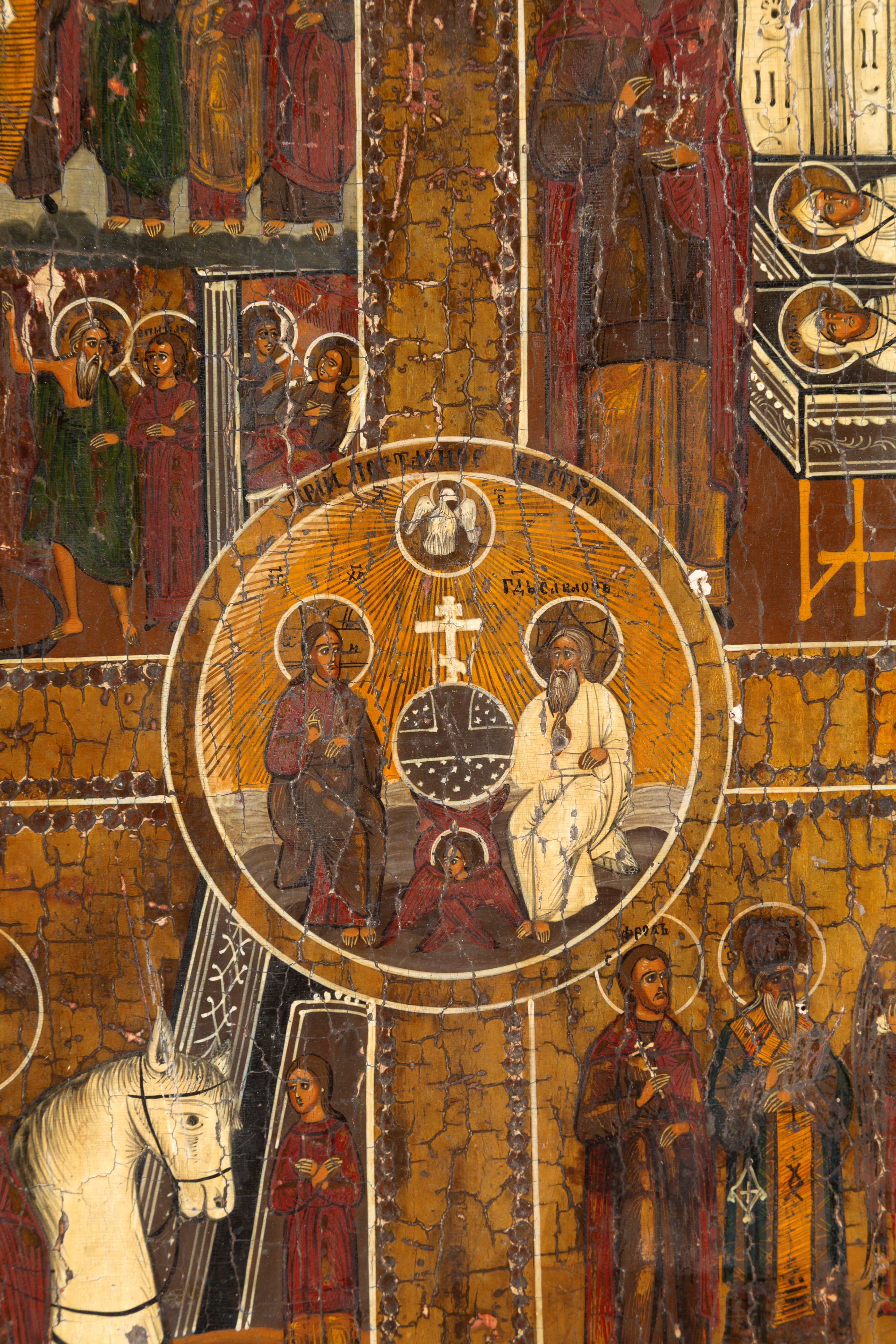
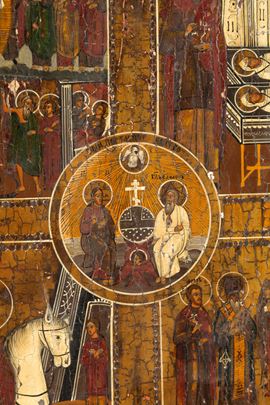
The composition is organized according to a rigorous four-part structure converging toward the large central medallion, within which the Cross of Calvary is represented standing upon Mount Golgotha. Christ and God the Father appear on either side of the Cross, while the skull of Adam is depicted at its base, in accordance with the traditional theological interpretation of humanity's salvation through Christ's sacrifice. Above the Cross appears the representation of the Holy Trinity enclosed within a small radiant mandorla.
The upper left quadrant depicts the Mother of God "Joy of All Who Sorrow" (Vsekh Skorbyashchikh Radost'), surrounded by a large assembly of angels, saints, and supplicating faithful, according to one of the most celebrated Marian iconographies of the Russian Orthodox tradition.
The upper right section presents a funerary scene with Christ the Blessing standing beside the tombs of holy martyrs, probably referring to Saints Florus and Laurus, or to another liturgical commemoration associated with the cult of the martyrs, according to an iconographic type frequently encountered in the production of the Old Believers (Staroobryadtsy).
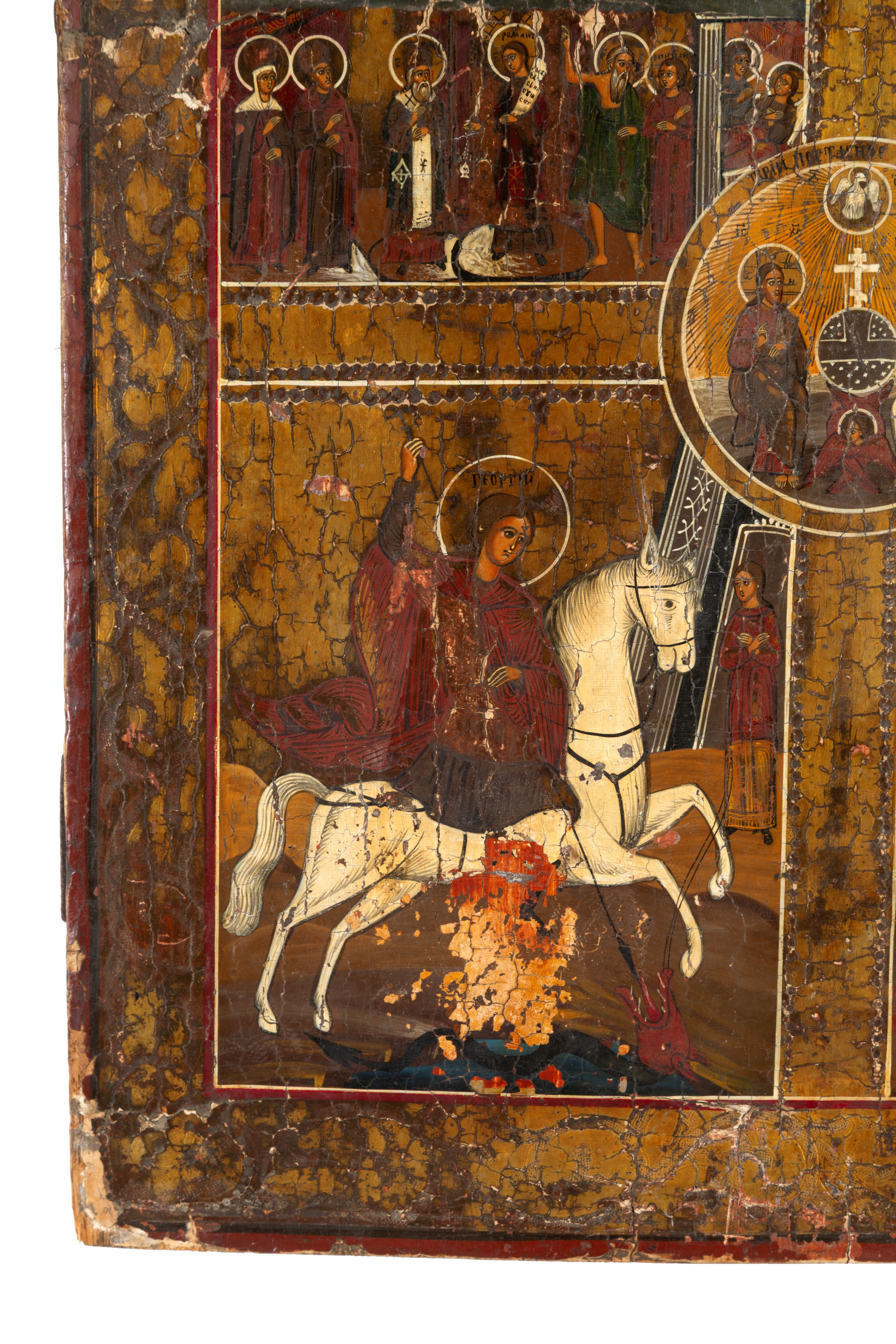
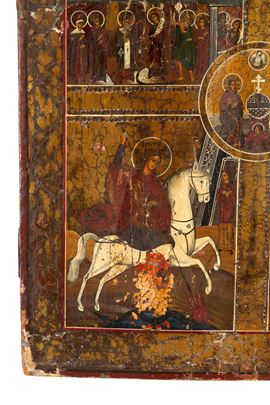
The lower left quadrant depicts Saint George the Victorious mounted on a white horse as he pierces the dragon, symbolizing the triumph of faith over evil. The saint is rendered with remarkable dynamism and occupies much of the available space, distinguished by the vivid contrast between the brilliant white of the horse and the intense crimson tones of his flowing cloak.
The lower right section contains a group of saints, ascetics, and martyrs of the Eastern Church, arranged frontally according to a strict hierarchical order. In the foreground are also depicted three horses, probably alluding to the cult of saints regarded as protectors of animals and rural life.
The entire composition is enclosed within a richly decorated border executed in gold leaf and embellished with stylized floral and vegetal ornamentation. The gilded background unifies the composition while enhancing the refined chromatic contrast between the deep reds of the garments, the rich greens, and the warm ochre tones of the painted ground.
The icon belongs to the production of Central Russia between the late eighteenth century and the early decades of the nineteenth century, a period during which workshops associated with the Old Believers (Staroobryadtsy) developed an important production of composite icons intended for private devotion.
On the basis of its iconographic conception, the richness of its pictorial program, and its stylistic characteristics, the present icon may be attributed to a high-quality workshop of Central Russia, and may be dated to the late eighteenth or early nineteenth century.
The composition is organized according to a rigorous four-part structure converging toward the large central medallion, within which the Cross of Calvary is represented standing upon Mount Golgotha. Christ and God the Father appear on either side of the Cross, while the skull of Adam is depicted at its base, in accordance with the traditional theological interpretation of humanity's salvation through Christ's sacrifice. Above the Cross appears the representation of the Holy Trinity enclosed within a small radiant mandorla.
The upper left quadrant depicts the Mother of God "Joy of All Who Sorrow" (Vsekh Skorbyashchikh Radost'), surrounded by a large assembly of angels, saints, and supplicating faithful, according to one of the most celebrated Marian iconographies of the Russian Orthodox tradition.
The upper right section presents a funerary scene with Christ the Blessing standing beside the tombs of holy martyrs, probably referring to Saints Florus and Laurus, or to another liturgical commemoration associated with the cult of the martyrs, according to an iconographic type frequently encountered in the production of the Old Believers (Staroobryadtsy).
The lower left quadrant depicts Saint George the Victorious mounted on a white horse as he pierces the dragon, symbolizing the triumph of faith over evil. The saint is rendered with remarkable dynamism and occupies much of the available space, distinguished by the vivid contrast between the brilliant white of the horse and the intense crimson tones of his flowing cloak.
The lower right section contains a group of saints, ascetics, and martyrs of the Eastern Church, arranged frontally according to a strict hierarchical order. In the foreground are also depicted three horses, probably alluding to the cult of saints regarded as protectors of animals and rural life.
The entire composition is enclosed within a richly decorated border executed in gold leaf and embellished with stylized floral and vegetal ornamentation. The gilded background unifies the composition while enhancing the refined chromatic contrast between the deep reds of the garments, the rich greens, and the warm ochre tones of the painted ground.
The icon belongs to the production of Central Russia between the late eighteenth century and the early decades of the nineteenth century, a period during which workshops associated with the Old Believers (Staroobryadtsy) developed an important production of composite icons intended for private devotion.
On the basis of its iconographic conception, the richness of its pictorial program, and its stylistic characteristics, the present icon may be attributed to a high-quality workshop of Central Russia, and may be dated to the late eighteenth or early nineteenth century.
€ 600,00 / 800,00
Estimate
440,00 €
Starting price
€
Your bid
(The reserve price has not been exceeded)
(The reserve price has been exceeded)
Set your maximum bid
Live auction 396
OLD ORTHODOX ICONS FROM 17TH UNTIL 20TH CENTURY. Including a collection of important Traveling Russian Icons
Palazzo Caetani Lovatelli, tue 29 September 2026
SINGLE SESSION 29/09/2026 Hours 15:00
Discover Similar Lots
ART AND ARTISTS' BOOKS FROM THE MARIO PADOVAN'S [..]
Lot 354
Mercato dell’arte, riviste e cataloghi di settore (3 volumi)
ART AND ARTISTS' BOOKS FROM THE MARIO PADOVAN'S [..]
Lot 343
Max Ernst (3 volumi)
OLD ORTHODOX ICONS FROM 17TH UNTIL 20TH [..]
Lot 52
Russian icon depicting the Mother of God “Truly Worthy” with scenes from the lives of Christ and the [..]
ART AND ARTISTS' BOOKS FROM THE MARIO PADOVAN'S [..]
Lot 46
Segni e (Di)segni (2 volumi)
ART AND ARTISTS' BOOKS FROM THE MARIO PADOVAN'S [..]
Lot 287
Galleria Schneider (12 depliant)
ANCIENT FURNITURE AND WORKS OF ART FROM [..]
Lot 142
Bronze sculpture depicting Nessus and Deianira
FINE WINES. ICONS FROM FRANCE & ITALY
Lot 233
Brunello Di Montalcino Pian Delle Vigne Antinori 2020 2 Bot
ART AND ARTISTS' BOOKS FROM THE MARIO PADOVAN'S [..]
Lot 422
Miró, Joan: la lettera “M”, per la serie “L’Alfabeto” di Bolaffiarte
ANCIENT FURNITURE AND WORKS OF ART FROM [..]
Lot 323
Courvoisier & Comp
Gilded bronze table clock Empire period
FINE WINES. ICONS FROM FRANCE & ITALY
Lot 327