
8
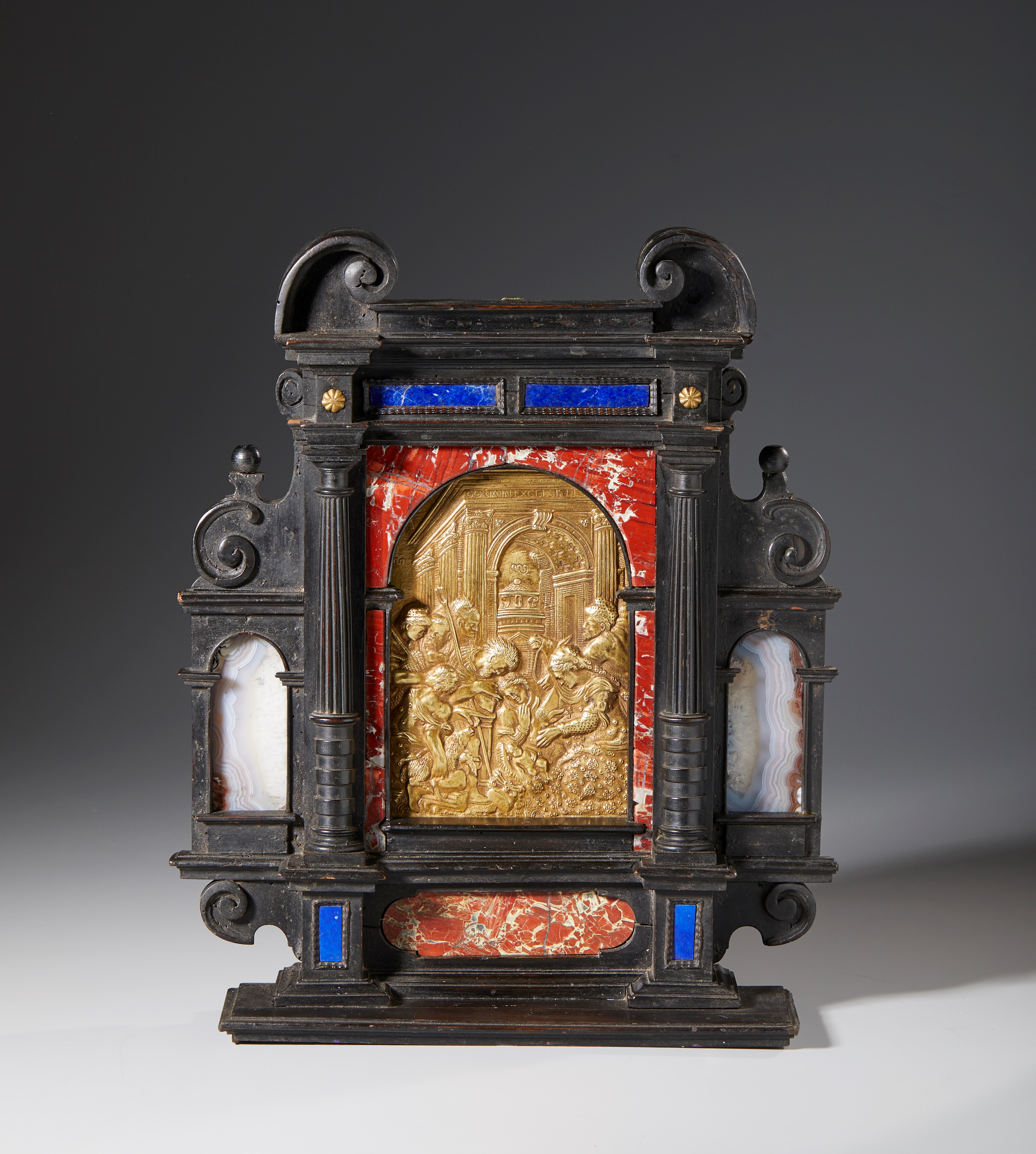
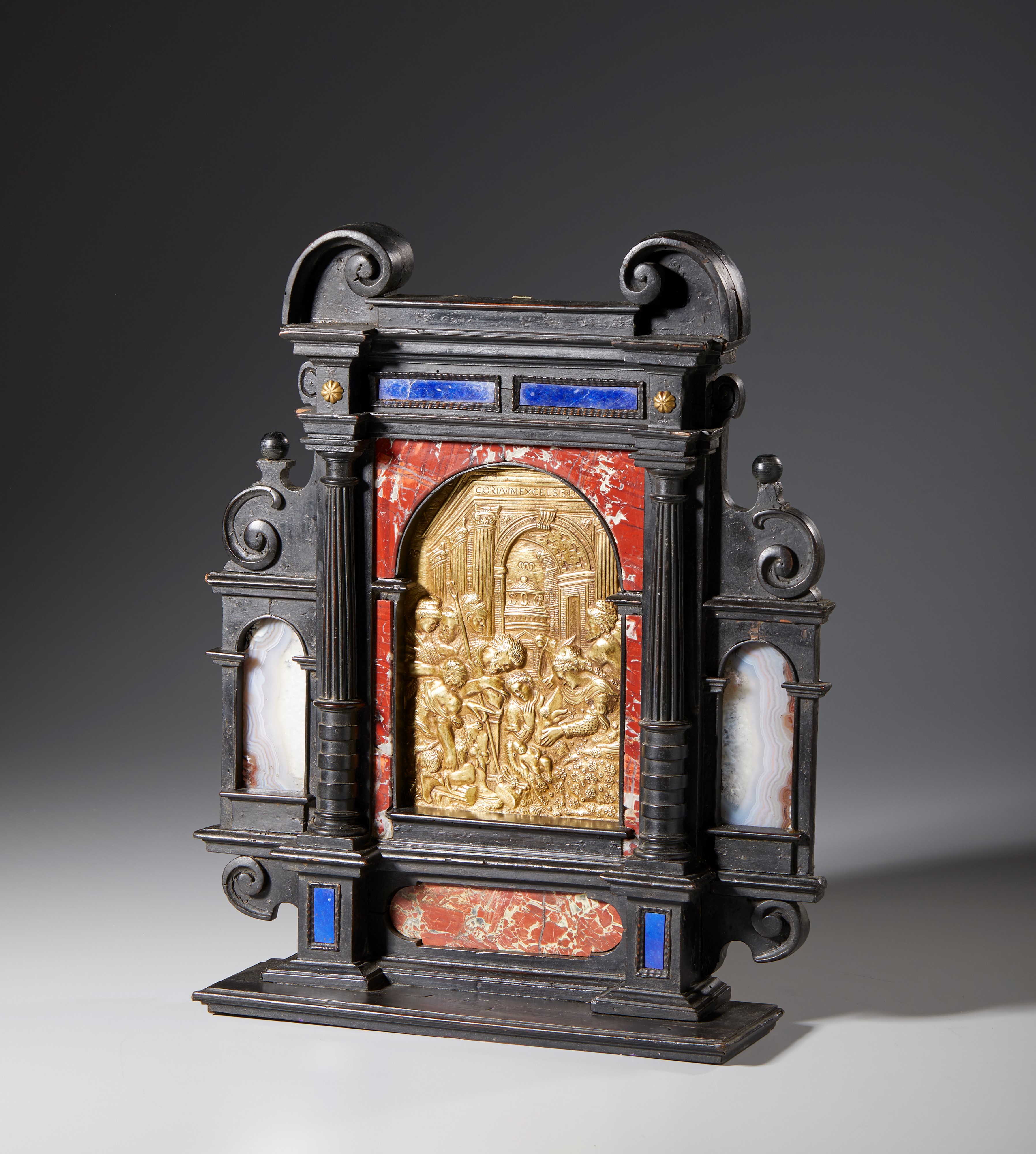
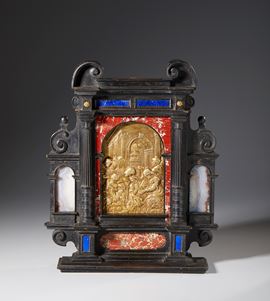
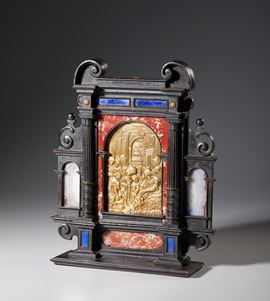
Domestic tabernacle. Rome or Florence, 17th century. Ebonized wood, semiprecious stones, gilded bronze plaque.
Overall 40 x 30 x 8 cm
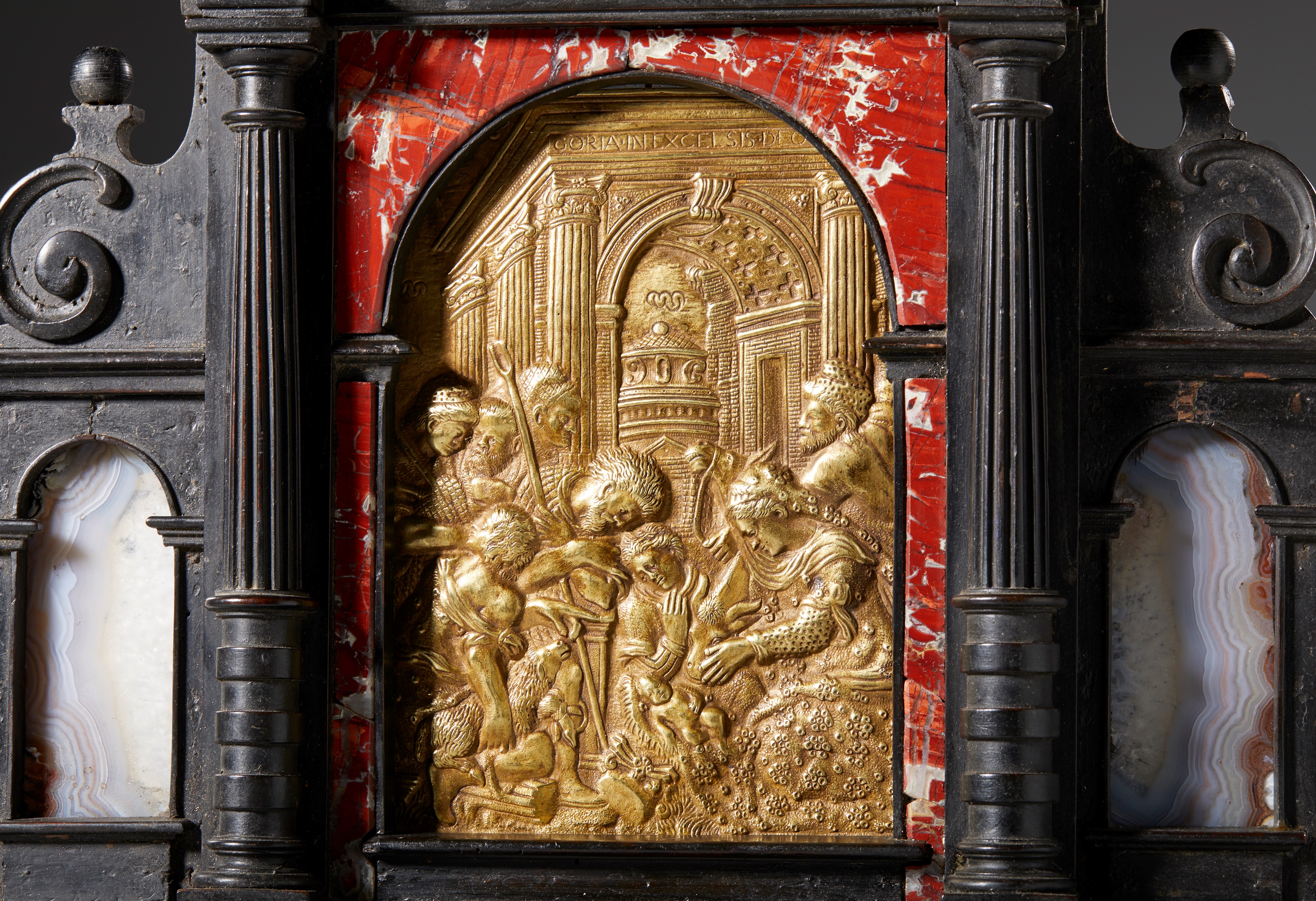
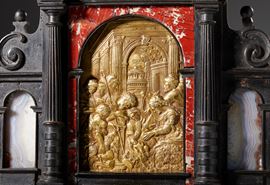
Architectural aedicule in the form of a small temple with fluted columns, a molded entablature, and spiral volutes at the sides and top. At the center, within an arched niche with a red jasper frame, is a finely chased and gilded bronze plaque depicting the Nativity with the Adoration of the Shepherds. At the top is the inscription "Gloria in Excelsis Deo": a scene with shepherds, the Holy Family, and classical architecture against a background of late Roman Mannerist influence, in the style of Guglielmo della Porta.
The ebonized wooden structure is covered with semiprecious stone slabs: red jasper for the central frame and for the cartouche at the base; deep blue lapis lazuli for the upper and lower bands; two lateral niches in banded agate.
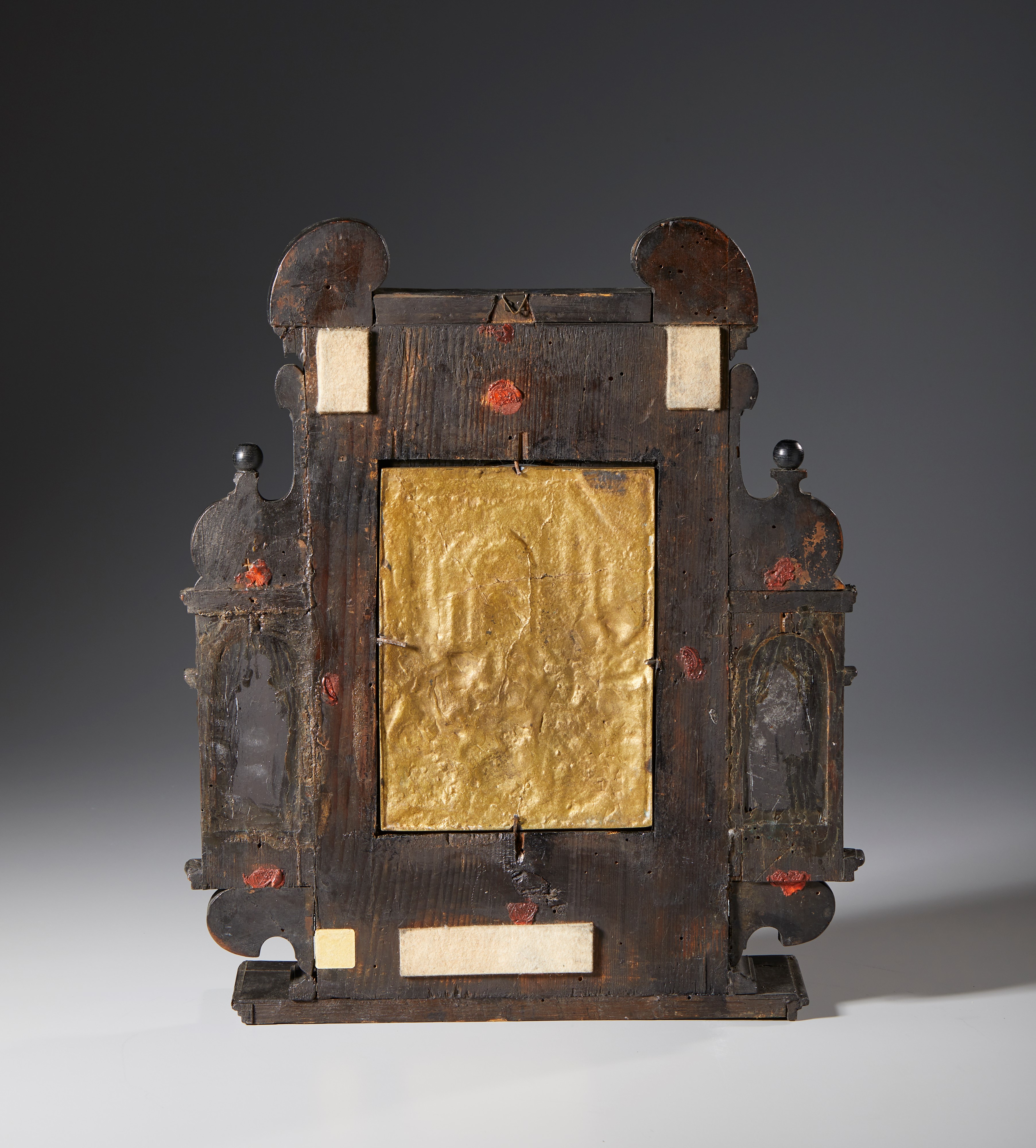
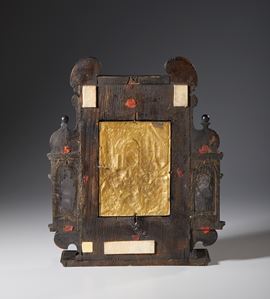
Good condition, with modest signs of historical woodworm and wear consistent with its age. The original gilded bronze central plaque has a patina. On the back are traces of five ancient red sealing wax seals from a private collection, worn and illegible, attesting to its ancient provenance. The sealing waxes may also indicate the presence of a lost reliquary box on the back.
A luxury item produced in Rome or Florence between the 16th and 17th centuries for the private devotion of high-ranking clerics and aristocracy. These objects reflect the taste and production of the Florentine Opificio delle Pietre Dure.
bibliography
A. Gonzales-Palacios, The Temple of Taste, 1984, second volume.
Sotheby's London, 6 July 2017, lot 15.
Christie's Rome, 2005, lot 234.
€ 4.000,00 / 8.000,00
Estimate
4.000,00 €
Starting price
€
Your bid
(The reserve price has not been exceeded)
(The reserve price has been exceeded)
Set your maximum bid
Live auction 409
CUPRUM
CUPRUM
Important Small Bronzes, Old Master Sculpture, Works of Art
Palazzo Caetani Lovatelli, wed 9 December 2026
SINGLE SESSION 09/12/2026 Hours 16:00
Discover Similar Lots
JEWELLERY / CARVED CORAL / WATCHES / LUXURY [..]
Lot 249
Sterling silver lapis lazuli necjlace
THE ARCHBISHOP LOZANO COLLECTION OF ANTIQUE [..]
Lot 128
Mother of God of the Three Hands (Troeručica) with metal riza
CUPRUM Important Small Bronzes, Old Master [..]
Lot 40
Pair of Empire candlesticks. Gilded bronze. First half of the 19th century.
JEWELLERY / CARVED CORAL / WATCHES / LUXURY [..]
Lot 305
CARLO PARLATI
Coral sculpture depicting a horse's head, with a white gold mount, on a malachite and white marble ba [..]
JEWELLERY / CARVED CORAL / WATCHES / LUXURY [..]
Lot 309
CARLO PARLATI
Female head carved in coral, with gold mount set with diamonds and sapphires, on a malachite base
THE ARCHBISHOP LOZANO COLLECTION OF ANTIQUE [..]
Lot 10
Composite Russian icon depicting "Major Feasts, the Life of Saint George and Saint John, and a host [..]
THE ARCHBISHOP LOZANO COLLECTION OF ANTIQUE [..]
Lot 144
Quadriptych travel icon (skladon)
CUPRUM Important Small Bronzes, Old Master [..]
Lot 58
Barthelemy Prieur (Berzieux, 1536- Paris, 1611) Workshop of, 17th century. Cupid Archer Running (Love [..]
POKÉMON 30th ANNIVERSARY AUCTION: Iconic [..]
Lot 7
The Pokémon Company
Stellar Tera Type Starter Set Lot: Sylveon ex & Ceruledge ex [JAP]
IMPORTANT MEMORABILIA, MILITARIA, ORDERS [..]
Lot 366