
66
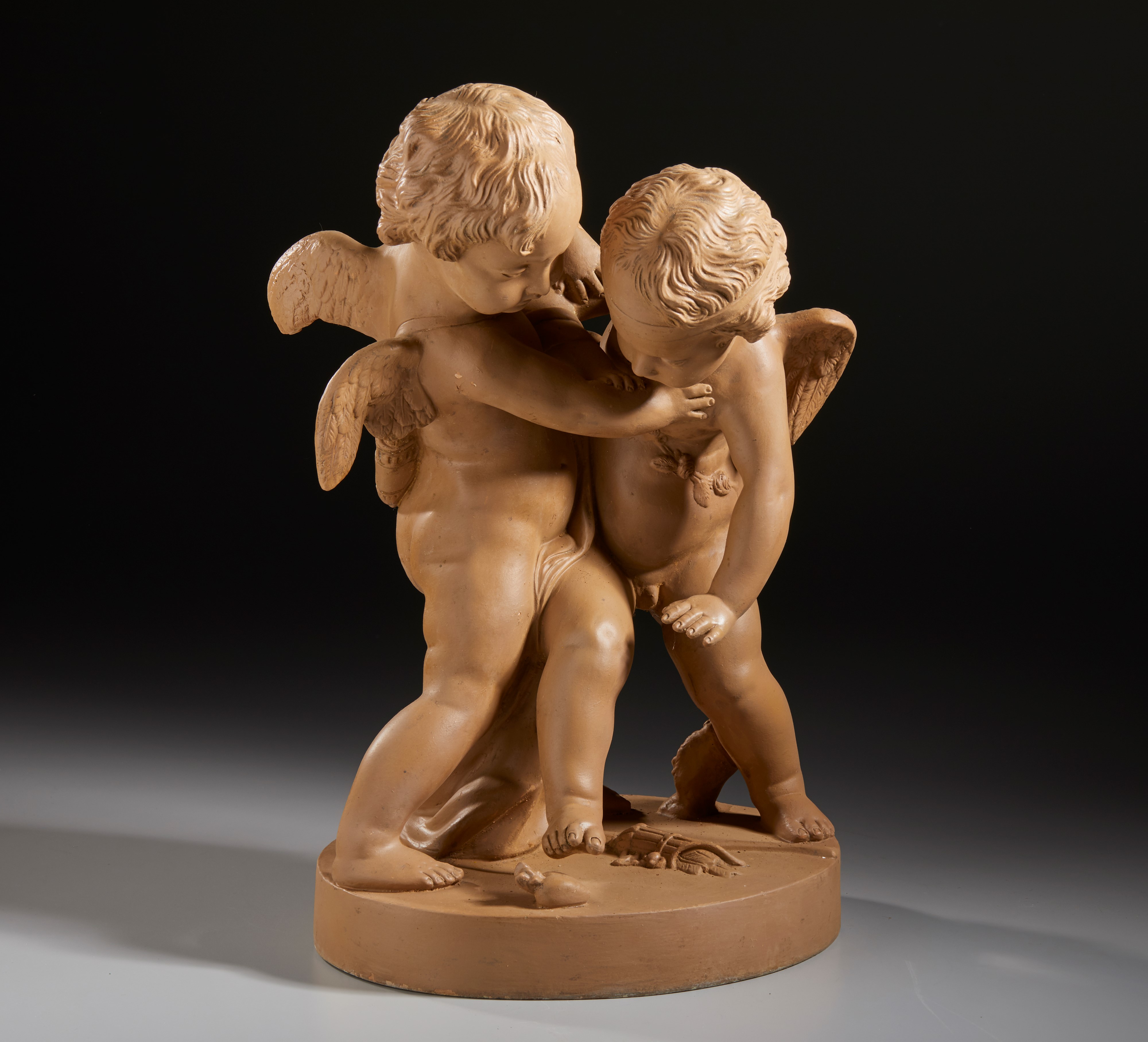
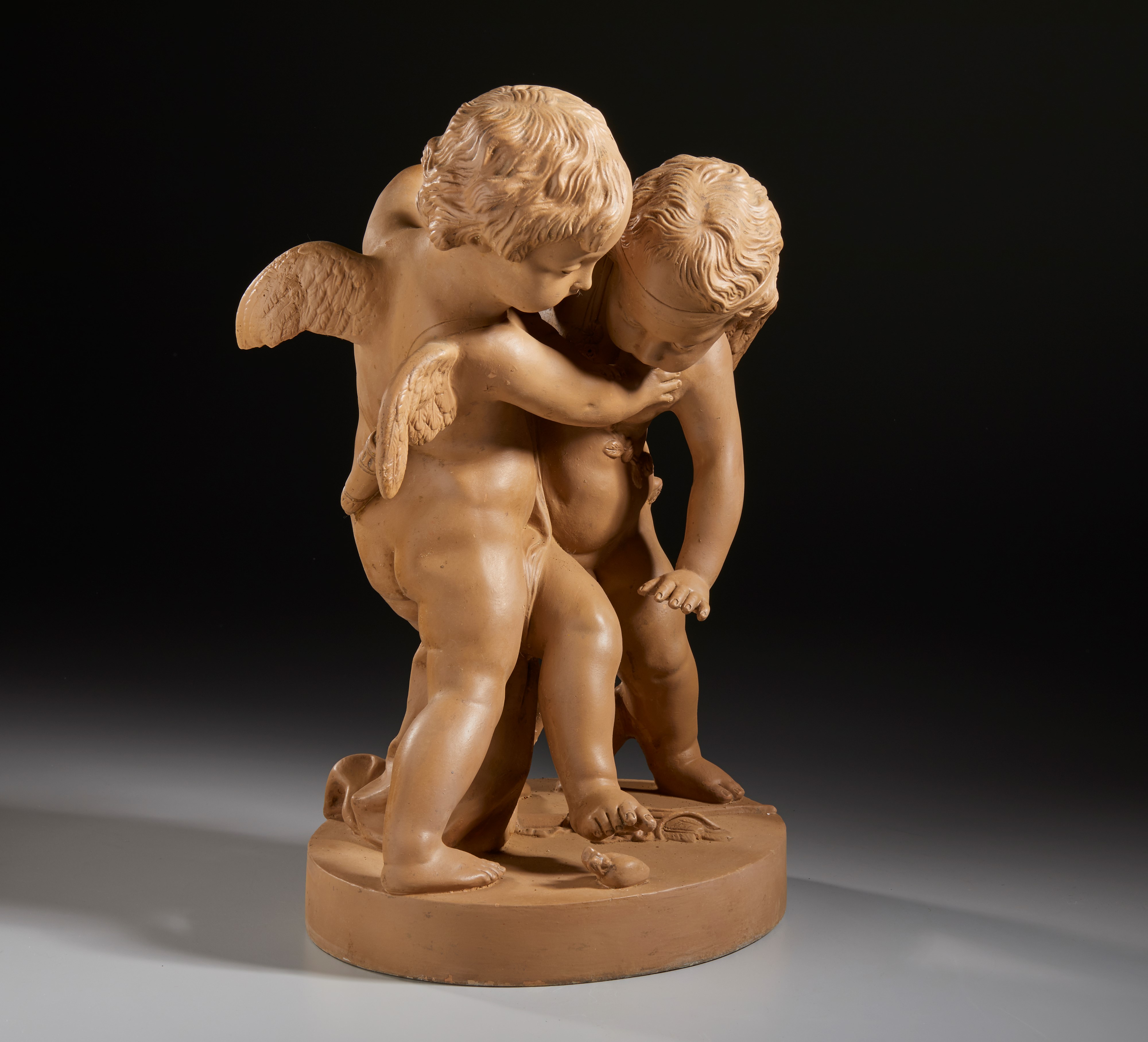
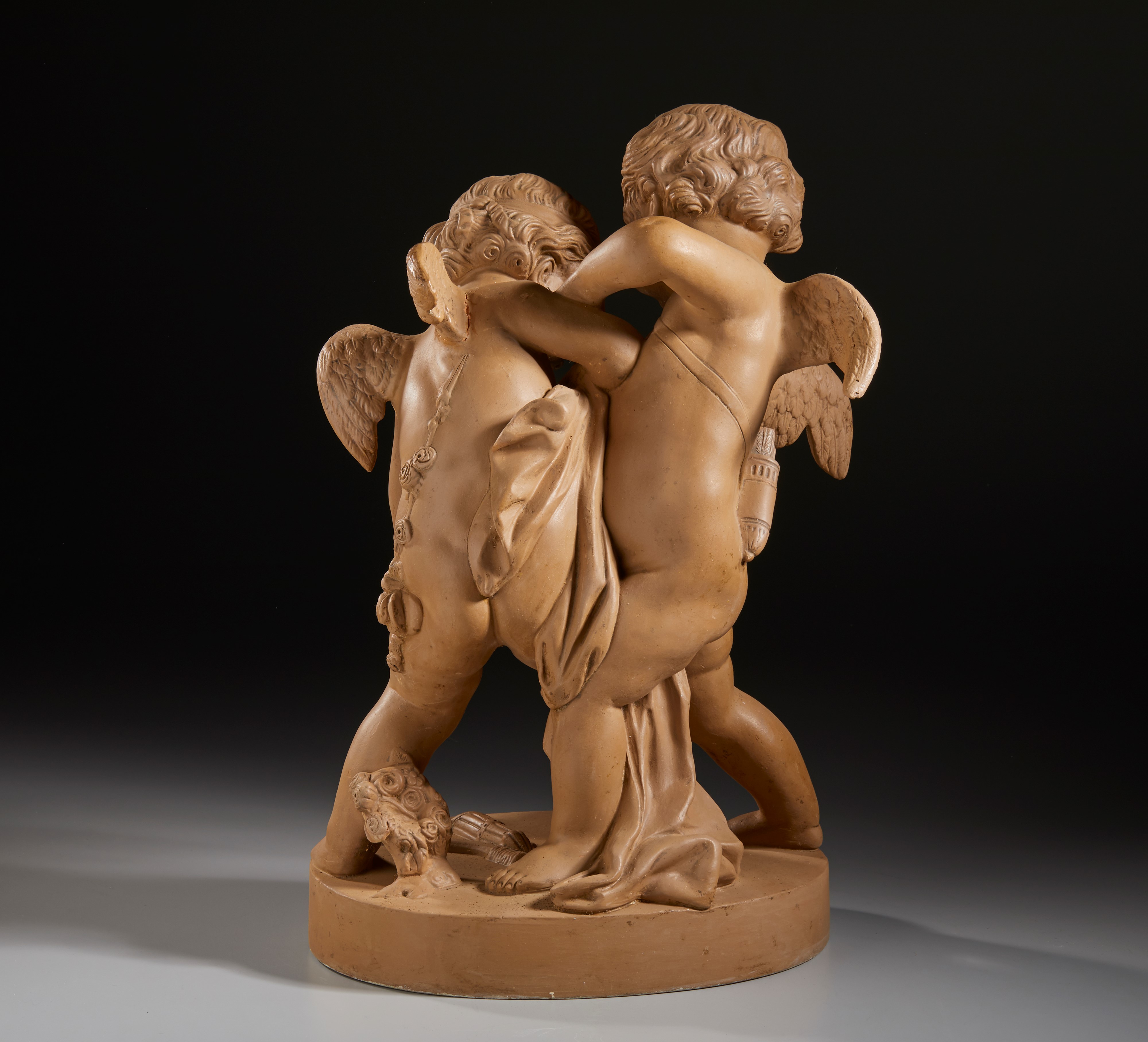
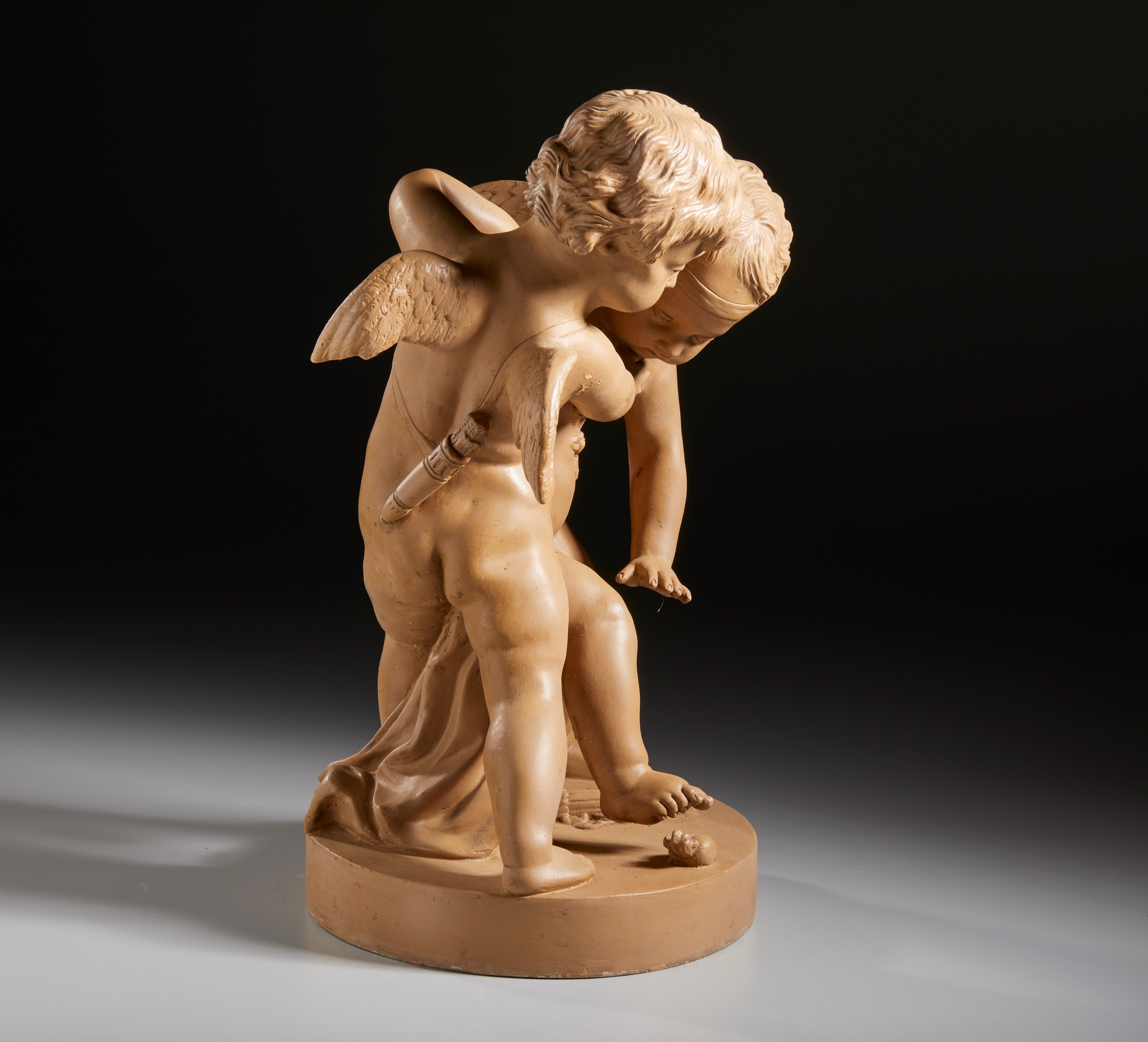
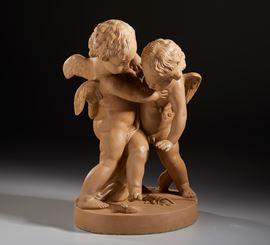
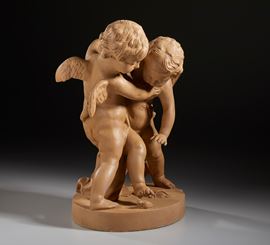
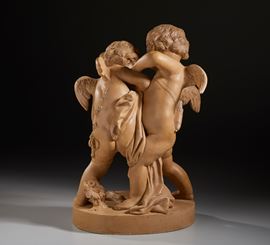
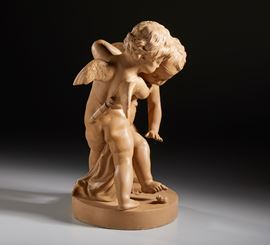
Étienne-Maurice Falconet (Paris, 1716 – 1791). Based on the model Two Cupids Disputing a Heart. Second half of the 19th century. Molded and finished with a stick, the base features factory marks stamped within an oval cartouche bearing the words Terre Cuite and cold-stamped catalog inventory numbers.
Each 44 x 30 x 22 cm
The large sculpture depicts two winged putti (cupids or cherubs) caught in a tense and dynamic childish bickering of an allegorical nature.
The two child figures are intertwined in a complex pyramidal composition, where the bodies intertwine and the arms are outstretched in a play of light and shade of great plastic vivacity.
On the circular support base, at the feet of the two contenders are the Dionysian attributes of love, a quiver with arrows tied with a ribbon and the small disputed heart towards which the entire narrative tension of the group converges.
This group constitutes one of the most successful and collected decorative inventions of the French eighteenth century, originally conceived by the genius of Étienne-Maurice Falconet.
The subject enjoyed overwhelming success, being reproduced both in biscuit by the Royal Manufactory of Sèvres and in marble and bronze for the homes of the European aristocracy.
During the period of Napoleon III, the vogue for the revival of the Louis XV and Louis XVI styles led the most renowned French manufacturers of artistic terracotta to re-edit this model in large dimensions intended for the furnishing of the sumptuous bourgeois salons.
Bibliography
L. Réau, "Étienne-Maurice Falconet", Paris, 1922.
€ 600,00 / 1.200,00
Estimate
300,00 €
Starting price
€
Your bid
(The reserve price has not been exceeded)
(The reserve price has been exceeded)
Set your maximum bid
Live auction 409
CUPRUM
CUPRUM
Important Small Bronzes, Old Master Sculpture, Works of Art
Palazzo Caetani Lovatelli, wed 9 December 2026
SINGLE SESSION 09/12/2026 Hours 16:00
Discover Similar Lots
CUPRUM Important Small Bronzes, Old Master [..]
Lot 14
Pair of putti. Niccolò Roccatagliata (1560 - 1636), 17th century school. Bronze, transparent reddish [..]
CUPRUM Important Small Bronzes, Old Master [..]
Lot 59
Justus le Court (Ypres, 1627-Venice, 1679) From the model of. Envy in the guise of Medusa 18th-19th [..]
IMPORTANT MEMORABILIA, MILITARIA, ORDERS [..]
Lot 100
Fascism-corporate syndicalism, Trieste, object donated by the Workers' Cooperatives to the Hon. [..]
IMPORTANT MEMORABILIA, MILITARIA, ORDERS [..]
Lot 44
Sculpture
CHRISTMAS SMART AUCTION. Featuring furnishings [..]
Lot 200
Lot of two marble high reliefs
IMPORTANT MEMORABILIA, MILITARIA, ORDERS [..]
Lot 121
Theatre, International Prize “Fountains of Rome” – bronze sculpture-trophy by Remo Brindisi, awarded [..]
IMPORTANT MEMORABILIA, MILITARIA, ORDERS [..]
Lot 85
Politics - Irredentism - Great War. Cesare Battisti at the gallows. Plaster with bronze patina, 1918. [..]
IMPORTANT MEMORABILIA, MILITARIA, ORDERS [..]
Lot 84
Irredentism - Great War, “Cesare Battisti in Alpine uniform”, 1916. Work by the sculptor Oreste Labò. [..]
CUPRUM Important Small Bronzes, Old Master [..]
Lot 42
Apollo and Daphne. From the model by Gianlorenzo Bernini (Naples, 1589-Rome, 1680). Bronze with a transparent [..]
CUPRUM Important Small Bronzes, Old Master [..]
Lot 63