
13
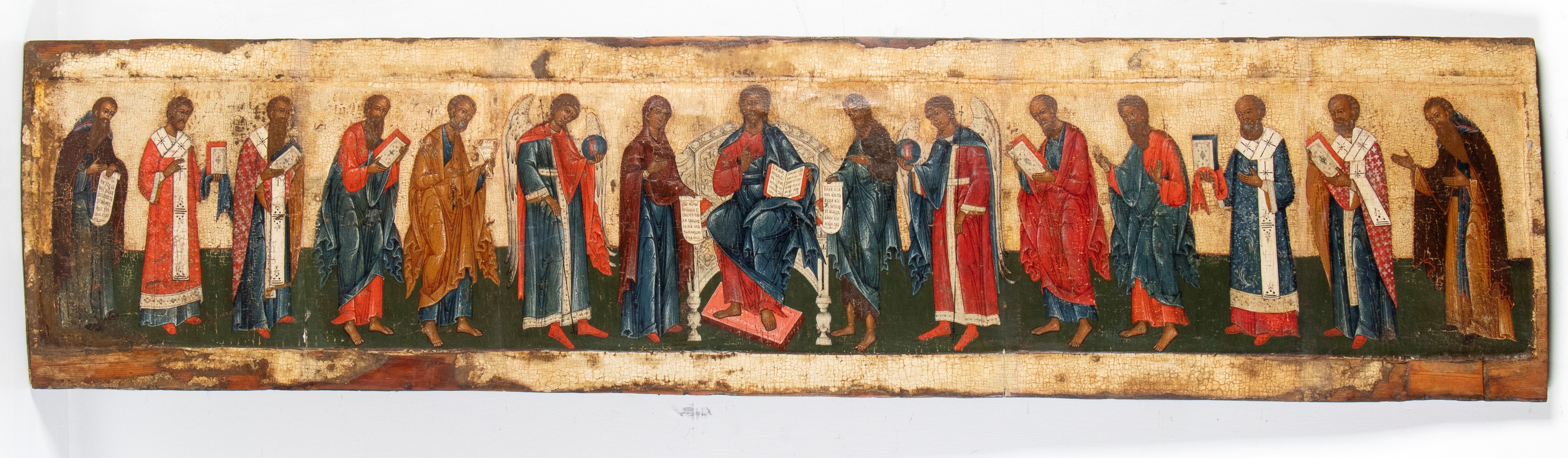
Extended Deesis register (iconostasis frieze), 19th century
Egg tempera and pigments on a wooden panel
Height x width: 36 x 152 cm
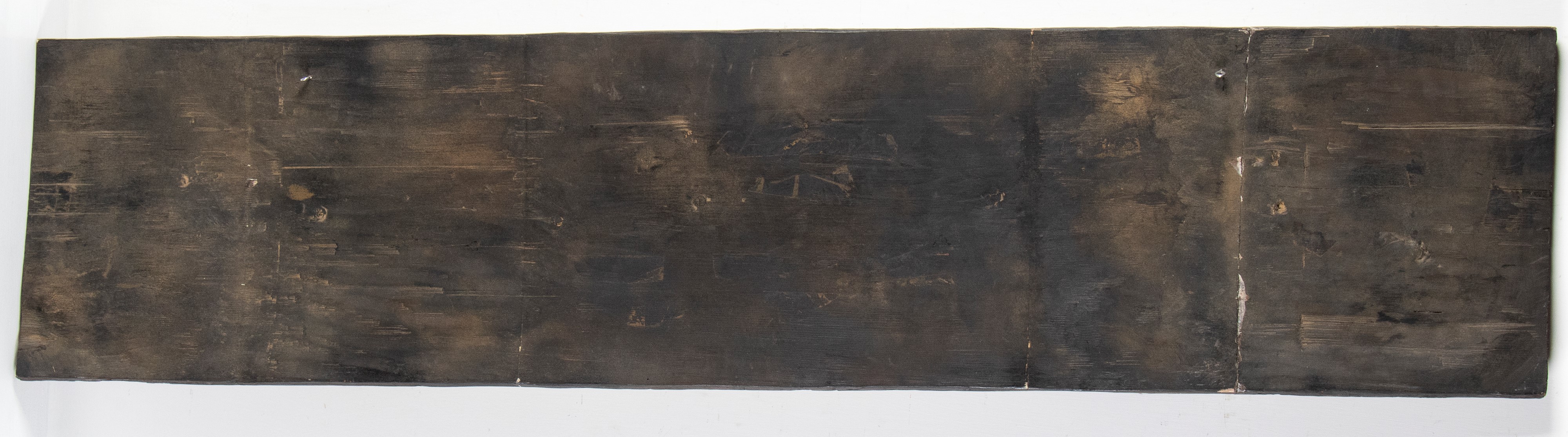
Characteristic of Central Russian sacred painting. The work does not originate as an isolated predella in the Western sense of the term, but rather as the continuous, load-bearing horizontal frieze intended to decorate the large partition wall separating the sanctuary from the nave. The technical choice of uniting the entire composition onto a single long wooden panel rather than separate vertical panels, combined with the slender silhouettes of the figures and the rhythmic flow of the saturated-color garments (cinnabar reds, deep blues, and malachite greens), is characteristic of provincial or regional workshops gravitating around the orbits of Moscow or Yaroslavl during the Late Baroque and Neoclassical eras. From an executive standpoint, the work is executed according to the most rigorous traditional Russian technique, featuring egg tempera and mineral pigments on a wooden panel prepared with levkas, the traditional gesso and animal-glue ground. The iconographic composition develops convergently toward the central axis, the theological focal point of the entire composition, where Christ Pantocrator and Universal Judge sits enthroned, caught in the act of blessing with His right hand and holding the open book of the Gospels with His left. Flanking Him are the two pivotal figures of intercession for humanity: the Virgin Mary on the left and Saint John the Baptist on the right, both leaning forward in a deep, symmetrical, and reverent bow. Immediately behind the central triad stands the heavenly court represented by the Archangels Michael and Gabriel, recognizable by their large feathered wings, who act as an honor guard to the divine throne. The procession continues toward the extremities with the apostolic college led by the holy princes Peter and Paul, followed in turn by the other evangelists. The frieze finally concludes at the two outer sides with the solemn presence of the Holy Fathers and Doctors of the Eastern Church (among whom Basil the Great, John Chrysostom, or Nicholas of Myra can be recognized), immediately identifiable thanks to their characteristic white episcopal liturgical vestments decorated with large black crosses, known as *polystavrion*. The work presents itself as a fundamental visual testimony of the ceaseless prayer that the heavenly and earthly Church offers to Christ for the salvation of the world. Regarding its state of conservation, the pictorial surface is entirely affected by a dense and prominent phenomenon of natural craquelure (aging crackle). This fine web of microscopic geometric fractures is due to the natural progressive drying of the binder and the physiological thermal and hygrometric shifting movements undergone by the underlying wooden support over the centuries. The craquelure, which develops uniformly and coherently across both the background and the sacred figures, does not compromise the legibility of the design and, indeed, attests to the historical authenticity of the work and the absolute integrity of its original material layers, which maintain excellent cohesion with the support.
Provenance:
H.E. Most Rev. Francisco-Javier Lozano Sebastián, Titular Archbishop of Penafiel and Apostolic Nuncio Emeritus.
H.E. Most Rev. Francisco-Javier Lozano Sebastián, Titular Archbishop of Penafiel and Apostolic Nuncio Emeritus.
€ 4.000,00 / 6.000,00
Estimate
€ 2.500,00
Starting price
Live auction 411
THE ARCHBISHOP LOZANO COLLECTION OF ANTIQUE ORTHODOX ICONS. A Charity Auction for building a Youth Community Centre
Palazzo Caetani Lovatelli, fri 18 December 2026
SINGLE SESSION 18/12/2026 Hours 15:00
Discover Similar Lots
THE ARCHBISHOP LOZANO COLLECTION OF ANTIQUE [..]
Lot 63
Extended Deesis with selected apostles and saints
THE ARCHBISHOP LOZANO COLLECTION OF ANTIQUE [..]
Lot 81
Deesis
THE ARCHBISHOP LOZANO COLLECTION OF ANTIQUE [..]
Lot 136
Dormition of the Mother of God with silver riza
THE ARCHBISHOP LOZANO COLLECTION OF ANTIQUE [..]
Lot 12
Saint Sophia, the Divine Wisdom of God (Novgorod variant)
THE ARCHBISHOP LOZANO COLLECTION OF ANTIQUE [..]
Lot 142
Triptych of the Deesis
THE ARCHBISHOP LOZANO COLLECTION OF ANTIQUE [..]
Lot 133
Saint Nicholas of Myra (Nikolaos tòumata) with a silver riza
THE ARCHBISHOP LOZANO COLLECTION OF ANTIQUE [..]
Lot 123
Christ Pantocrator with a silver riza
THE ARCHBISHOP LOZANO COLLECTION OF ANTIQUE [..]
Lot 34
Adoration of Christ Taken Down from the Cross
THE ARCHBISHOP LOZANO COLLECTION OF ANTIQUE [..]
Lot 101
Mother of God of Kazan (Kazanskaya)
THE ARCHBISHOP LOZANO COLLECTION OF ANTIQUE [..]
Lot 139