
145
Quadriptych travel icon (skladon), XIX century
Champlevé
Height x width: 17.5 x 40 cm
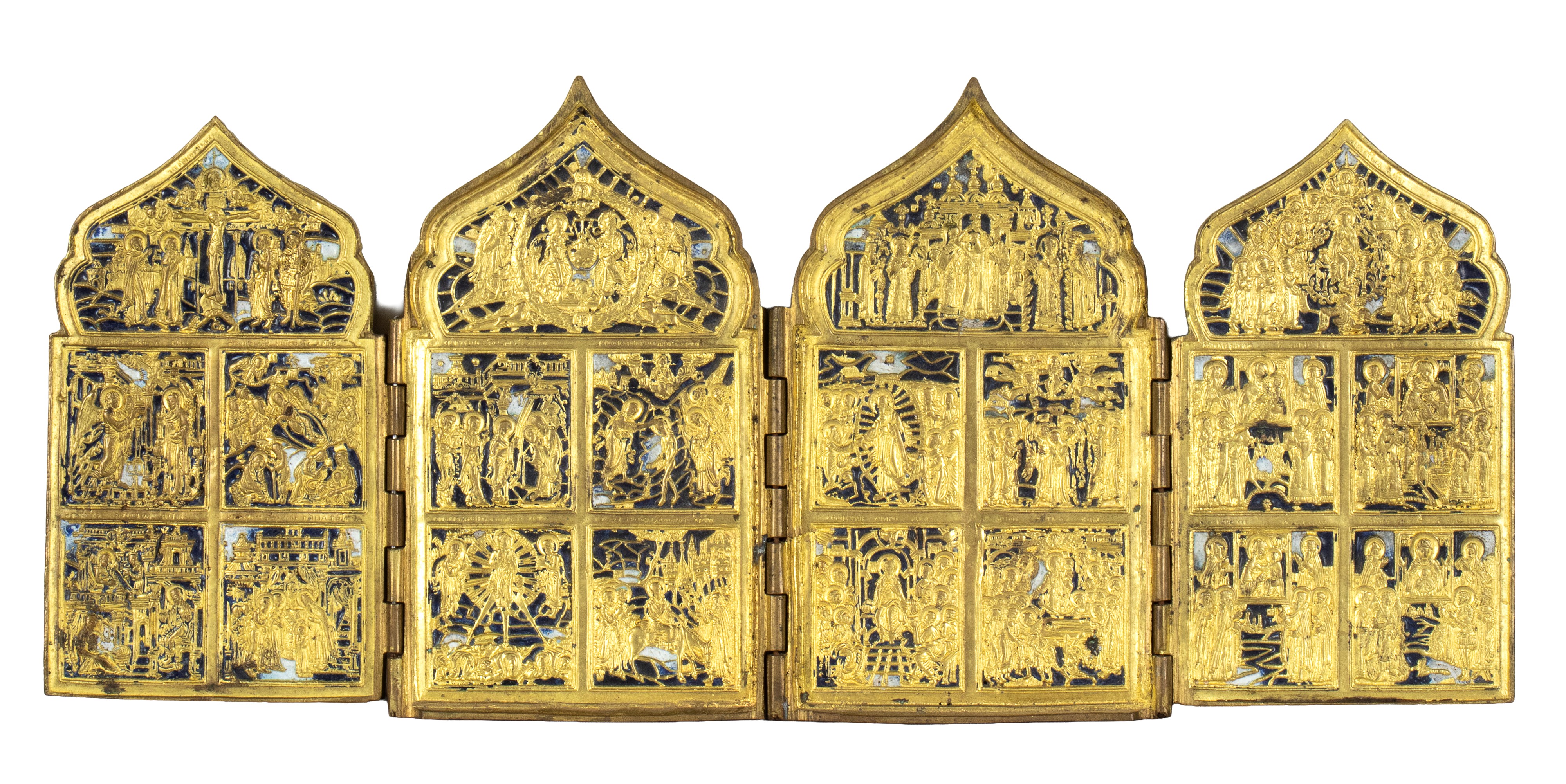
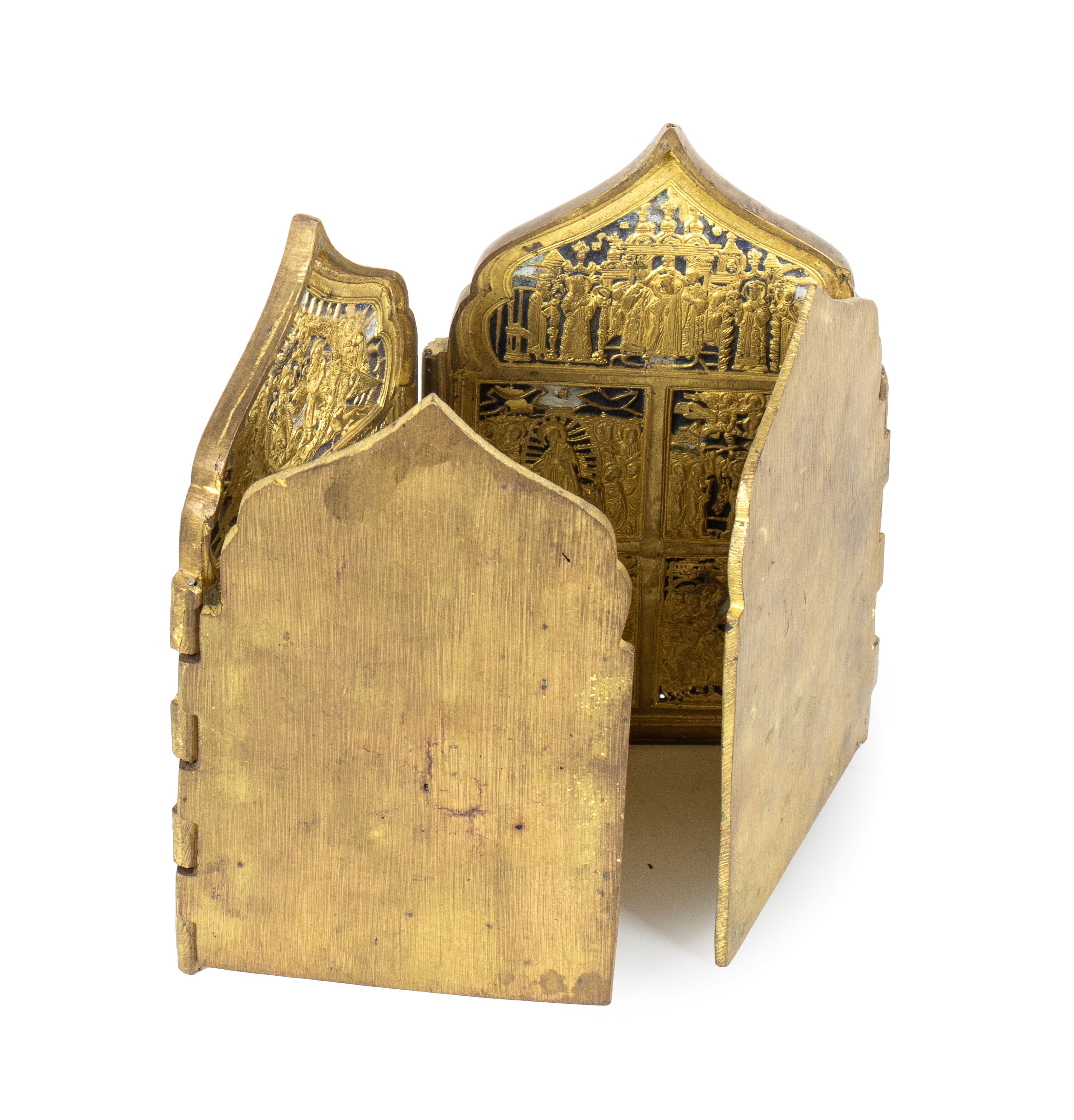
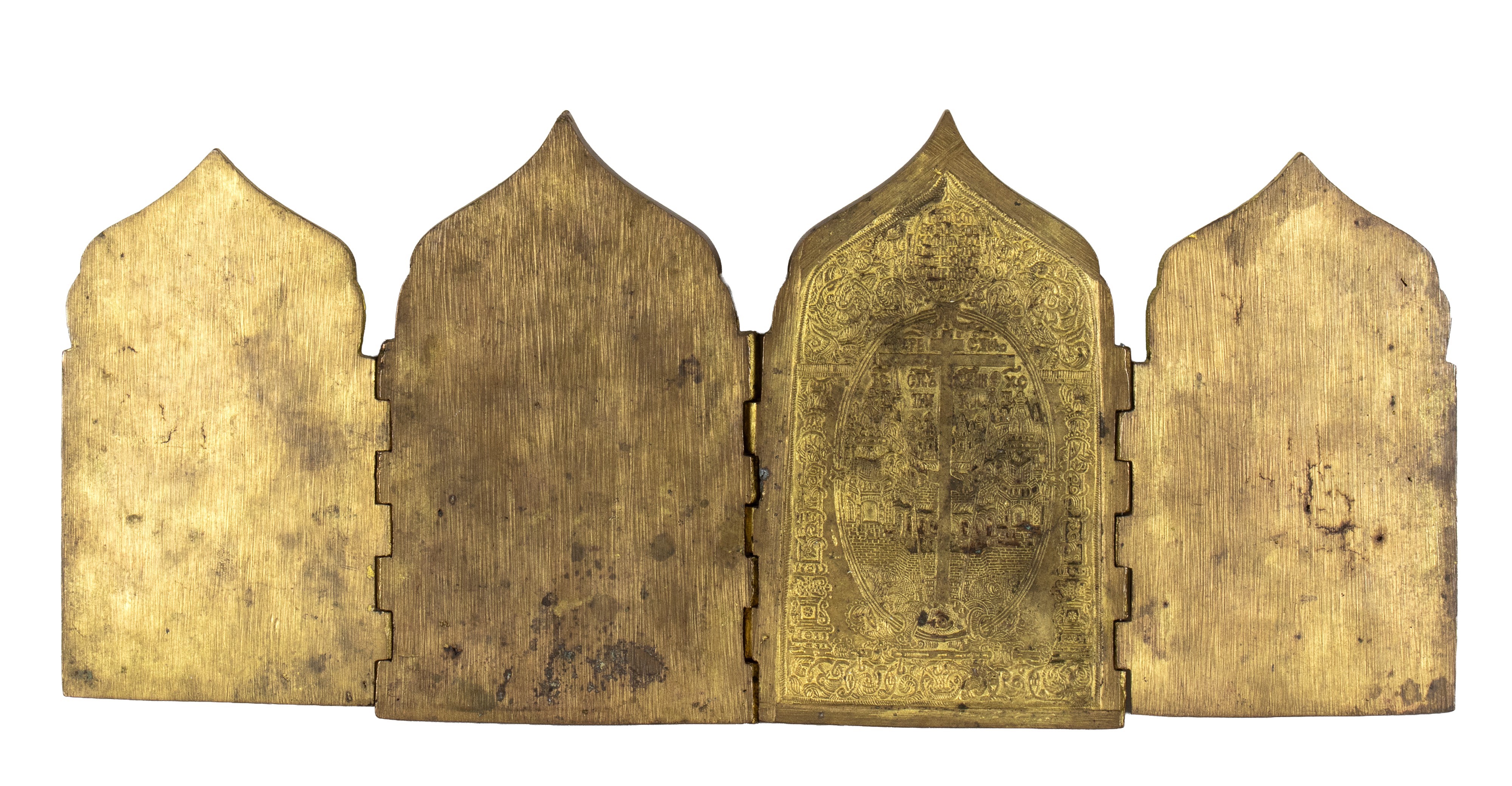
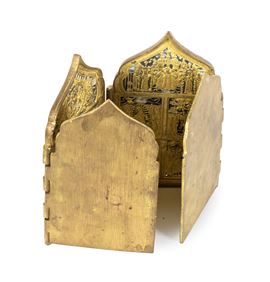
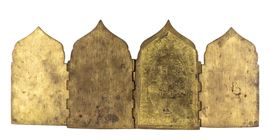
closely tied to the production of the Old Believer communities (Staroobrjadcy), the work is cast in bronze using the lost-wax technique, finely chased, fire-gilded, and embellished with polychrome champlevé enamels in the characteristic white and blue tones. From a historical and cultural perspective, this specific type of artifact met the precise practical and spiritual needs of the Old Believers who, following the seventeenth-century schism (Raskol) caused by the liturgical reforms of Patriarch Nikon, chose bronze and brass for their icons. The metal guaranteed the formal incorruptibility of the sacred images, withstanding frequent relocations during forced flights and pilgrimages. The exquisite craftsmanship of these micro-castings, capable of concentrating an extraordinary theological density within a few square centimeters, attests to the exceptionally high technical skill achieved by the clandestine foundries active in the northern Pomor'e regions or in the specialized workshops of Guslitsy and Vetka. The structure of the polyptych unfolds across four panels, each surmounted by a shaped ogival cusp. Within each panel, the scenes read sequentially from left to right and from top to bottom. The first cusp houses the solemn scene of the Crucifixion of Our Lord Jesus Christ on Calvary, while the second presents the depiction of the Holy Trinity. The cusp of the third panel displays the Exaltation of the Holy Cross, where the Patriarch of Jerusalem elevates the relic with the three onion domes of the Church of the Holy Sepulchre behind him, surrounded by two symmetrical wings of praying figures, among whom Constantine and his mother Helena are distinguished in imperial robes. The fourth and final cusp visually describes the liturgical hymn of the Akathistos, in which all of creation and the assembly of the righteous glorify Mary; at the center, the Virgin sits upon a high throne surrounded by a flowering vine recalling the Jesse Tree, flanked by Old Testament prophets holding their respective prophetic attributes such as the nest, the ladder, the candlestick, and the mountain. The cycle of the main panels opens with the first leaf, entirely dedicated to the mystery of the Incarnation. In the upper register, the narrative begins on the left with the Annunciation to the Mother of God, flanked on the right by the Nativity of Our Lord Jesus Christ, a densely composed and articulated form enclosing the Virgin reclining in the cave, the Child in the manger watched over by the ox and the ass, Saint Joseph tormented by doubts in the lower left, and the scene of the newborn's first bath in the opposite corner. In the lower register, the reading resumes on the left with the Nativity of the Mother of God, showing Saint Anne lying on the birthing bed and handmaidens tending to the infant Mary in the presence of Saint Joachim, closing on the right with the Presentation of the Virgin in the Temple, in which the child Virgin walks toward High Priest Zechariah. The second panel illustrates Christ's public manifestation and the revelation of His divine nature. The upper register opens on the left with the Presentation of Jesus in the Temple, where the elderly Simeon the God-Receiver welcomes the Child in his arms, followed on the right by the Baptism of Christ in the Jordan River. In the lower register, on the left, is the Transfiguration of the Lord, with Christ radiant on Mount Tabor between the prophets Moses and Elijah while the three apostles are blinded by the divine light, and on the right, Christ's Entry into Jerusalem welcomed by the crowd. The third panel focuses on the birth of the Church and the triumph over death. The upper register opens on the left with the Anastasis, the Descent into Hell which, in Orthodox theology, represents the Resurrection itself; here, Christ, enclosed in a radiant mandorla, tramples the broken gates of Hades and seizes Adam and Eve by the wrists to draw them out of the tombs. On the right follows the Ascension of the Lord, with Jesus ascending to heaven in a glory of light supported by angels. In the lower register of the same panel, on the left, is Pentecost, with the Apostles arranged in a semicircle around the central figure of the Virgin Mary, and on the right, the Dormition of the Mother of God, which illustrates the lifeless body of Mary on the funerary bed surrounded by weeping apostles, while behind her stands Christ, receiving her soul in the likeness of an infant in swaddling clothes. The fourth leaf departs from the traditional cycle of liturgical feasts to dedicate itself entirely to the veneration of four celebrated Miraculous Icons of the Mother of God, configuring itself as a profound tribute to Russian Marian devotion. In the upper left is depicted the Icon of the Mother of God of Tikhvin; in the scene below, before an altar, two wings of Holy Fathers, monks, and Church hierarchs bow in prayer toward the miraculous image. In the upper right is found the Icon of the Mother of God of Vladimir; the composition below shows at the center the complex multi-domed and bell-towered structure of the Cathedral of the Dormition in the Moscow Kremlin—the historical site where the original is kept—flanked by the great Moscow metropolitans and saints Peter, Jonah, Alexius, and Philip with their pastoral staves. In the lower left is inserted the Icon of the Mother of God of Smolensk, paired below with a solemn procession or supplication rite in which the faithful and monks surround a basin or holy spring, a detail linked to the spring's healing miracles associated with the icon. The polyptych concludes in the lower right with the Icon of the Mother of God of the Sign; the lower scene represents the praise of the Russian wonderworking saints, captured as they devoutly bow before the vision of the Sign which, according to historical tradition, saved the city of Novgorod from a siege. The external cover of the artifact, visible when closed, is dominated by a monumental eight-armed Golgota Cross inscribed within an elaborate oval medallion. Against the background stand the stylized outlines of the walls of Jerusalem, flanked by the instruments of the Passion (the lance and the sponge). In the lower cavity of the mountain, Adam's skull is inserted. The theological focal point of the façade is constituted by the ogival medallion placed in the upper register. Inside the cartouche appears a relief inscription executed in archaic Cyrillic characters, following the dense ornamental calligraphic technique known as Vjaz'.
Text (Old Church Slavonic): «КРЕСТУ ТВОЕМУ ПОКЛОНЯЕМСЯ ВЛАДЫКО И СВЯТОЕ ВОСКРЕСЕНИЕ ТВОЕ СЛАВИМ».
Translation: «We bow down before Your Cross, O Master, and we glorify Your Holy Resurrection».
The formula, drawn from the troparion of Sunday of the Cross, served a devotional introductive function: it welcomed the gaze of the faithful prior to the opening of the skladon, disposing the spirit to the contemplation of the cycle of liturgical feasts and Marian icons housed within the inner panels.
Provenance:
H.E. Most Rev. Francisco-Javier Lozano Sebastián, Titular Archbishop of Penafiel and Apostolic Nuncio Emeritus.
H.E. Most Rev. Francisco-Javier Lozano Sebastián, Titular Archbishop of Penafiel and Apostolic Nuncio Emeritus.
€ 150,00 / 200,00
Estimate
€ 100,00
Starting price
Live auction 411
THE ARCHBISHOP LOZANO COLLECTION OF ANTIQUE ORTHODOX ICONS. A Charity Auction for building a Youth Community Centre
Palazzo Caetani Lovatelli, fri 18 December 2026
SINGLE SESSION 18/12/2026 Hours 15:00
Discover Similar Lots
THE ARCHBISHOP LOZANO COLLECTION OF ANTIQUE [..]
Lot 144
Quadriptych travel icon (skladon)
THE ARCHBISHOP LOZANO COLLECTION OF ANTIQUE [..]
Lot 143
Quadriptych travel icon (skladon)
THE ARCHBISHOP LOZANO COLLECTION OF ANTIQUE [..]
Lot 148
Quadriptych travel icon (skladon)
THE ARCHBISHOP LOZANO COLLECTION OF ANTIQUE [..]
Lot 146
Quadriptych travel icon (skladon)
THE ARCHBISHOP LOZANO COLLECTION OF ANTIQUE [..]
Lot 156
Travel polyptych depicting the Twelve Orthodox Feasts and four miraculous apparitions of the Virgin
THE ARCHBISHOP LOZANO COLLECTION OF ANTIQUE [..]
Lot 153
Kiot cross
THE ARCHBISHOP LOZANO COLLECTION OF ANTIQUE [..]
Lot 140
Kiot cross
THE ARCHBISHOP LOZANO COLLECTION OF ANTIQUE [..]
Lot 25
Crucifixion of Our Lord Jesus Christ surrounded by scenes of the Passion and saints
THE ARCHBISHOP LOZANO COLLECTION OF ANTIQUE [..]
Lot 149
Kiot cross
THE ARCHBISHOP LOZANO COLLECTION OF ANTIQUE [..]
Lot 94