
34 bis
Russian Icon Depicting the Solovki Deesis with Christ Pantocrator Enthroned, Archangels and Interceding Saints, 19th century
Egg tempera on panel
Height x width x depth: 31 x 27 x 3 cm
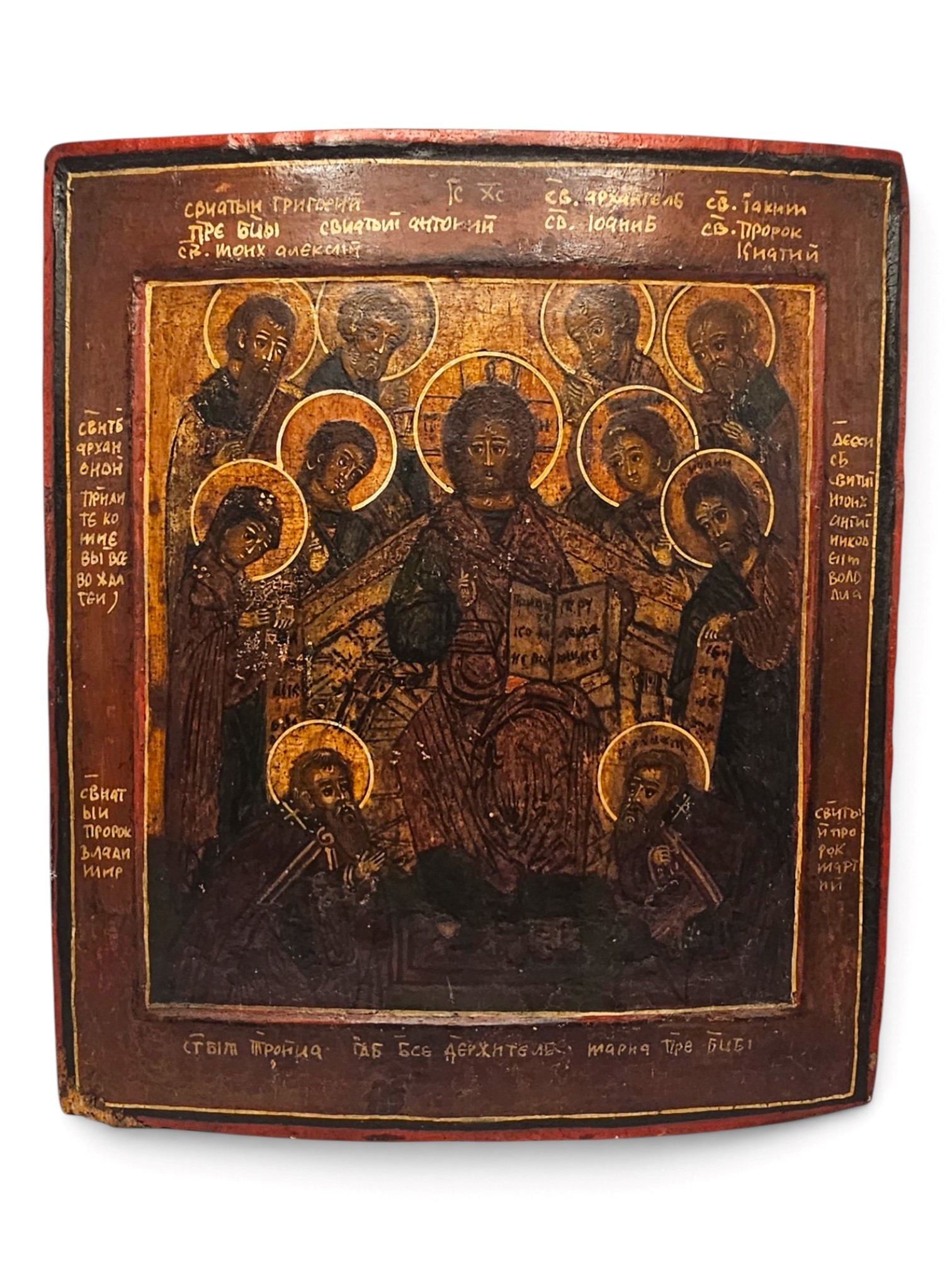
depicting an Extended Deesis, attributable to the particular iconographic variant known as the Solovki Deesis (Solovetsky Deesis), widespread in the religious tradition of the Russian Orthodox Church.
At the centre of the composition, Christ Pantocrator is depicted frontally, seated upon a monumental throne, with his right hand raised in blessing and his left holding an open Gospel Book bearing inscriptions in Church Slavonic Cyrillic characters. The Saviour, characterised by a solemn and contemplative expression, displays the traditional cruciform halo and wears a garment in reddish-brown tones, with drapery defined by subtle highlights and carefully delineated folds.
On either side of the throne, the Virgin Mary and Saint John the Baptist are symmetrically arranged in attitudes of veneration and intercession, accompanied by the Archangels Michael and Gabriel and additional figures of saints, distributed across several registers according to an elaborate hierarchical scheme. The figures, characterised by elongated faces, intense gazes and restrained gestures, are framed by gilded haloes that stand out against the ochre and gold tones of the background.
Particularly significant is the presence, in the lower part of the composition, of two kneeling monastic saints at the feet of Christ, identifiable, according to the iconographic tradition of the Solovki Deesis, as Saints Zosima and Savvaty, venerated as the founders of the Solovetsky Monastery, situated on the Solovetsky Islands in the White Sea, northern Russia.
This particular variant of the Deesis, a term of Greek origin meaning "supplication" or "intercession", expands the traditional Byzantine iconographic scheme through the inclusion of saints especially venerated within Russian monastic spirituality. Their presence carries a specific theological and devotional significance, representing the participation of the saints in the prayer of intercession addressed to Christ for the salvation of humanity.
The painted composition is distinguished by the rigorous balance of the figures, arranged according to a symmetrical and ascending scheme, in which the central image of the Saviour constitutes the visual and spiritual focus of the entire representation. The diagonal arrangement of the architectural elements of the throne, the stylised drapery and the closely grouped figures lend depth and movement to the scene, while preserving the frontality and solemnity characteristic of the Orthodox iconographic tradition.
The colour palette is dominated by shades of brown, deep red, dark green and ochre, enlivened by the gilding of the background and haloes. The treatment of the faces, characterised by subtle highlights and restrained chiaroscuro transitions, is complemented by the graphic rendering of the garments and ornamental details. The composition is enclosed within a painted reddish-brown border, outlined by fine gilded lines, while numerous inscriptions in Church Slavonic Cyrillic characters appear along the upper and lateral margins, identifying the sacred figures represented.
From a historical and artistic perspective, the work appears attributable to Russian icon painting of the 19th century, a period during which traditional figurative models of Byzantine and medieval origin continued to be reproduced, frequently reinterpreted by provincial workshops and monastic centres according to established stylistic conventions.
The arrangement of the figures, the graphic treatment of the drapery, the definition of the facial features and the predominantly dark colour palette are consistent with the production of Russian devotional icons of the 19th century, in which earlier compositional models remained in use. In particular, the iconography of the Solovki Deesis bears witness to the continuity of the cult of the monastic saints of northern Russia, whose veneration spread far beyond the geographical boundaries of the original monastery.
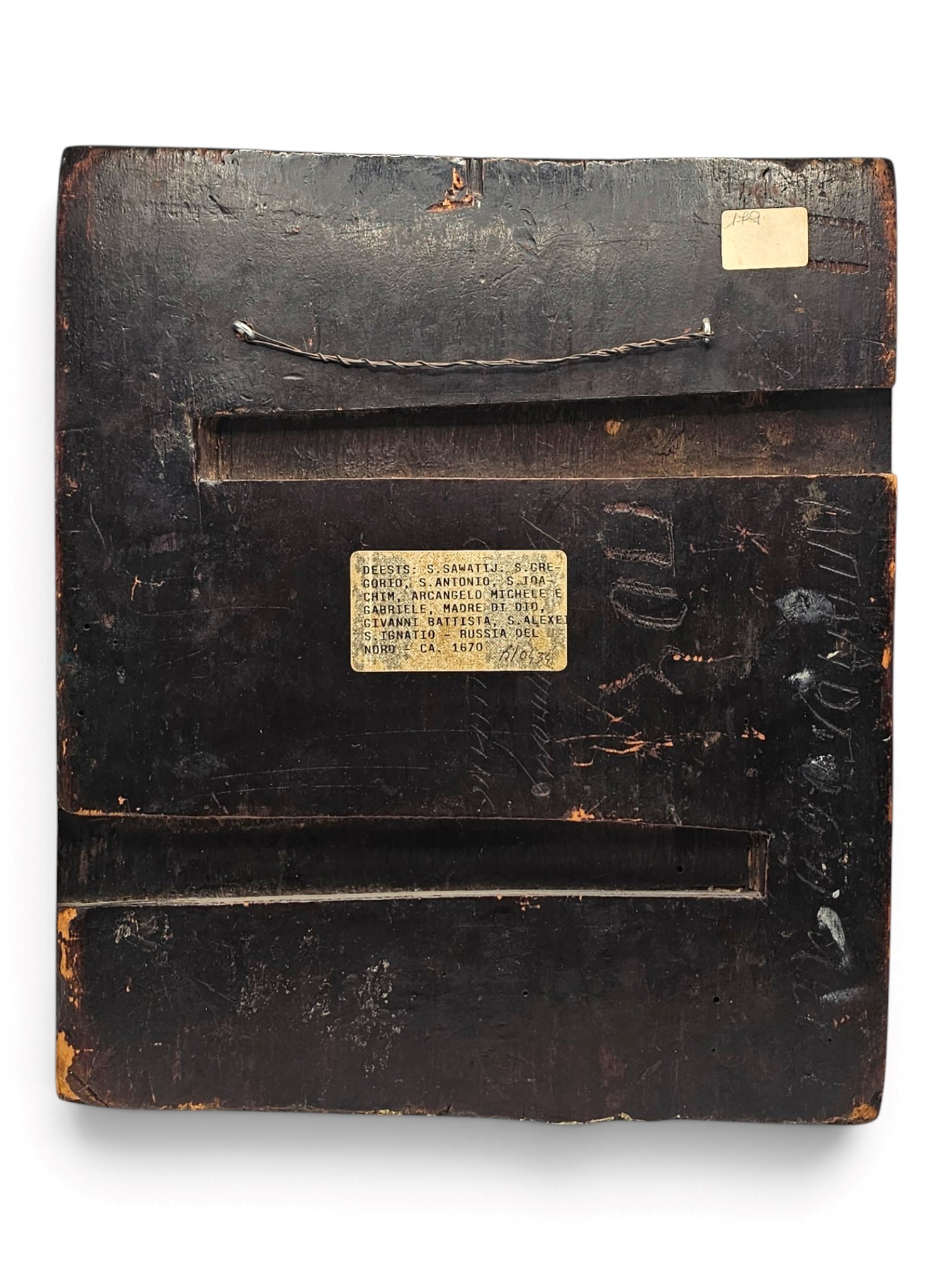
On the reverse of the panel, reinforced by two horizontal wooden battens, there is an old descriptive label in Italian, identifying the subject as a Deesis and listing several of the saints depicted, including Saint Savvaty, Saint Gregory, Saint Anthony, Saint Joachim, Saint Alexius and Saint Ignatius. The same label indicates a general provenance from "Northern Russia" and a date of approximately 1670, which should be regarded as an earlier traditional attribution, unsupported by conclusive documentary evidence.
In light of the stylistic and technical characteristics and the iconographic comparisons examined, a date within the 19th century, most probably between the middle and the latter half of the century, appears more plausible, while acknowledging the persistence of pictorial and compositional models belonging to an earlier tradition.
Literature:
A particularly significant iconographic comparison is provided by an icon depicting the Deesis of Solovki (Deesis delle Solovskij), preserved in the Pinacoteca Repossi in Chiari (Brescia), attributed to the Central Russian School and dated to the third quarter of the 19th century. This example displays a similar arrangement of the scene, with Christ Pantocrator enthroned, the Virgin Mary, Saint John the Baptist, the Archangels and additional figures of interceding saints, together with the presence of the monks Zosima and Savvaty at the feet of the Saviour. The correspondences primarily concern the compositional structure and the particular iconographic interpretation of the subject, providing a useful reference for the historical, artistic and chronological assessment of the present work.
Fondazione Biblioteca Morcelli–Pinacoteca Repossi, Chiari (Brescia), Deesis delle Solovskij (Deesis of Solovki), Central Russian School, third quarter of the 19th century, egg tempera on wooden panel with repoussé and chased silver oklad, inv. no. D00409. Regione Lombardia, Sistema Informativo Regionale Beni Culturali (SIRBeC), catalogue record OA 3y010-01674, compiled by Mariella Lobefaro and Camilla Gualina, 2016.
www.lombardiabeniculturali.it/opere-arte/schede/3y010-01674/
€ 600,00 / 800,00
Estimate
€ 300,00
Starting price
Live auction 411
THE ARCHBISHOP LOZANO COLLECTION OF ANTIQUE ORTHODOX ICONS. A Charity Auction for building a Youth Community Centre
Palazzo Caetani Lovatelli, fri 18 December 2026
SINGLE SESSION 18/12/2026 Hours 15:00