



29
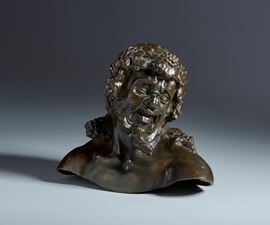
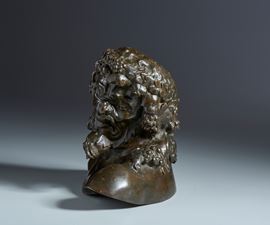
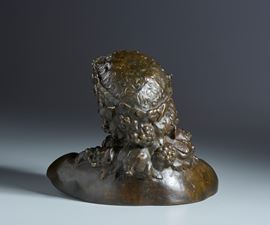
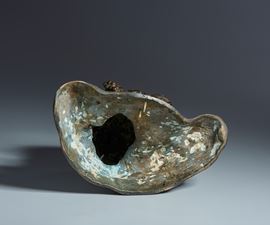
Bacchic Man. Adriaen de Vries (The Hague, 1556-Prague, 1626). From a 16th-17th century model? Accompanied by alloy studies.
cm 21 X 26 X 15
This extremely rare bust is based on a full-body sculpture now in the Hill Collection.
A very interesting chapter opens related to the Lombard Renaissance (initiatory) culture.
When it appeared at Sotheby's, in the early decades of the last century, this bronze Satyr-Bacchus was immediately attributed to a Northern pupil of Giambologna.
Susanna Zanuso initially linked it to the rain nymphaeum at Villa Litta in Lainate, Milan. This was a dispersal that occurred in the early 1900s. The Bacchus was placed on a tall column and sprayed water from various holes on visitors, a typical feature of Italian Renaissance gardens.
The first attribution was to Pelliccioni, a Lombard sculptor working in the Duomo factory.
This bronze, which was sold at an international auction and entered the Hill Collection, was attributed by Claudia Kryza Gersch to Adriaen de Vries, one of Giambologna's greatest students, and published.
Now, the interest of our bust lies in the fact that there are no ancient copies of the subject, which has been placed on a tall column since the 17th century. Furthermore, it is not a slavish copy but presents some differences from the original, therefore it is not a cast, but an original work.
Metallurgical tests are underway to establish the date of construction, which would completely change the assessment.
Bibliography:
Patricia Wengraf, AA.VV., Renaissance & Baroque Bronzes from the Hill Collection, Paul Holberton Publishing, London, 2014, pp.248-261.
A very interesting chapter opens related to the Lombard Renaissance (initiatory) culture.
When it appeared at Sotheby's, in the early decades of the last century, this bronze Satyr-Bacchus was immediately attributed to a Northern pupil of Giambologna.
Susanna Zanuso initially linked it to the rain nymphaeum at Villa Litta in Lainate, Milan. This was a dispersal that occurred in the early 1900s. The Bacchus was placed on a tall column and sprayed water from various holes on visitors, a typical feature of Italian Renaissance gardens.
The first attribution was to Pelliccioni, a Lombard sculptor working in the Duomo factory.
This bronze, which was sold at an international auction and entered the Hill Collection, was attributed by Claudia Kryza Gersch to Adriaen de Vries, one of Giambologna's greatest students, and published.
Now, the interest of our bust lies in the fact that there are no ancient copies of the subject, which has been placed on a tall column since the 17th century. Furthermore, it is not a slavish copy but presents some differences from the original, therefore it is not a cast, but an original work.
Metallurgical tests are underway to establish the date of construction, which would completely change the assessment.
Bibliography:
Patricia Wengraf, AA.VV., Renaissance & Baroque Bronzes from the Hill Collection, Paul Holberton Publishing, London, 2014, pp.248-261.
€ 3.000,00 / 6.000,00
Estimate
2.000,00 €
Starting price
€
Your bid
(The reserve price has not been exceeded)
(The reserve price has been exceeded)
Set your maximum bid
Live auction 390
CUPRUM. An important collection of ancient small bronzes
Palazzo Caetani Lovatelli, fri 26 June 2026
SINGLE SESSION 26/06/2026 Hours 16:00
Discover Similar Lots
CUPRUM. An important collection of ancient [..]
Lot 16
River God. Pietro Tacca (Carrara, 1577-Florence, 1640) Workshop. Bronze with a translucent reddish patina. [..]
CUPRUM. An important collection of ancient [..]
Lot 36
Rampant lion. Florentine art, 16th-17th century. Bronze, transparent reddish patina. On a green marble [..]
CUPRUM. An important collection of ancient [..]
Lot 46
Satiro e ninfa, Arte veneta, XVII secolo, Bronzo a patina nera bituminosa
CUPRUM. An important collection of ancient [..]
Lot 34
Bacchus with a Panther. Barthelemy Prieur (1536-1611). 17th century. Bronze with a transparent patina [..]
CUPRUM. An important collection of ancient [..]
Lot 31
Pair of candlesticks. Niccolò Roccatagliata (1560 - 1636) School of. 16th-17th century. Bronze, black [..]
CUPRUM. An important collection of ancient [..]
Lot 41
Christ, Living and Naked. Francesco Mochi (Montevarchi, 1580-Rome 1654). Attributed. 17th century. Patinated [..]
CUPRUM. An important collection of ancient [..]
Lot 37
Hercules and the Nemean Lion. Florentine art, 16th-17th century. Patinated bronze, splendid transparent [..]
CUPRUM. An important collection of ancient [..]
Lot 47
Cavallo al passo, Giambologna (Douai, 1529- Firenze, 1608) Bottega di. Bronzo, lacca rossa trasparen [..]
CUPRUM. An important collection of ancient [..]
Lot 25
Christ at the Column. Tuscan School? 17th-18th century. Bronze with brown patina.
CUPRUM. An important collection of ancient [..]
Lot 4