
31
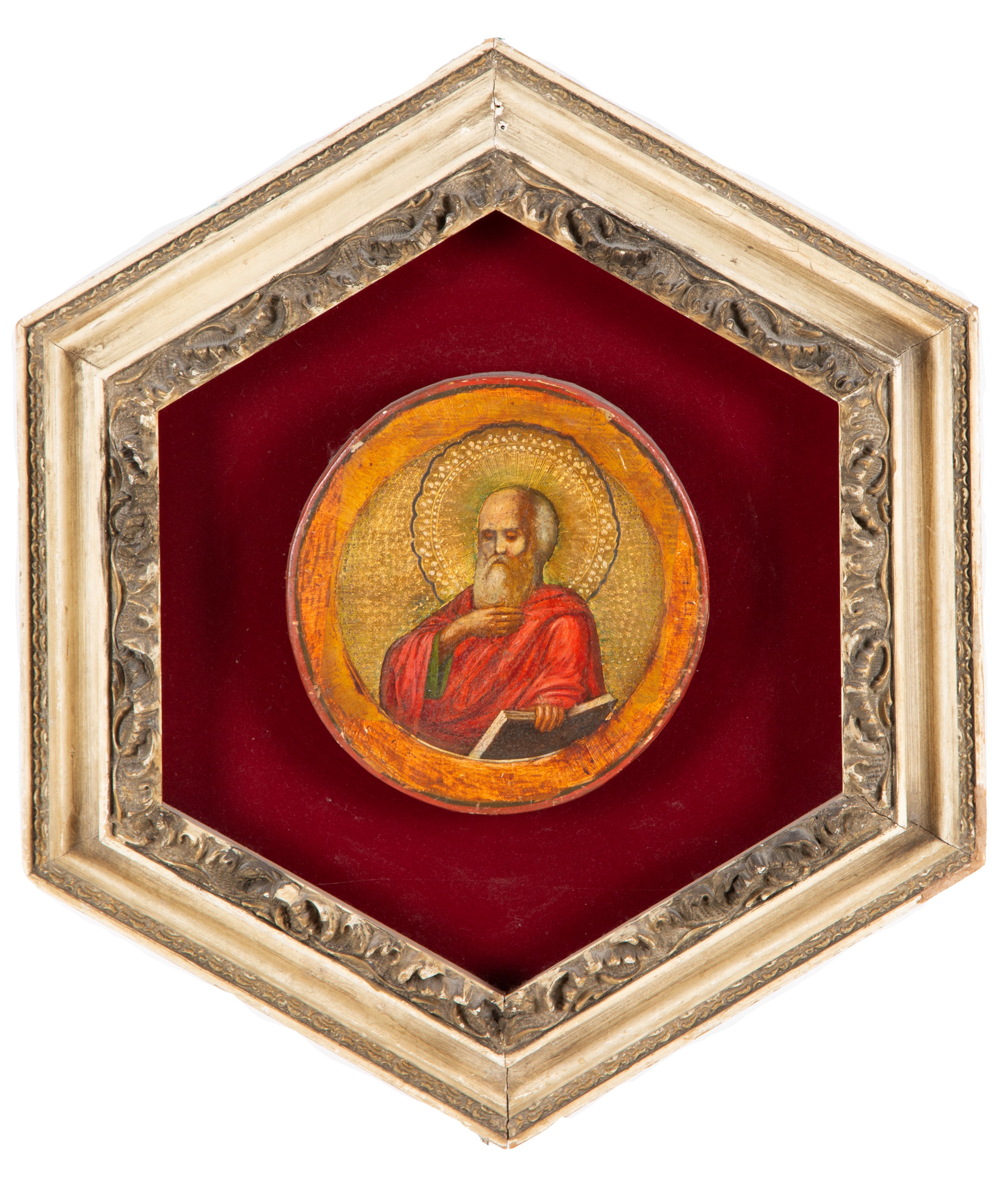
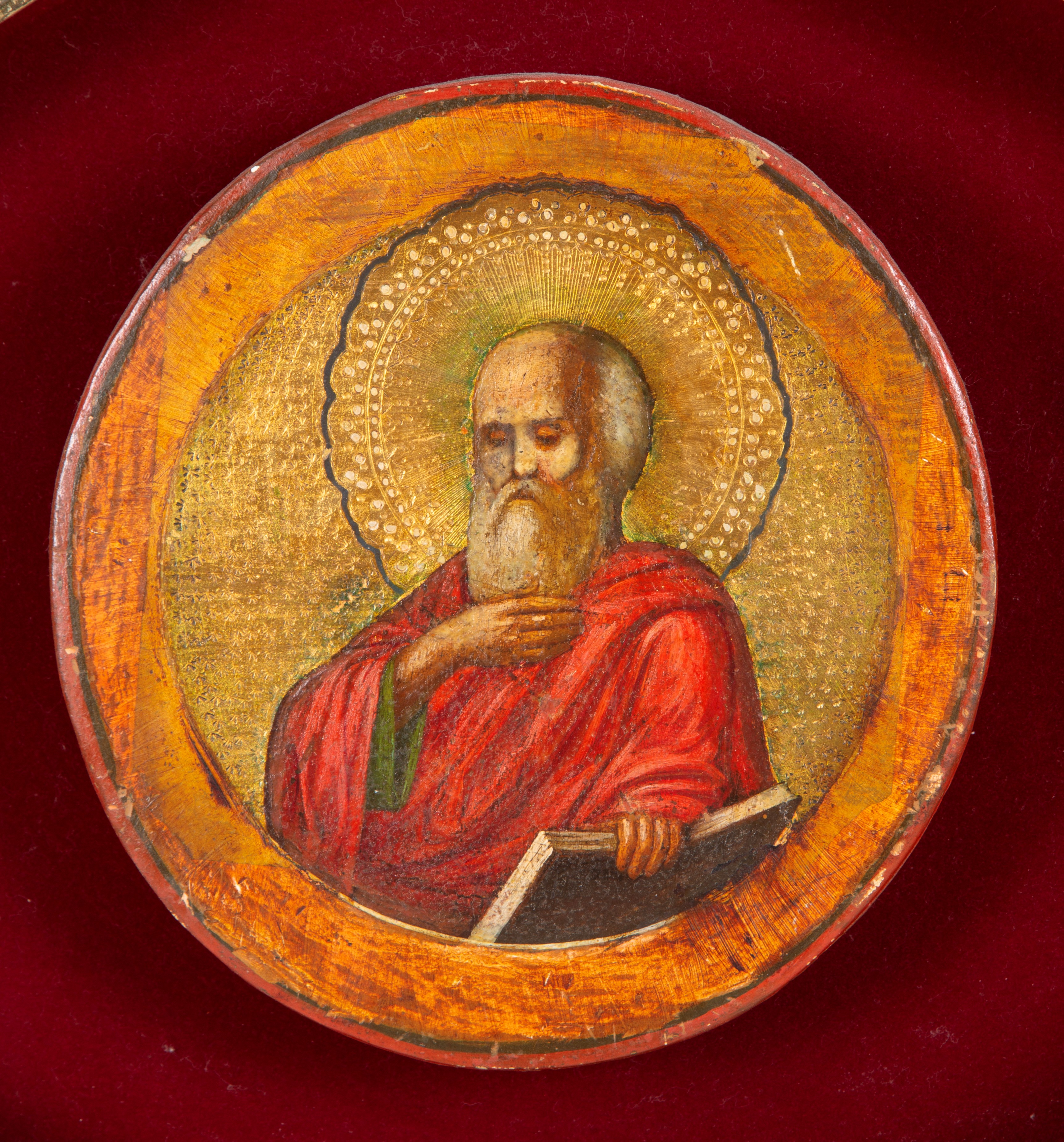
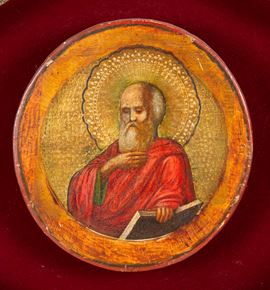
Russian Icon depicting Saint John the Evangelist, late 19th century
Tempera on panel
Diameter: 21 cm
Small icon on a circular wooden panel depicting Saint John the Evangelist, one of the Twelve Apostles, author of the Fourth Gospel, and a central figure in the Eastern Christian tradition.
The saint is portrayed in half-length, with his head gently inclined and his gaze contemplative, following an iconographic type that emphasizes his meditative nature and the profound theological inspiration traditionally associated with him. His right hand is placed upon his chest in a gesture of contemplation, while his left hand supports the Book of the Gospels, symbolizing both his evangelical mission and the revelation of the Divine Word.
The Evangelist is depicted as an elderly man with a broad forehead, a long white beard, and thinning hair, in accordance with the traditional Byzantine and Russian iconographic model. He wears a green tunic partially covered by a voluminous red mantle, whose drapery is rendered through delicate highlights that impart plasticity and depth without departing from the strict visual language of Orthodox icon painting.
The background is entirely covered with gold leaf, while the halo is finely embellished with elaborate punched and engraved concentric ornamentation composed of delicate radiating lines and rows of small impressed circles, a decorative solution characteristic of the finest Russian productions of the second half of the nineteenth century. A broad gilded border frames the composition, enhancing the monumentality of the figure despite the icon's modest dimensions.
Between the second half of the nineteenth century and the early decades of the twentieth century, the principal workshops of Central Russia, particularly those of Moscow, Mstëra, Palekh, and Kholuy, produced numerous small-format icons distinguished by a refined balance between the revival of the seventeenth-century Moscow School tradition and a more naturalistic, academically influenced pictorial language developed during the Imperial period.
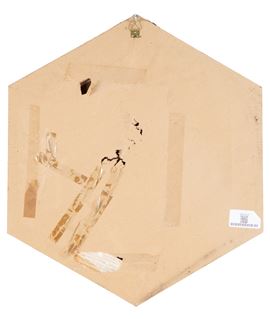
The icon is presently housed within a hexagonal wooden display frame lined with red velvet, probably manufactured during the twentieth century for devotional or exhibition purposes.
The saint is portrayed in half-length, with his head gently inclined and his gaze contemplative, following an iconographic type that emphasizes his meditative nature and the profound theological inspiration traditionally associated with him. His right hand is placed upon his chest in a gesture of contemplation, while his left hand supports the Book of the Gospels, symbolizing both his evangelical mission and the revelation of the Divine Word.
The Evangelist is depicted as an elderly man with a broad forehead, a long white beard, and thinning hair, in accordance with the traditional Byzantine and Russian iconographic model. He wears a green tunic partially covered by a voluminous red mantle, whose drapery is rendered through delicate highlights that impart plasticity and depth without departing from the strict visual language of Orthodox icon painting.
The background is entirely covered with gold leaf, while the halo is finely embellished with elaborate punched and engraved concentric ornamentation composed of delicate radiating lines and rows of small impressed circles, a decorative solution characteristic of the finest Russian productions of the second half of the nineteenth century. A broad gilded border frames the composition, enhancing the monumentality of the figure despite the icon's modest dimensions.
Between the second half of the nineteenth century and the early decades of the twentieth century, the principal workshops of Central Russia, particularly those of Moscow, Mstëra, Palekh, and Kholuy, produced numerous small-format icons distinguished by a refined balance between the revival of the seventeenth-century Moscow School tradition and a more naturalistic, academically influenced pictorial language developed during the Imperial period.
The icon is presently housed within a hexagonal wooden display frame lined with red velvet, probably manufactured during the twentieth century for devotional or exhibition purposes.
€ 250,00 / 300,00
Estimate
180,00 €
Starting price
€
Your bid
(The reserve price has not been exceeded)
(The reserve price has been exceeded)
Set your maximum bid
Live auction 396
OLD ORTHODOX ICONS FROM 17TH UNTIL 20TH CENTURY. Including a collection of important Traveling Russian Icons
Palazzo Caetani Lovatelli, tue 29 September 2026
SINGLE SESSION 29/09/2026 Hours 15:00
Discover Similar Lots
ANCIENT FURNITURE AND WORKS OF ART FROM [..]
Lot 116
Bust of Venus
ANCIENT FURNITURE AND WORKS OF ART FROM [..]
Lot 101
A pair of paintings depicting battle and hunting scenes
ANCIENT FURNITURE AND WORKS OF ART FROM [..]
Lot 208
Carved and gilded mirror
ANCIENT FURNITURE AND WORKS OF ART FROM [..]
Lot 207
Carved and gilded wooden mirror
ART AND ARTISTS' BOOKS FROM THE MARIO PADOVAN'S [..]
Lot 191
Icone, Sindone e Immagini del Sacro (2 volumi)
ANCIENT FURNITURE AND WORKS OF ART FROM [..]
Lot 151
Copper pyx with polychrome enamel
ART AND ARTISTS' BOOKS FROM THE MARIO PADOVAN'S [..]
Lot 234
Maestri italiani tra Ottocento e Novecento (3 volumi)
ANCIENT FURNITURE AND WORKS OF ART FROM [..]
Lot 109
Pair of vases with lids
ANCIENT FURNITURE AND WORKS OF ART FROM [..]
Lot 142