
6
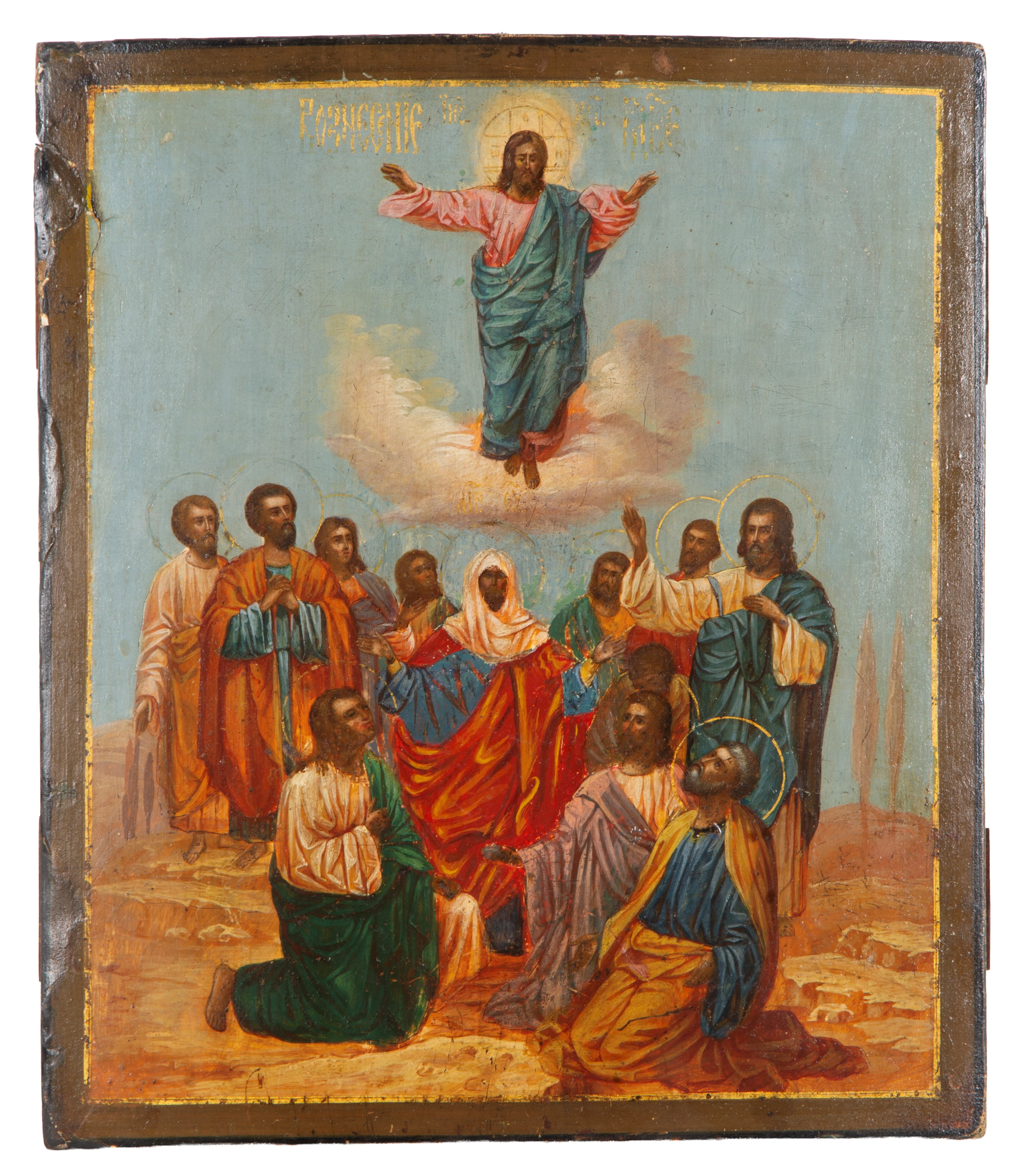
Russian icon depicting the Ascension of Christ, late 19th century (circa 1880–1900)
Tempera on panel
Height x width: 31 × 26,5 cm
Icon on a wooden panel depicting the Ascension of Christ (Voznesenie Gospodne), one of the Twelve Great Feasts (Dodekaorton) of the Orthodox liturgical calendar, celebrated forty days after the Resurrection.
The composition depicts Christ in the upper register ascending into Heaven, borne aloft upon a luminous cloud. He is shown frontally, with His arms outstretched in a gesture of blessing and glorification, wearing a rose-colored tunic and a flowing blue mantle. His cruciform halo and the delicate Slavonic inscription clearly identify Him as the Savior.
In the lower part of the composition, the Apostles are gathered around the Mother of God, who occupies the central position in accordance with traditional Eastern iconography. The Virgin, clad in a red maphorion over a blue tunic, is depicted in a solemn attitude of prayer, forming the visual and spiritual focal point of the ecclesial community assembled at the foot of the Mount of Olives.
The Apostles are arranged symmetrically on either side of the Virgin, each displaying gestures that express amazement, contemplation, and adoration before the miraculous event. Some gaze upward toward Christ, others converse among themselves, while one Apostle points toward Heaven, directing the viewer's attention to the glorified Redeemer.
The background is characterized by a luminous blue sky that lends an exceptional sense of openness to the composition, while the rocky landscape, rendered in warm ochre and brown tones, evokes the Mount of Olives. The halos are executed in gold leaf and defined by delicate engraved outlines, enhancing the overall luminosity of the icon.
The composition is distinguished by the harmonious balance of its figures, the brilliance of its palette, and the refined modeling of the faces, all characteristic features of Russian icon painting during the late Imperial period.
The Ascension is one of the principal subjects of Orthodox iconography, representing the culmination of Christ's earthly ministry and the promise of humanity's future glorification.
Between the second half of the nineteenth century and the early decades of the twentieth century, the principal workshops of Central Russia, particularly those of Moscow, Mstëra, Palekh, and Kholuy, produced numerous icons intended for private devotion. These works drew inspiration from the seventeenth-century Moscow School while reinterpreting its models through a softer, more luminous pictorial language influenced by Imperial academic painting.
The composition depicts Christ in the upper register ascending into Heaven, borne aloft upon a luminous cloud. He is shown frontally, with His arms outstretched in a gesture of blessing and glorification, wearing a rose-colored tunic and a flowing blue mantle. His cruciform halo and the delicate Slavonic inscription clearly identify Him as the Savior.
In the lower part of the composition, the Apostles are gathered around the Mother of God, who occupies the central position in accordance with traditional Eastern iconography. The Virgin, clad in a red maphorion over a blue tunic, is depicted in a solemn attitude of prayer, forming the visual and spiritual focal point of the ecclesial community assembled at the foot of the Mount of Olives.
The Apostles are arranged symmetrically on either side of the Virgin, each displaying gestures that express amazement, contemplation, and adoration before the miraculous event. Some gaze upward toward Christ, others converse among themselves, while one Apostle points toward Heaven, directing the viewer's attention to the glorified Redeemer.
The background is characterized by a luminous blue sky that lends an exceptional sense of openness to the composition, while the rocky landscape, rendered in warm ochre and brown tones, evokes the Mount of Olives. The halos are executed in gold leaf and defined by delicate engraved outlines, enhancing the overall luminosity of the icon.
The composition is distinguished by the harmonious balance of its figures, the brilliance of its palette, and the refined modeling of the faces, all characteristic features of Russian icon painting during the late Imperial period.
The Ascension is one of the principal subjects of Orthodox iconography, representing the culmination of Christ's earthly ministry and the promise of humanity's future glorification.
Between the second half of the nineteenth century and the early decades of the twentieth century, the principal workshops of Central Russia, particularly those of Moscow, Mstëra, Palekh, and Kholuy, produced numerous icons intended for private devotion. These works drew inspiration from the seventeenth-century Moscow School while reinterpreting its models through a softer, more luminous pictorial language influenced by Imperial academic painting.
€ 800,00 / 1.000,00
Estimate
550,00 €
Starting price
€
Your bid
(The reserve price has not been exceeded)
(The reserve price has been exceeded)
Set your maximum bid
Live auction 396
OLD ORTHODOX ICONS FROM 17TH UNTIL 20TH CENTURY. Including a collection of important Traveling Russian Icons
Palazzo Caetani Lovatelli, tue 29 September 2026
SINGLE SESSION 29/09/2026 Hours 15:00
Discover Similar Lots
ANCIENT FURNITURE AND WORKS OF ART FROM [..]
Lot 154
Terracotta statue depicting Saint Joseph
ANCIENT FURNITURE AND WORKS OF ART FROM [..]
Lot 116
Bust of Venus
ANCIENT FURNITURE AND WORKS OF ART FROM [..]
Lot 364
Pair of Large Kerosene Lamps
ART AND ARTISTS' BOOKS FROM THE MARIO PADOVAN'S [..]
Lot 234
Maestri italiani tra Ottocento e Novecento (3 volumi)
ANCIENT FURNITURE AND WORKS OF ART FROM [..]
Lot 109
Pair of vases with lids
ANCIENT FURNITURE AND WORKS OF ART FROM [..]
Lot 142
Bronze sculpture depicting Nessus and Deianira
ANCIENT FURNITURE AND WORKS OF ART FROM [..]
Lot 32
Georgian English extendable table
ANCIENT FURNITURE AND WORKS OF ART FROM [..]
Lot 89
Raffaello Sanzio
Deposition
ART AND ARTISTS' BOOKS FROM THE MARIO PADOVAN'S [..]
Lot 375
Arte russa e sovietica: icone, realismo e avanguardie (3 volumi)
ANCIENT FURNITURE AND WORKS OF ART FROM [..]
Lot 224