
5
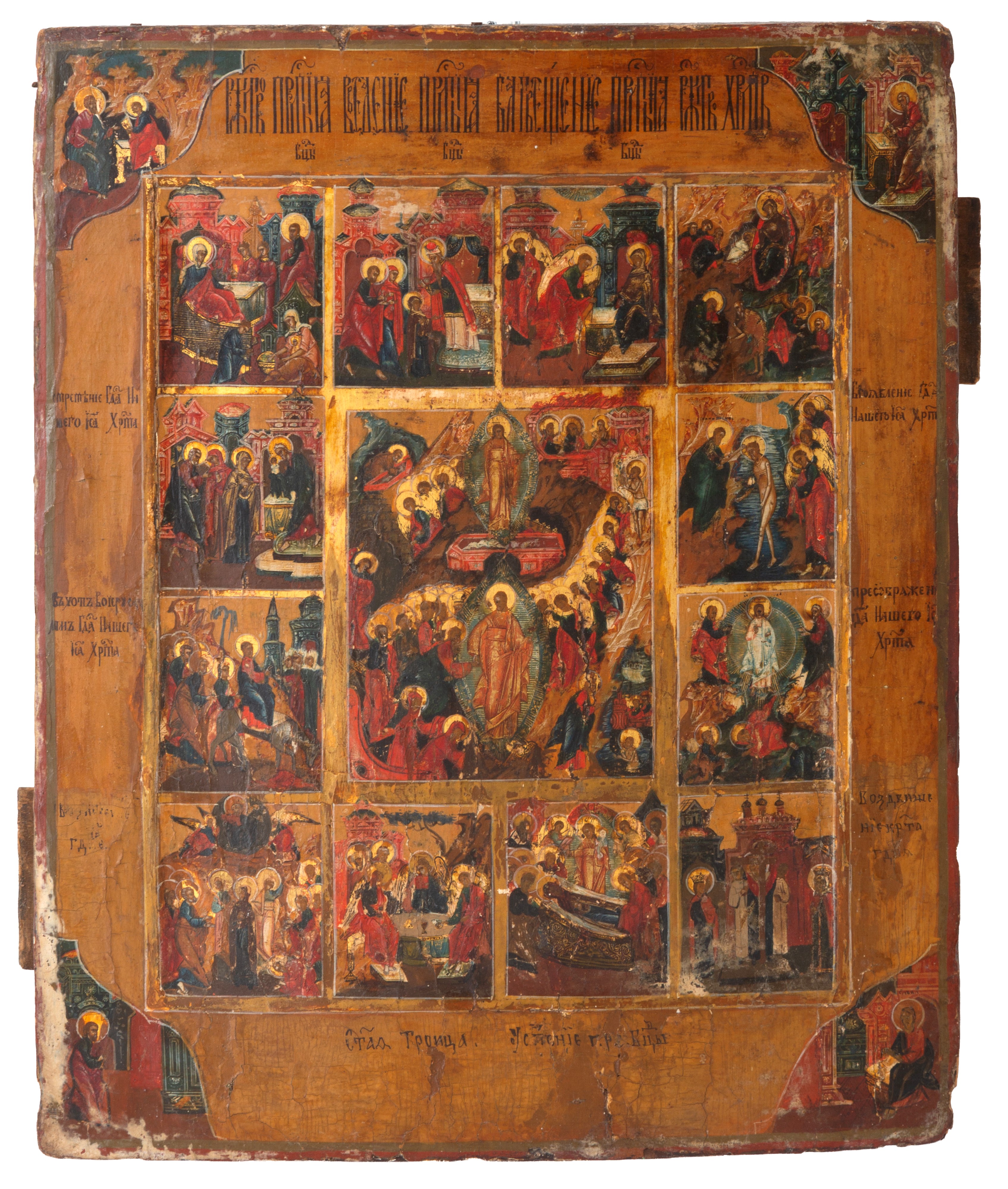
Russian Icon Depicting the Twelve Great Feasts with the Resurrection of Christ and the Anastasis at the Center, late 18th – early 19th century
Tempera on panel
Height x width: 31 x 26 cm
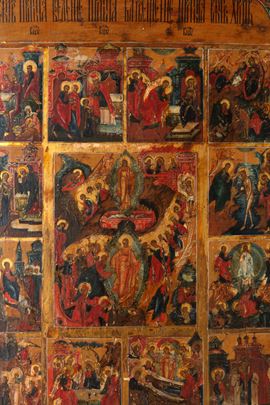
Icon on panel depicting the cycle of the Twelve Great Feasts of the Orthodox liturgy (Dodekaorton), arranged around the central scene of the Resurrection of Christ (Anastasis), the traditional Eastern representation of Christ's victory over death.
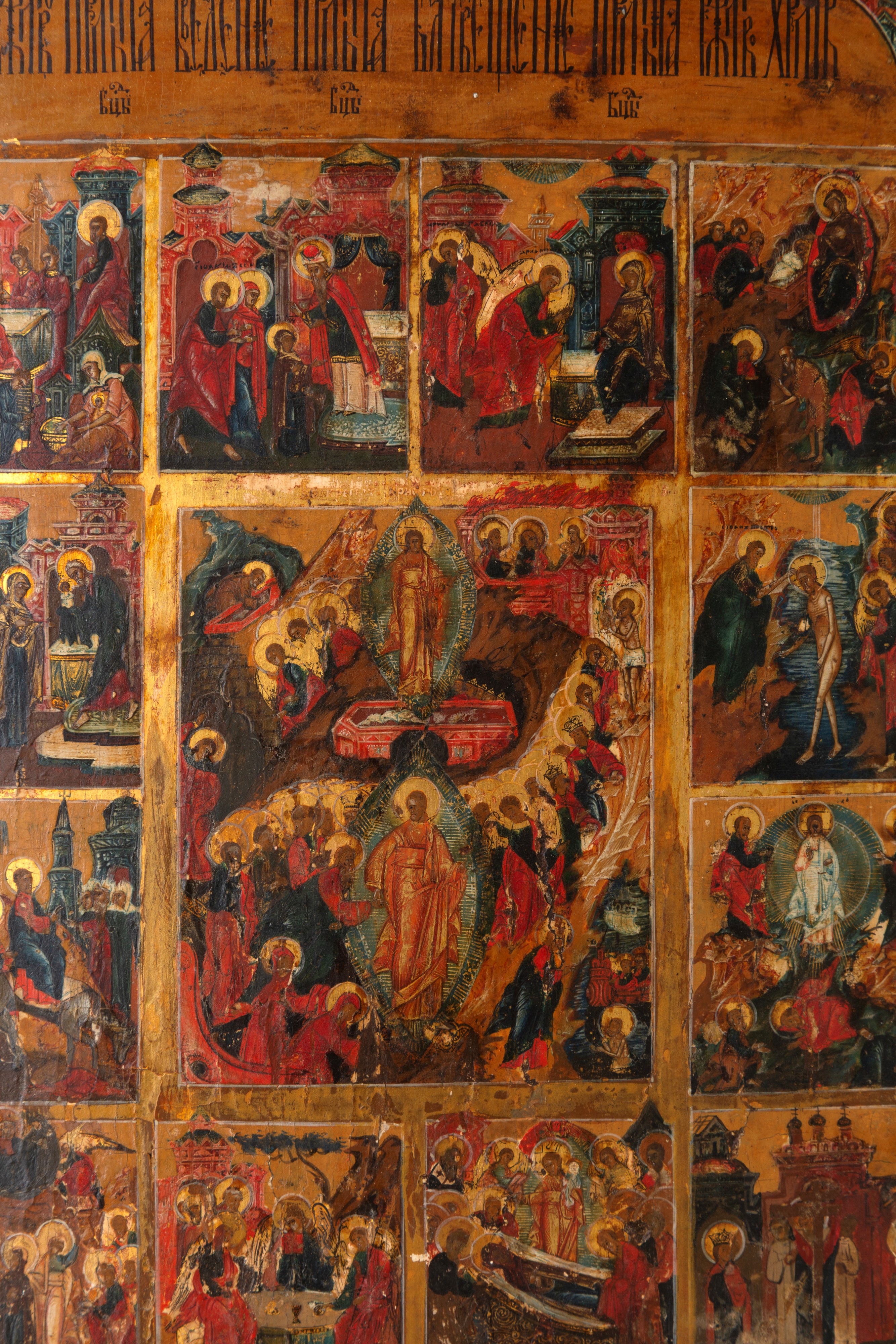
The composition is structured according to a complex narrative scheme divided into numerous panels. At the center, the Risen Christ is depicted within a radiant mandorla as He descends into Hades to deliver Adam and Eve, surrounded by the Patriarchs, Prophets, and Righteous of the Old Testament, in accordance with the established Byzantine-Russian iconographic tradition.
Surrounding the central scene is the cycle of the principal feasts of the Orthodox liturgical year, each identified by inscriptions in Church Slavonic. Recognizable episodes include the Nativity of the Virgin, the Presentation of the Virgin in the Temple, the Annunciation, the Nativity of Christ, the Baptism of Christ, the Entry into Jerusalem, the Transfiguration, the Dormition of the Virgin, and other fundamental events in the history of salvation.
The entire composition is enclosed within a broad ochre border bearing Church Slavonic inscriptions and is further enriched at the four corners by representations of the Four Evangelists engaged in writing their respective Gospels. The background alternates ochre, red, green, and brown tones, reflecting the palette characteristic of Russian icons produced for private devotion.
The Dodekaorton represents one of the most comprehensive visual syntheses of Orthodox theology, bringing together in a single image the principal events in the lives of Christ and the Mother of God celebrated throughout the liturgical year. This iconographic type became particularly widespread in the workshops of central Russia between the late eighteenth and the first half of the nineteenth century, where it was intended both for domestic iconostases and for private devotional use.
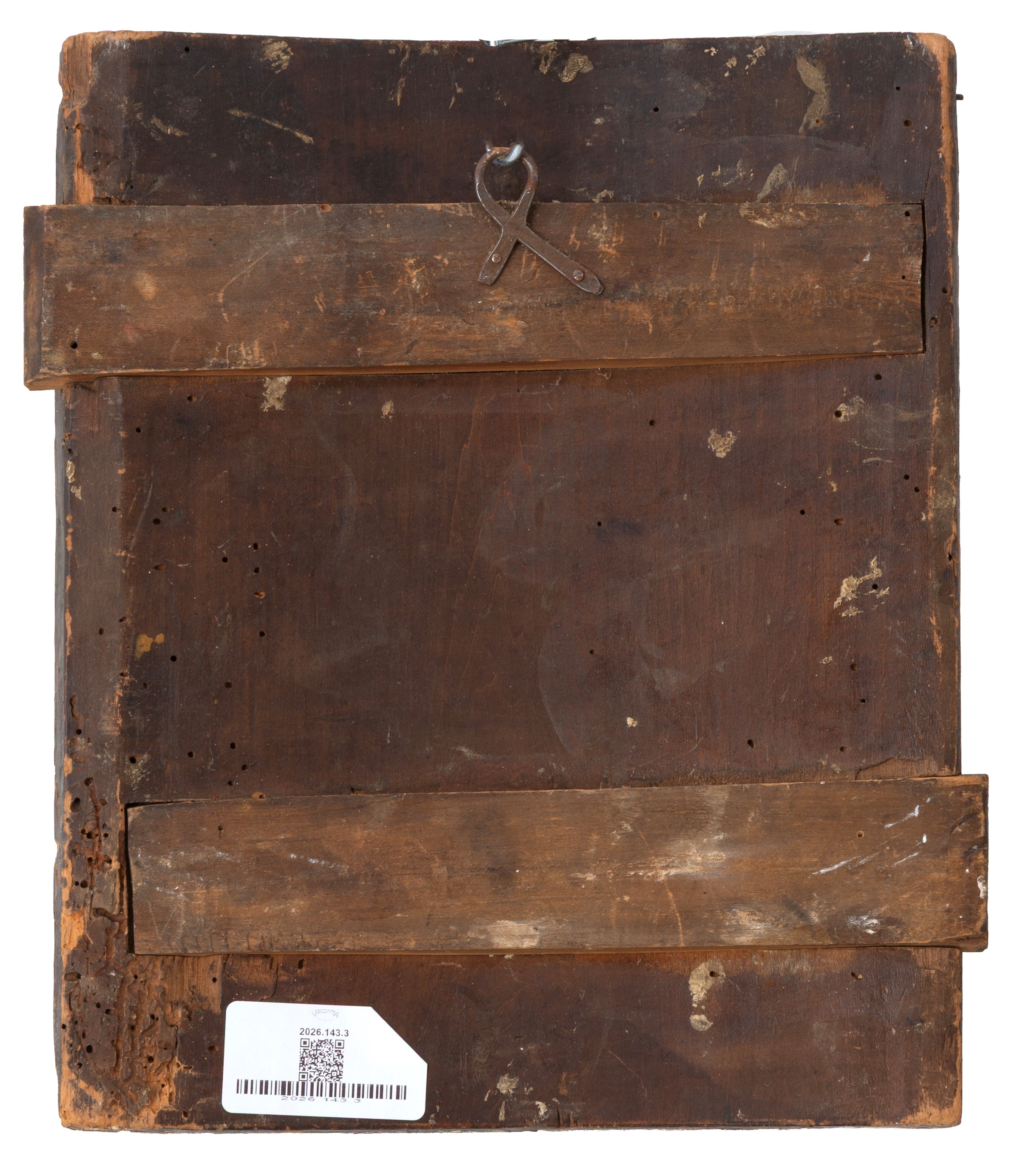
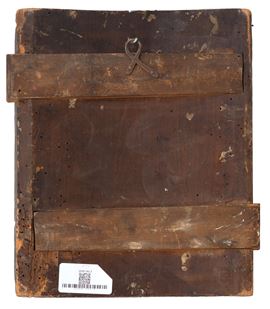
On the basis of its stylistic characteristics, compositional layout, Church Slavonic inscriptions, painting technique, and the construction of its wooden support, the present icon may be attributed to a Russian workshop active between the late eighteenth and the first half of the nineteenth century.
The composition is structured according to a complex narrative scheme divided into numerous panels. At the center, the Risen Christ is depicted within a radiant mandorla as He descends into Hades to deliver Adam and Eve, surrounded by the Patriarchs, Prophets, and Righteous of the Old Testament, in accordance with the established Byzantine-Russian iconographic tradition.
Surrounding the central scene is the cycle of the principal feasts of the Orthodox liturgical year, each identified by inscriptions in Church Slavonic. Recognizable episodes include the Nativity of the Virgin, the Presentation of the Virgin in the Temple, the Annunciation, the Nativity of Christ, the Baptism of Christ, the Entry into Jerusalem, the Transfiguration, the Dormition of the Virgin, and other fundamental events in the history of salvation.
The entire composition is enclosed within a broad ochre border bearing Church Slavonic inscriptions and is further enriched at the four corners by representations of the Four Evangelists engaged in writing their respective Gospels. The background alternates ochre, red, green, and brown tones, reflecting the palette characteristic of Russian icons produced for private devotion.
The Dodekaorton represents one of the most comprehensive visual syntheses of Orthodox theology, bringing together in a single image the principal events in the lives of Christ and the Mother of God celebrated throughout the liturgical year. This iconographic type became particularly widespread in the workshops of central Russia between the late eighteenth and the first half of the nineteenth century, where it was intended both for domestic iconostases and for private devotional use.
On the basis of its stylistic characteristics, compositional layout, Church Slavonic inscriptions, painting technique, and the construction of its wooden support, the present icon may be attributed to a Russian workshop active between the late eighteenth and the first half of the nineteenth century.
€ 700,00 / 1.200,00
Estimate
500,00 €
Starting price
€
Your bid
(The reserve price has not been exceeded)
(The reserve price has been exceeded)
Set your maximum bid
Live auction 396
OLD ORTHODOX ICONS FROM 17TH UNTIL 20TH CENTURY. Including a collection of important Traveling Russian Icons
Palazzo Caetani Lovatelli, tue 29 September 2026
SINGLE SESSION 29/09/2026 Hours 15:00
Discover Similar Lots
OLD ORTHODOX ICONS FROM 17TH UNTIL 20TH [..]
Lot 16
Russian Icon Depicting the Descent into Hades
OLD ORTHODOX ICONS FROM 17TH UNTIL 20TH [..]
Lot 10
Russian Icon Depicting the Descent into Hades with Feast Scenes, the Mother of God of the Sign and Saint [..]
OLD ORTHODOX ICONS FROM 17TH UNTIL 20TH [..]
Lot 13
Russian devotional cross mounted on a painted panel
OLD ORTHODOX ICONS FROM 17TH UNTIL 20TH [..]
Lot 1
Russian icon depicting the Ascension of the Prophet Elijah
OLD ORTHODOX ICONS FROM 17TH UNTIL 20TH [..]
Lot 30
Russian icon depicting the Mother of God of Tikhvin
OLD ORTHODOX ICONS FROM 17TH UNTIL 20TH [..]
Lot 355
Small travel icon depicting the Virgin of Smolensk
OLD ORTHODOX ICONS FROM 17TH UNTIL 20TH [..]
Lot 28
Russian Icon depicting the Holy Martyrs of Edessa (Gurias, Samonas, and Abibus) with Saint Euphemia
OLD ORTHODOX ICONS FROM 17TH UNTIL 20TH [..]
Lot 211
Travel icon depicting the Mother of God of the Burning Bush
OLD ORTHODOX ICONS FROM 17TH UNTIL 20TH [..]
Lot 144
Travel icon depicting the Hodegetria with the symbols of the Passion
OLD ORTHODOX ICONS FROM 17TH UNTIL 20TH [..]
Lot 121