

15
Russian Icon Depicting the Twelve Great Feasts with the Resurrection of Christ at the Center, late 18th – first half of the 19th century
Tempera on panel
Height x width: 38 x 31 cm
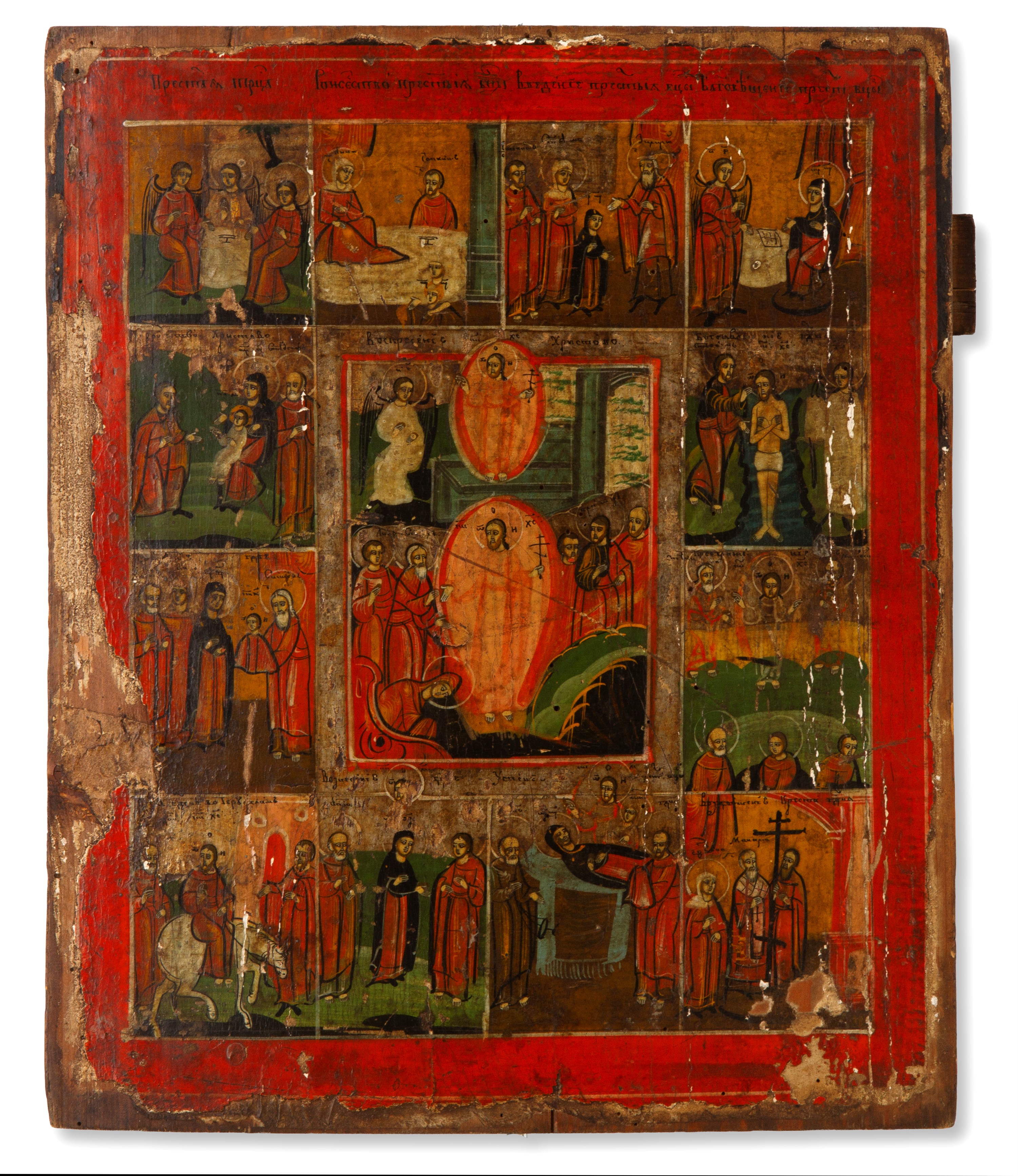
Icon depicting the Cycle of the Twelve Great Feasts (Dodekaorton) with the Descent into Hades (Anastasis) at the Center, the traditional Eastern representation of the Resurrection of Christ.
The composition is organized according to a complex narrative scheme divided into numerous compartments. At the center, the Risen Christ is depicted descending into the realm of the dead to liberate Adam and Eve, shown within a luminous oval mandorla and surrounded by the Patriarchs and the Righteous of the Old Testament, following the traditional Byzantine-Russian iconography of Christ's victory over death.
Surrounding the central scene is the cycle of the principal feasts of the Orthodox liturgical year, each identified by inscriptions in Church Slavonic. Among the recognizable episodes are the Holy Trinity, the Nativity of the Virgin, the Presentation of the Virgin in the Temple, the Annunciation, the Nativity of Christ, the Baptism of Christ, the Entry into Jerusalem, the Ascension, the Dormition of the Virgin, the Exaltation of the Holy Cross, together with other fundamental events in the history of salvation.
The entire composition is framed by a broad red border, while the background alternates ochre, green, and brown tones, reflecting the palette characteristic of Russian icons produced for private devotion. The Church Slavonic inscriptions identify each individual feast and also give the work a didactic and liturgical function.
The iconography of the Dodekaorton represents one of the most comprehensive visual syntheses of Orthodox theology, bringing together in a single image the principal events of the lives of Christ and the Mother of God commemorated throughout the liturgical year. This type of icon became particularly widespread in the workshops of central Russia during the eighteenth and nineteenth centuries, where it was produced for both domestic iconostases and private devotional use.
Based on its stylistic characteristics, compositional layout, Church Slavonic inscriptions, and painting technique, the present icon can be attributed to a Russian workshop dating from the late eighteenth to the first half of the nineteenth century.
The composition is organized according to a complex narrative scheme divided into numerous compartments. At the center, the Risen Christ is depicted descending into the realm of the dead to liberate Adam and Eve, shown within a luminous oval mandorla and surrounded by the Patriarchs and the Righteous of the Old Testament, following the traditional Byzantine-Russian iconography of Christ's victory over death.
Surrounding the central scene is the cycle of the principal feasts of the Orthodox liturgical year, each identified by inscriptions in Church Slavonic. Among the recognizable episodes are the Holy Trinity, the Nativity of the Virgin, the Presentation of the Virgin in the Temple, the Annunciation, the Nativity of Christ, the Baptism of Christ, the Entry into Jerusalem, the Ascension, the Dormition of the Virgin, the Exaltation of the Holy Cross, together with other fundamental events in the history of salvation.
The entire composition is framed by a broad red border, while the background alternates ochre, green, and brown tones, reflecting the palette characteristic of Russian icons produced for private devotion. The Church Slavonic inscriptions identify each individual feast and also give the work a didactic and liturgical function.
The iconography of the Dodekaorton represents one of the most comprehensive visual syntheses of Orthodox theology, bringing together in a single image the principal events of the lives of Christ and the Mother of God commemorated throughout the liturgical year. This type of icon became particularly widespread in the workshops of central Russia during the eighteenth and nineteenth centuries, where it was produced for both domestic iconostases and private devotional use.
Based on its stylistic characteristics, compositional layout, Church Slavonic inscriptions, and painting technique, the present icon can be attributed to a Russian workshop dating from the late eighteenth to the first half of the nineteenth century.
€ 500,00 / 700,00
Estimate
360,00 €
Starting price
€
Your bid
(The reserve price has not been exceeded)
(The reserve price has been exceeded)
Set your maximum bid
Live auction 396
OLD ORTHODOX ICONS FROM 17TH UNTIL 20TH CENTURY. Including a collection of important Traveling Russian Icons
Palazzo Caetani Lovatelli, tue 29 September 2026
SINGLE SESSION 29/09/2026 Hours 15:00
Discover Similar Lots
OLD ORTHODOX ICONS FROM 17TH UNTIL 20TH [..]
Lot 19
Russian icon depicting the Twelve Great Orthodox Feasts
OLD ORTHODOX ICONS FROM 17TH UNTIL 20TH [..]
Lot 5
Russian Icon Depicting the Twelve Great Feasts with the Resurrection of Christ and the Anastasis at [..]
OLD ORTHODOX ICONS FROM 17TH UNTIL 20TH [..]
Lot 278
Travel icon depicting the Paschal Cycle (Anastasis and the Resurrection from the Tomb)
OLD ORTHODOX ICONS FROM 17TH UNTIL 20TH [..]
Lot 14
Russian Icon depicting the Dormition of the Mother of God
OLD ORTHODOX ICONS FROM 17TH UNTIL 20TH [..]
Lot 52
Russian icon depicting the Mother of God “Truly Worthy” with scenes from the lives of Christ and the [..]
OLD ORTHODOX ICONS FROM 17TH UNTIL 20TH [..]
Lot 230
Travel triptych depicting the Mother of Consolation
OLD ORTHODOX ICONS FROM 17TH UNTIL 20TH [..]
Lot 297
Travel triptych depicting the Mother of Consolation
OLD ORTHODOX ICONS FROM 17TH UNTIL 20TH [..]
Lot 6
Russian icon depicting the Ascension of Christ
OLD ORTHODOX ICONS FROM 17TH UNTIL 20TH [..]
Lot 334
Small travel icon depicting the Ascensione
OLD ORTHODOX ICONS FROM 17TH UNTIL 20TH [..]
Lot 264